Tuesday, 13 September 2011

Boundaries

And priorities:
“We’re getting close to a full-blown banking crisis in Europe,”
And:
"September is likely to be a defining month for the euro area’s destiny," wrote Julian Callow, chief European economist at Barclays Capital.

Strategists at JP Morgan, for their part, have pointed to ‘a growing sense that the crisis is reaching a climax’, saying that the ‘endgame on EMU [European Monetary Union] is approaching fast.'
But no fear our MP's are on the case:
Another, or possibly the same, unnamed 'senior Tory' source said (£):
“It has been really difficult to get MPs to focus on the big issues when all they want to know about is whether they’ll still have a seat. Some of the usual rebels could suddenly find themselves in trouble when they are looking to the party for a new seat or a place in the Lords.”
And that's it in a nutshell: no real concern about representation of the people or the disregard of natural geographical County boundaries, just a concern for their own skins.

Summit Wrong

I've had a twitter exchange today with Bruno Waterfield, Daily Telegraph Brussels correspondent, who tweeted that there is to be an EU 'summit' on the 17th and 18th October to deal with the Eurozone crisis. It is actually a European Council meeting - Bruno falls for the classic error of assuming that it is the same as international summits. They aren't (And it's not the first time he's made a similar mistake).

His tweet was as follows:

In response to my tweet pulling him up on the error, he said this:

The journalistic laziness is something to behold, in essence - "we call 'em summits 'cos it's all a bit complicated to call them by their proper name and function".

It is not, of course, bureaucratic jargon to call the European Council by its correct name; there is a fundamental difference between it and a summit - and to make light of it, as Bruno has done, is either to woefully misunderstand the project or set out to deliberately deceive.

A summit in essence is a gathering of sovereign heads of states or governments who have a jolly for a couple of days trying to thrash out a deal over some issue or other. However their first duty and responsibility is doing the best in their own national interests.

Conversely the European Council is different. It is an institution of the EU. Originally founded in 1974, it was formally recognised in the Nice Treaty (Article 4) and became a fully-fledged EU institution under the Lisbon Treaty. It is, therefore, not a summit but an official part of the EU - essentially the cabinet of the EU government. Unlike a summit, as soon as Cameron attends the European Council he no longer is head of the UK's government but becomes merely a 'representative of the UK region'. He has to put, legally, the interests of the Union first even above those of his own country.

This point is illustrated by Article 9 of the Lisbon Treaty (page 18) which formalises the European Council as an official institution and under this article the following paragraph makes the priorities of the members of the Council clear:
1. The Commission shall promote the general interest of the Union and take appropriate initiatives to that end. It shall ensure the application of the Treaties, and of measures adopted by the institutions pursuant to them. It shall oversee the application of Union law under the control of the Court of Justice of the European Union. It shall execute the budget and manage programmes. It shall exercise coordinating, executive and management functions, as laid down in the Treaties. With the exception of the common foreign and security policy, and other cases provided for in the Treaties, it shall ensure the Union's external representation. It shall initiate the Union's annual and multiannual programming with a view to achieving interinstitutional agreements.
In short, the heads of states and governments of EU members, who attend the European Council, cease to represent their own member state interests. They instead become part of a tier of the EU government, thus bound by its laws and obliged to further the aims and objectives of the EU.

Bruno of the Telegraph epitomises all that's wrong with the MSM and gives a wonderful example of the deep reluctance of our '4th estate' of acknowledging the true nature of how this country is now run.

Monday, 12 September 2011

Another Day, Another Euro Crisis

Everywhere you look this morning there's bad economic news, a combination of Vicker's report this morning but more predictably the growing Eurozone problems.

Germany appears to be laying the ground for a Greek default and exit. German finance minister Philipp Rösler said Greek bankruptcy was "no longer a taboo" a view shared by Merkel. Christian Lindner, general secretary of Chancellor Angela Merkel's junior FDP coalition partner, said Greece's departure from the eurozone "could not be ruled out". Views that would have been unthinkable a couple months ago are now being openingly expressed. Germany's patience therefore appears to have run out.

The Greek bailout is also in chaos with the EU refusing further funds unless there's firm action on the deficit, including disturbingly:
Germany’s EU commissioner Günther Oettinger said Europe should send blue helmets to take control of Greek tax collection and liquidate state assets.
The Greek chaos, and the apparent acceptance of German of a Greek default, has wrecked havoc on French Banks who are highly exposed to Greek debt. Shares in the big three - Société Générale, Credit Agricole and BNP Paribas - all suffered double-digit losses. There are also rumours that Moody's is going to downgrade French banks due to their Greek exposure

Italian, French Spanish and German bonds are at all new records while the money is going to safe havens like gold which is at new record high in Euros.

Global stock markets are down. Oh, and the Euro has plummeted.

Surprised?

A little gem from the Iceland and the European Union blog, particularly the last two sentences:
A delegation of MEPs from the European Parliament visited Iceland on September 7-9 meeting with government ministers, leading people from labour unions and employers and from organisations for and against membership of the European Union. After meeting with the MEPs the leader of the Icelandic no movement, Ásmundur Einar Daðason who also is a member of the Icelandic Parliament, wrote on his Facebook page yesterday:

"Just came from a meeting with members of the European Parliament who are staying in the country. They wanted to meet leading people from the no and yes movements. They seemed very surprised at the great opposition to an Icelandic EU membership. This meeting confirmed what many people have argued that the leaders of the government are not giving the correct picture of the situation of this matter in Iceland."
Sounds familiar.

Sunday, 11 September 2011

Euro Crisis Explained Using Lego

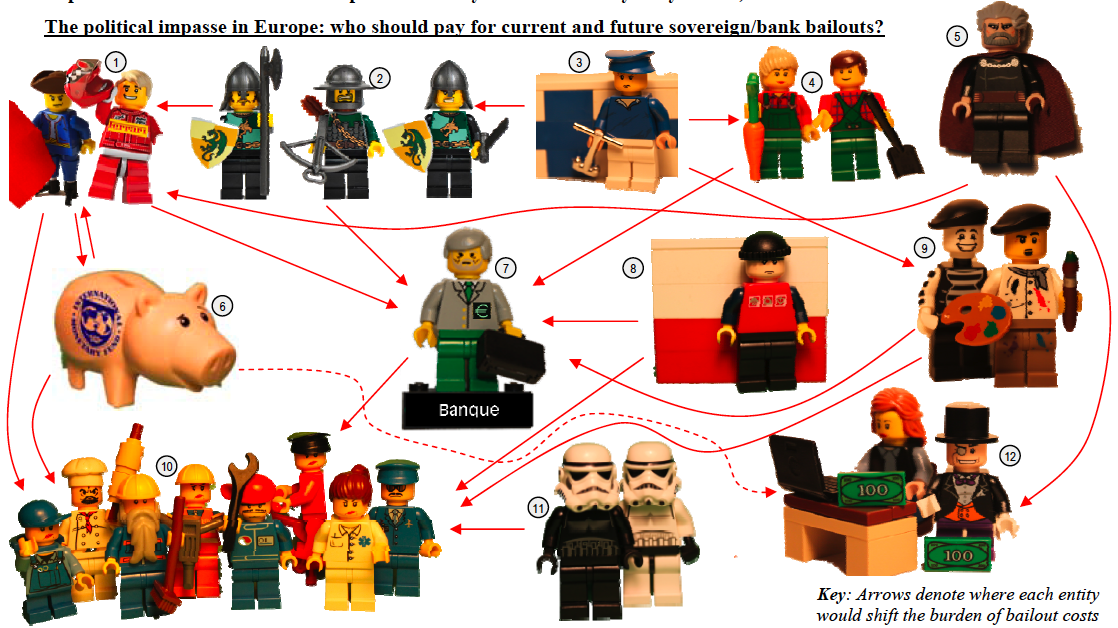
Whilst another tumultuous week awaits the Eurozone, I thought I would pass the time by reproducing this ever so helpful guide on the Euro crisis using Lego (click to enlarge):


  1. The toreador in a floppy hat, and the F1 driver with his helmet, represent Spain, Italy and the rest of the Euro Periphery.

  2. The three men with helmets, shields, and medieval weaponry represent the CDU, CSU and FDP parties in Germany.

  3. The blue-and-white sailor boy is Finland. Obvs.

  4. The woman with an oversized carrot and her friend in overalls with a shovel represent the Social Democrats and Greens.

  5. Wotan represents the Bundesbank.

  6. The piggy bank is the IMF.

  7. The grey-haired Banque chap is the ECB.

  8. The chap in the red bib is Poland.

  9. The artists are France.

  10. The angry chef, the sweeper with a broom, the airline pilot, and the rest of the motley crew at bottom left, represent EU taxpayers in Core countries.

  11. The storm troopers are the EU Commission and Euro Group Finance Ministers, chaired by Jose Manuel Barroso and Jean- Claude Juncker.

  12. The monocled banker and his assistant are EU bondholders and shareholders.
Enjoy.

Saturday, 10 September 2011

Irony And Thick Socialists

The Boiling Frog has returned from UKIP's conference and hopes to do a write up (of sorts) as soon as. In the meantime this has tickled me - apparently socialist idiots Chumbawamba have objected to the use of their most well known song played to introduce Nigel Farage on stage yesterday:
Former singer Alice Nutter, quickly took to the offensive. "If ever there was gross misuse of a band's music this is it," she said...I would like it to go on record that we do not support either Nigel Farrage or Ukip. In fact we would go further and say...his party is mainly made up of bigots and its policies are racist."
Alice Nutter (aptly named) considers me a bigot despite having never met me. Amazing the irony - accusing others of bigotry based on your own prejudices and assumptions. Talking of irony it's worth pointing out that they are also self-confessed anarchists who then want to take legal action:
"It's beyond the pale and if they use it again we will consider legal action."
Anyway as UKIP's usage of the song annoys them so much I'll post it here, as a member of UKIP


Edit: Just spotted that Bloggers4UKIP has made a similar point yesterday.

Thursday, 8 September 2011

Quiet

Apologies, but the simmering saucepan containing the Boiling Frog will be quiet for a couple of days as I attend a jolly in a certain seaside resort.

Back To School For Merkel

Courtesy of the Purple Scorpian I spot this 'breathtakingly stupid' remark from Merkel:
"History has shown that countries with a common currency never wage war against one another, and that is why the euro is far more than just a currency. If the euro fails, Europe fails. It must not fail, and will not fail,"
Purple Scorpion does the business of frisking this here. Merkel's comments can also be dismissed with one simple word: Yugoslavia.

Wednesday, 7 September 2011

No Surprise

As expected the German Constitutional Court has thrown out the challenges to eurozone financial rescue packages, but Merkel's and the Eurozone's problems are far from over.