Showing posts with label UKIP. Show all posts

Friday, 8 January 2016

Farage: I've Made A Terrible Terrible Mistake

Under the scrutiny of the media, and potentially more crucially the harsh spotlight of the internet, Nigel Farage has had to embarrassingly backtrack on his allegations that attempts on his life were made.
The Ukip leader said he should never have spoken out about the wheel falling off his car, after questions were raised about the so-called assassination attempt
Such accusations clearly should never be made without substantial evidence. It appears that Farage has "shot from the hip" as he always has been inclined to do. It's a trait he has played on within the concept of being "honest" in contrast to other politicians. It's a strategy that worked when speaking to the converted and outside mass media scrutiny.

However with a higher profile and the intense spotlight of the forthcoming referendum it's difficult to conclude that his comments could be anything other than damaging for Brexit if he's associated with the leavers.

Farage's comments also leaves UKIP's de facto mouthpiece Breitbart in a difficult position:

 Rightly it criticised the hypocritical media when it comes to mistakes:
If Breitbart London had made a faux pas as large as the Guardian, the Independent, LBC, and the Huffington Post – we’d be laughed out of every shitty, Westminster drinks reception for weeks on end.
But then whoops:
I confess, UKIP leader Nigel Farage told me about this specific concern [assassination] over his car in November of last year. Off the record, not for reporting. “Fine,” I sighed. After the, “Oh my God, are you okay, mate?” obviously.
Farage has now admitted such claims are a "terrible terrible mistake". If true then Raheem Kassam is not the first, nor will be last, to be dropped in it by Farage where loyalty is an unusual concept. I wonder if Breitbart will follow its own advice.

That such a story made the rounds does though neatly illustrate the decline in standards in the UK media. The Mail on Sunday published the claims without critical content; a claim which was reproduced by the mainstream media at the time with no critical analysis. It took the internet to take the claims apart.

Ironically for a man who understood the need to bypass the legacy media when trying to establish UKIP as a credible political party in the late '90s - he used public meetings as a means of negating the hostility of the media - the internet has passed him by.

Of additional concern is news that Farage, having made a "terrible mistake", has now gone public regarding advocating a "public protest" on new alcohol guidelines - this from a man who spends a lot of time in the pub.

This then is all about Farage and not Brexit. It's becoming clear that the sooner he is distanced from the leave movement the better.

Thursday, 7 January 2016

UKIP: The Wheels Come Off?

I didn't particularly want to write another piece about UKIP as this blog prefers to concentrate on campaigning trying to exit from the EU - we have much bigger fish to fry. However following on from our piece regarding the Mail on Sunday headlines, we note an understandable determination of the legacy media this week to probe further Farage's "claims".

The Mirror reports that Farage's car was not part of a widely publicised recall:
A Volvo spokesman later said: "I can confirm that Mr Farage’s car was not part of that recall, so no such work was required."
The Mirror was following up the story and despite clearing Farage of ignoring a possible recall the story as published by the Mail still has significant question marks hanging over it. With this in mind we see that the Times reports (I quote a substantial part of it as it's behind a paywall):
[Farage's] version was challenged by the prosecution service in Dunkirk, which said that a police report said it was an accident and made no mention of sabotage. A spokesman said that prosecutors would have started a criminal investigation if there had been any suspicion of foul play. They did not.

Farage, who was not hurt, said that he chose not to file a lawsuit following the crash. The prosecution service in Boulogne-sur-Mer said: “In France, prosecutors can investigate even without the victim’s agreement.”

The Ukip leader said that the mechanic called to repair the car had told him that the nuts had been unscrewed deliberately.

Philippe Marquis, a garage owner, told Libération that he had said nothing of the sort. He told the newspaper that the nuts were loose but that he believed that this was because of shoddy repair work. He added that he had been unable to communicate with Mr Farage because neither spoke the other’s language: “We only spoke with our hands.”
Farage's account is now being directly contradicted by reports in the Times.

And it's no surprise there is scrutiny. To make an accusation of an assassination attempt is a very serious charge. One that should not be made without substantial evidence. That the French police failed to investigate and Farage never made an official compliant calls into significant doubts over the claim.

However oddities of the story could also be due to the case that UKIP has now split in two, albeit unofficially, so reports of "Farage assassination" may reflect that split and may not be what they seem.

Not that it matters anymore. If we are to win an EU referendum it's going to be the people who matter, not the internal politics of a party supposedly dedicated to EU exit.

We have more pressing issues to deal with...

Hattip for image scribblingsfromseaham


Sunday, 3 January 2016

UKIP: May Contain Loose Nuts.

The forthcoming referendum, which is very likely to be held in late 2017, will have to be a vote by the people against the establishment if we are to leave. That the media attempt to couch a referendum within the context of party politics misses the point entirely; politicians will have the same vote as the rest of us in a poll that is not about electing a political party.

It's for this reason this blog has largely ignored UKIP since May 2015; if the leavers are to win the referendum then party political baggage has to be left at the door regardless of the party allegiances.

However Farage has made it clear that he wishes to take a prominent role in the referendum so his UKIP party protestations are going to have an effect on the outcome. This is especially so when the BBC will undoubtedly use him for interviews, thus adopting the same tactic as it did in the 1975 referendum when only clearly diversive leavers were interviewed, such as Tony Benn and Enoch Powell. This tactic allows the BBC to claim they've upheld impartiality while discreetly undermining the anti-EU position.

So it becomes essential that the leave movement doesn't come across as diversive or lay itself open as an object of ridicule. Thus it is with some depression that we see this morning that Farage claims that he was subjected to an assassination attempt:
Nigel Farage fears he has been the victim of an assassination attempt after his car was sabotaged, causing a terrifying motorway crash.

The Ukip leader careered off a French road after a wheel on his Volvo came loose while he was driving from Brussels back to his home in Kent.

When the police arrived at the scene, they told him that the nuts on all of the wheels had been deliberately unscrewed...
The story was the prominent story on the Daily Mail website first thing this morning, but it gives an indication how little they take the claims seriously that the story dropped much further down the website by mid-morning.

The story also appears to have been given little credence by other media outlets as well - the BBC news has led with flooding stories throughout its television output. It would be tempting to regard this as anti-UKIP bias but a party leader of the country's "fourth party" facing a genuine assassination attempt would have led the media agenda. But it has not.

More likely the story hasn't been taken seriously because Farage's claims have a number of significant questions hanging over it. Why, for example, has Farage:
  • ...decided to take no further action, despite "the mechanics were absolutely certain of [foul play]". This after Farage has received "death threats"
  •  ...only published the story now, not at the time in October 2015?
That Farage believes loose wheel nuts is an assassination attempt is revealing regarding his priorities and overlooks other possible causes. Loose wheel nuts on a car would tend to lead to a "knocking" noise before it becomes a danger, so there would be significant vibrations which would become more acute and apparent under braking. A visit to a local garage would be normal under these circumstances surely? For reassurance if nothing else.

There are a number of reasons wheel nuts could potentially fail. For example a car can go in for a service and the wheel nuts haven't been tightened properly - garages can be hit and miss in quality of customer service. Even among professionals at the pinnacle of elite sport can prove that they can cock up when it comes to loose wheel nuts.

Another explanation perhaps unlikely, though not impossible, is the potential that persons were attempting to steal the alloy wheels early on but were disturbed during the process leaving the wheel nuts loose.

However more interesting is to note that in 2010 Volvo issued a recall regarding wheel nuts which applied to Farage's Volvo V70 (click to enlarge):
"It has been identified that the standard wheel securing bolts may not have undergone the correct hardening process. This will result in corrosion, a noise and/or vibration. If this condition is not rectified, there is a possibility that the wheel may become loose and detach".
It's interesting that Farage's claim has emerged on the first Sunday of new year - a day of the week traditionally associated with political stories - rather than October last year when it apparently happened. Cynically the timing might not be unexpected, particularly with a party which is clearly fundamentally split and an attempt to shore up his position by trying to define the new year narrative.

Further questions emerge that if Farage has had indeed death threats in the past, as he claims, then why was he driving himself?

Facing death threats mean surely hiring a chauffeur would be a logical option. Not only does it provide a witness but hiring a chauffeur has other benefits. It allows politicians to work during long road trips, it absolves politicians of responsibility during an accident especially if it's politically sensitive and anti-terrorist driver training is virtually compulsory for chauffeurs to top political and business figures in Europe. Surely a priority if facing death threats.

Predictably, in light of Farage's comments, UKIP supporters are making hay on social media with claims reinforcing an invidious belief that the EU is "evil" trying to kill eurosceptics rather than dealing with the issue that the UK's membership is entirely voluntary by Parliament. Our problem lies at home.

Even on a very basic level the EU won't try to kill Farage for the same reason the IRA didn't try to kill Ian Paisley. The IRA were canny enough to appreciate that Paisley was the ultimate recruitment sergeant for their movement. The same applies to Farage.

Thus comments in today's article have simply left the leave campaign open to ridicule, inevitably picked up by social media as mere hyperbole. But Farage's hyperbole is nothing new as we saw with his comments on immigration regarding M4 traffic.

It's clear we either support Farage or we support Brexit - the two are mutually exclusive.

Friday, 11 September 2015

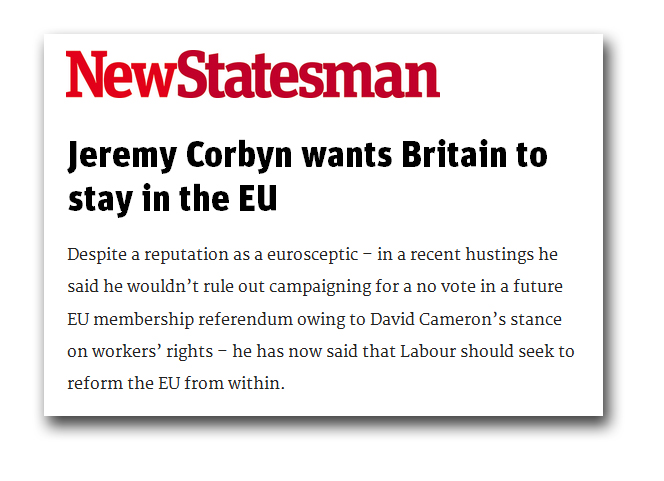
EU Referendum: Corbyn's Not Our Friend

It's depressingly familiar that the British media and Westminster cannot debate the EU without communicating it through the prism of a domestic London bubble.

A clear example was neatly illustrated recently by European Commission President Juncker's State of the Union speech earlier this week, a speech which was reduced down to reporting it as an announcement on migrants. The term State of the Union, if it was used at all, was done so in UK media with inverted commas. That the real point of the speech was to fire the starting gun for a new EU treaty which has been signalled well in advance was largely overlooked.

Westminster media though has more 'pressing concerns', mainly that of the ongoing contest over the summer within Labour of candidates jostling for leadership of the party. All indications suggest that it will be Jeremy Corbyn who wins, against his Parliamentary party's wishes and indeed, by his admission, his own.

Within such tittle tattle, we see the question being asked of Corbyn, with an impending EU referendum, how he voted in the EEC referendum in 1975:
The man expected to win control of Britain's opposition Labour Party said on Thursday that he voted 'No' to Britain's membership of the forerunner to the European Union in a 1975 referendum.
And with that admission he's being seen as a eurosceptic. Yet by his own recent interviews that's not what he is at all (my emphasis):
Labour should set out its own clear position to influence negotiations, working with our European allies to set out a reform agenda to benefit ordinary Europeans across the continent. We cannot be content with the state of the EU as it stands. But that does not mean walking away, but staying to fight together for a better Europe.”
Veterans of trying to remove ourselves from a uniquely supranational organisation will not be fooled by Corbyn's comments; they are straight out of the Tory handbook on how to use "reform" as a means to remain in the EU. Cameron would be proud.

Whereas Margaret Thatcher campaigned and voted yes in 1975 and then changed her mind, albeit too late, Corbyn has changed his mind for opposite intentions.

Thus it's worth noting Corbyn has based his vote on being an anti-establishment candidate, but in reality part of the establishment he will become. His supporters will be let down as were Lib Dem ones were in 2010. Probably with no surprise we suspect he will support Associate Membership, or the renamed equivalent, but complain the Tories haven't done enough about reform  - about insignificant detail.

With this in mind it's disappointing then to see Farage endorsing Corbyn:
Ukip leader Nigel Farage has backed Jeremy Corbyn to be the next leader of the Labour party.
An interesting comment from 1975, in the first Parliamentary debate after the referendum, Harold Wilson (Labour leader) noted this:
"Never out on principle; never in on principle [regarding EEC membership]. It depends on the terms and whether it is best for Britain. The country has now decided that it is best for Britain, the Commonwealth, Europe and the wider world."
An illustration on how the establishment never does anything on principle, including Corbyn. We, as a people, have to force them to listen to us.

Monday, 18 May 2015

EU Referendum: 51%

The cruel clarity of boolean outcomes inherent in referendums means that we need 51% of the vote to win the EU one in 2017. If we don't, we lose. It's as simple as that.

There are 45 million people who are eligible to vote although, 7.5 million of them fail to register by the general election of 2015. We may see a higher figure eligibility figure should there, like Scotland, be a last minute rush to register.

Most of all we have to consider turnout. This is hard to predict. In the 1975 referendum the turnout was 64.5%, the AV referendum was a very low 42.2%. Generally, turnouts for referendums have not been promising. Indeed of all of the twelve referendums which have been held in the UK only two have breached 64% in terms of turnout; Northern Ireland Good Friday Agreement referendum, 1998 at 81.1% and the Scottish referendum even higher at 84.59%.

Assuming therefore, for the sake of argument, a turnout of between 65-70%, this would leaves us with between 29.3 million and 31.5 million potential voters. To achieve the magic 51% we would need to convince around 16 million voters.

Dr Eric Edmond highlights the difficulty of the task in front of us:
To win the in/out Cameron referendum requres [sic]a 51% vote in favour of leaving the EU. Last year in Scotland the SNP under Alex Salmond backed by Nicola Sturgeon and a superb organisation could only get 45% and we all saw how Nicola trounced Cam, Mil and Cleggy in the General Election debate.It shows the  enormity of the task we face to get a leave the EU vote. LibLabCon are not scared of the referndum [sic] vote. As things stand they would win it 2 to 1.

On 7th May UKIP won 12.6% of the national vote. To win the referendum they will have to quadruple that vote. That siimply [sic] cannot be done on UKIP votes. You need to attract millions of voters who voted LibLabCon.

On  7th May. UKIP got 3.8 million votes. LabCon got 20.6 million, the SNP and LibDems who are EU fanatics together got 3.8 million. So the Out campaign has to pick up roughly 10.5 million votes from LabCon to secure an out vote. That's a big ask.and with Farage anywhere near the campaign its impossible.
Eric Edmond, makes a crucial point. In any "out" campaign we need votes from those who have voted for anyone other than UKIP. And therein lies the danger when conducting a campaign which does not have a broad focus. Using the referendum to highlight issues of climate change, NHS, electoral reform, and immigration risks alienating the very voters across the political spectrum we need on board.

As Complete Bastard observers, language like "quislings, traitors and fifth columnists" with sometimes an ill-disguised anti Muslim feeling (who vote too) coupled with language on HIV infected foreigners will mean we comprehensively lose.

Ultimately the referendum will not be decided on the likes of myself who will vote 'out' regardless, nor on the likes of Nick Clegg who will vote 'in' but on the soft middle - the "could-be-persuaded-either-way". And it's here where we must make our case.

Saturday, 9 May 2015

EU Referendum: A UKIP Free Zone

It's does seem rather incredulous that as the starting gun has been fired on an EU referendum, UKIP - supposedly an anti-EU party - vacates the debate completely. Their website's "very latest" reduces mention of the impending referendum down to a footnote without being a main piece, Farage its leader decides to take four months off on vacation, setting up the party for civil war in the form of a leadership challenge. And with no exit plan, the party now seems more interested in electoral reform than actually taking any interest in trying to win a referendum.

With this in mind, this blog will now become largely a UKIP free zone. Regarding exit from the EU they have become an irrelevance. Ancient history. Instead, for the rest of us, we have a "out" campaign to organise - to do the job that UKIP was set up to do.

Instead we will now concentrate on issues that will be relevant to the forthcoming referendum campaign. And to relect the slight change in emphasis, this blog has undergone somewhat of a makeover. One major change is that I've embedded Disqus for comments. However by doing so it has removed from public view all previous comments. We will try to upload them to Disqus in due course.

There will be further changes to come and any observations, suggestions or criticisms of the new look are most welcome.

More importantly though we now have a referendum to try to win.

Thursday, 7 May 2015

Polling Day: Spoiling The Ballot Paper

We arrive at polling day after what has to be one of the most lacklustre and uneventful election campaigns in recent memory despite that the result is too close to call. Here we agree with Scribblings From Seaham that it has "felt to be an interminable farce of a general election".

With a deep reluctance to deal with issues which matter to voters, a lack of policies of any substance and a largely staged television campaign with a reliance on pointless stupid gimmicks is it any wonder that 1 in 4 voters have yet to make up their minds by polling day.

I'm one of those 1 in 4 and when I began to write this blog piece on why, I realised I was repeating many of the points I had made 5 months ago. Here I wrote:
Voting for the Tories - a party that has consistently betrayed its country, its members and its voters - is somewhat nauseating and is something I've never done before. This blog has never really forgiven the Tories for Maastricht and particularly the membership of the ERM. To vote for them would take a Herculean effort and the intake of industrial quantities of intoxicating substances.
And
Then there's UKIP. Yet it has been increasingly this blog's view that under its current leadership UKIP is detrimental to Eurosceptic cause - a party which has also performed copious u-turns within a very short space of time on the whim of its leader.
More damaging is UKIP remains largely a single issue party but instead of being anti-EU it is now anti-immigrant and is being described as such. By reducing EU membership solely down to an aggressive stance on immigration, toxifies the debate, limits itself to dismissing an exit strategy which could actually win us a referendum and leaves itself very exposed to being outflanked by Cameron on Article 48.  
Perhaps if I lived in a marginal Tory seat then I would have to grit my teeth and vote Tory for the first time to ensure a referendum. But I don't. I live in a seat where Tory PPC/MP "Lazy Vaizey" has his votes weighed not counted. How I vote won't make any difference to the outcome, a situation common among many voters.

With UKIP, despite that my local candidate is very good, I cannot endorse a party which is helping us to lose the eurosceptic argument with YouGov now reporting a 12-point lead for the "inners", up two points since April.

So unable to vote for any of the options available it's for the first time in a General Election that I have spoiled my ballot paper (see above) and I'm not the only one.

I simply can't wait for the whole charade to be out of the way to see if the Tories will win an overall majority. If so we get an EU referendum and then the real work starts.

Tuesday, 31 March 2015

UKIP: Thanks For Nothing

We've noted before on this blog UKIP's increasingly toxic tendency to blame "everything on immigrants". Previously it was Farage's assertion that he was held up on the M4 motorway due to the fact that "open door immigration has meant that the M4 is not as navigable as it used to be'".

That he was traveling by car early evening on a Friday around a notorious bottleneck on the M4 wasn't taken into consideration. Thus "bloody immigrants" was dog whistle politics writ large.

With this in mind it therefore comes as no surprise to see that Farage believes that immigrants are to blame for children not playing in the streets:
Britons are so ill at ease with levels of immigration in their towns that their children do not play football with their neighbours in the streets, Nigel Farage has said.
The UK Independence Party leader said people in eastern England felt a “deep level of discomfort” about the millions of immigrants who have settled in the UK in the past decade.
He said: “I want to live in a community where our kids play football in the streets of an evening and live in a society that is at ease with itself.
And I sense over the last decade or more we are not at ease"
It's not unfair in our view to believe that Nick Griffin would have been proud of these sentiments. That children may not, or cannot, play in the streets is often down to a myriad of factors, not least its illegal, it's unsafe and that many roads simply have too many cars - ironically Farage's children couldn't play outside his own house, in the street, for this reason alone.

In trying to remove ourselves from the EU however Farage's language is toxic. With what began as a eurosceptic party, has been hijacked by a man who has turned it into a self-promotional vehicle and is prepared as a consequence to condemn the eurosceptic movement in terms which hinder significantly the argument of getting out. So much so that we are set to lose before we even start.

With such language and thus with effectively a self-imposed glass ceiling on support, no wonder the media have begun to catch up with bloggers by noticing belatedly that UKIP's trend is on a downward trajectory.

With so-called 'UKIP strategy' we get a measure of the man when we see this:
“If we went to every town up eastern England and spoke to people about how they felt, their town, their city had changed in the last 15 years, there is a deep level of discomfort, because if you have immigration at these sorts of levels integration doesn’t happen.” 
Note the words "eastern England". It's an odd statement to make for a leader of a party named the United Kingdom Independence Party. What about Scotland, Northern Ireland and Wales where immigration is not necessarily such a vote winner - immigration has an uneven effect across the country.

But within "eastern England" is the constituency of Thanet South; where Farage is standing to be elected as an MP. It's also next door to where UKIP held its Spring Conference in Margate which had no mobile signal nor internet access.

A professional party with workable facilities at its conference less important than Farage's own campaign it seems. So no policies, no strategy, no exit plan just dog-whistle soundbites to get Farage elected.

Perhaps in this sense it will work and this will please the cult, but in getting us out of the EU no chance.

What a waste of 20 odd years...

Wednesday, 25 March 2015

Why A 2015 EU Referendum Cannot Happen (Update).


Following on from our previous post regarding the impossibility of a 2015 referendum, we contacted the Electoral Commission to try to clarify a number of further potential technical issues.

While, like most quangos, the Electoral Commission displayed a deep reluctance to commit themselves to answering certain questions posed, their first response confirmed our initial points that, contrary to Farage's assertion, a referendum cannot happen in a few weeks (quoted from the Electoral Commission's email):
Currently, we cannot say how the designation process will work at any future referendum until Parliament passes the legislation setting out the rules for that referendum. 

Our role is to regulate the referendum and designate campaigners under the rules for each referendum. The rules that applied at previous referendums required the Commission to designate campaigners that sufficiently represented those campaigning for the outcome they support, or, if more than one, represented those campaigning to the greatest extent.
This reiterates precisely our point that it means campaigning groups can't begin to officially campaign until they submit bids for the official "in" and "out" campaign and have been approved. With Scotland a campaign period of 16 weeks was the recommendation.

However the approval process is likely to take six months as also recommended by the Electoral Commission. This six month process cannot happen until after the referendum bill becomes law which in itself at best will take months.

Thus with the Electoral Commission's recommendations which considered the experience with Scotland (for recommendations, read demands) it becomes clear that a 2015 referendum is simply out of the question.

Friday, 20 March 2015

Why A 2015 EU Referendum Cannot Happen.

As noted in the Independent last Sunday, Nigel Farage has indicated that he will support a minority Conservative Government if Prime Minster David Cameron promises a referendum in 2015:
"The terms of my deal with the Tories would be very precise and simple. I want a full and fair referendum to be held in 2015 to allow Britons to vote on being in or out of the European Union. There would be no wiggle room for 'renegotiation' somewhere down the line'.

"The EU is facing an existential crisis and, given that it only takes a few weeks to launch and organise a referendum, it should be held in 2015.”
Although we would largely agree with the sentiments of a "full and fair" referendum, we would take issue with the "very precise and simple" demand that a referendum should be held in 2015 and "given that it only takes a few weeks to launch." For the very precise and simple reason that it can't be done. Farage is offering impossible terms on the practicality of timescale.

To support Farage's demands comparisons are sometimes made with the 1975 referendum where it is claimed that it is possible to have a referendum in a few weeks, the timeline often quoted is as follows:
December 1974: Harold Wilson requests renegotiation of EEC membership terms.

European Council agreed to new terms for UK in Dublin by 11 March 1975 and renegotiation largely ended.

26 February 1975: White Paper announcing referendum to be held after result of renegotiation was known

26 March 1975: Referendum Bill published.

31 March 1975: White Paper setting out the results of the renegotiation of the UK membership of the EC.

9 April 1975: after a three-day debate on the Government’s recommendation to continue Britain’s EC membership, the Commons voted 396 to 170 to continue in Common Market on the new terms. At the same time Government drafts Referendum Bill, to be moved in case of a successful renegotiation.

On 22 April 1975 the House of Lords approved continued membership by 261 votes to 20.

Post-legislative referendum held 5 June 1975. Referendum not directly related to White Paper on renegotiation, but preamble referred to renegotiation. Question much broader: “Do you think the UK should stay in the European Community (Common Market)?” The result was 67 per cent in favour on a 65 per cent turnout.
As we can see in 1975 the passage through Parliament to holding a referendum took circa 10 weeks (26 March - 5 June) from publishing the Bill to holding the Referendum. The 1975 Referendum book though notes (p.66):
"But the real reason for the unexpectedly easy passage of the Bill was political: pro-Marketeers were in an overwhelming majority in the House of Commons and they had belatedly realised that the referendum would go their way."
Even with an easy passage it still took two and half months to have a referendum. The election in 2015 is in May, then there's a summer recess so we can expect it to take longer. Especially when we consider that due to the complexity of an EU that has significantly evolved in over 40 years of UK membership and the less certainty of a referendum result, that its passage through Parliament will be more turbulent and difficult.
 
We have noted before regarding trying to win a referendum, 1975 is not 2015. The country has moved on in forty years. Procedures are now different, for example in 1975 the campaign started in January 1975 long before the Referendum Bill had been passed - with self-appointed "umbrella" groups.

However unlike 1975 referendums are now the responsibility of the Electoral Commission, which was established under Political Parties, Elections and Referendums Act 2000. Thus on that alone the timescale in comparison to 1975 has changed.

With the establishment of the Electoral Commission it means that campaigning groups can't begin to officially campaign until they submit bids for the official "in" and "out" campaign and have been approved. This process cannot happen until after the referendum bill becomes law.

There has to be a reasonable period to allow the Electoral Commission to invite submissions and make the designation, and then the lead organisations must be given time to organise themselves.

As we can see from the Electoral Commission December 2014 report on the Scottish Independence Referendum held on 18 September 2014, it recommends (my emphasis):
... that in planning for any future referendums, not only in Scotland but also those held across or in other parts of the UK, governments should aim to ensure that legislation (including any secondary legislation) is clear at least six months before it is required to be implemented or complied with by campaigners, the Chief Counting Officer, Counting Officers or Electoral Registration Officers.
Thus "a reasonable period" according the Electoral Commission amounts to six months, as it argues to allow for (again my emphasis):
The benefit of this additional time was passed on to campaigners, EROs and COs in preparing for their respective roles at the referendum:
Campaigners were able to engage constructively with the legislative process and had time to develop an understanding of the relevant guidance and rules, before they came into force. EROs and COs benefitted from sufficient time to put robust plans in place for the delivery of their responsibilities under the legislation, from targeted public awareness activity to the booking of polling places and the training of staff.
In addition the Electoral Commission also recommends (again my emphasis):
2.39 Following the 2011 referendum on additional powers for the National Assembly for Wales and the Parliamentary Voting System for the House of Commons, we recommended that for future referendums the detailed rules should be clear at least 28 weeks in advance of polling day, based on a statutory regulated referendum campaign period of 16 weeks.
Although the Electoral Commission cannot demand, where it recommends will be taken into account should there be a challenge to the Bill and it goes to a Judicial Review as undoubtedly it would should there be any form of corner cutting or fast-tracking.

Yet even with a relatively smooth process by the Electoral Commission's recommendations there would be a ten month delay between an Act of Parliament and a vote: that obviously takes us well into 2016.

In addition Farage thinks he can determine the referendum question:
 "Do you wish to be a free, independent sovereign democracy?"
Despite the fact that the Electoral Commission has already put forward its proposals for the referendum question - its full report is here, Farage's suggestion wouldn't even pass the unambiguity test let alone the neutral one.

At this point I don't know what to conclude. Either Farage is very poorly briefed which is a reflection on a lack of a decent research department despite having (now) 22 very well paid MEPs or he knows this and is deliberately demanding conditions that Cameron (or indeed anyone else) cannot possibly meet.

The latter of course allows UKIP to put forward the criticism that Cameron cannot be trusted which conveniently helps prop up Farage's position. If one is to be cynical there's nothing better than having a perpetual enemy to oppose to justify your own existence, especially in the absence of any party polices.

Either way the eurosceptic movement is being very poorly served by UKIP.

Saturday, 14 March 2015

Shameless And Cynical?

The fine line between which areas are appropriate or not with which to criticise a politician is sometimes difficult to ascertain. For example are the family members of politicians off limits to criticism? It could be considered that politician family's privacy should largely be respected. Michael Portillo put this point rather forcefully earlier this week to Daily Mail columnist Sarah Vine over her vindictive criticism of Ed "two kitchens" Miliband.

But in contrast what happens when said "happy family" is used as electioneering material such as by Cecil Parkinson and Chris Huhne only then for us to later find out what a sham it all was? Does criticism then become justified?

Very obviously the bereavements suffered by both Gordon Brown and David Cameron over the loss of a child should be completely off limits. Yet while both men would understandably at times wish to be open about such a loss, there is always the difficulty of determining if such openness is being done for political reasons.

And this brings me onto Farage. I always remember that leading up to the 2010 election, Farage gave an interview to Camilla Long of the Sunday Times. What stuck in my mind was not that clearly the article in question had an agenda to undermine Farage but that it did so by openingly mocking the fact that he reportedly had testicular cancer in his youth.

In terms of the depths that the media can sometimes plummet to we can compare this to the media treatment of the great Victorian statesman, Gladstone. He was at times vitriolically disliked - Queen Victoria famously commented that "[Gladstone] speaks to me as if I were a public meeting". Yet despite the remorseless abuse from such satirical publications as Punch rarely, if ever, was Gladstone's disability mocked - that he lost fingers on one hand due to a shooting accident.

Interestingly where Farage is concerned we move on five years from 2010, where we see today in the Telegraph it has extracts from Farage's new book, where very 'candidly' he talks about his health:
Mr Farage, now 50, says the plane crash, combined with the effects of another car accident in his twenties, “has left me with a body 20 years older”.
It's worth noting that the car accident in question was the consequence of being too drunk and walking out in front of a moving vehicle. However:
The National Health Service “almost killed me”, Nigel Farage says today as he reveals that his body is now so frail that he could be registered disabled.
It is indeed curious that while UKIP still haven't publicly put forward any coherent polices in the lead up to a general election, despite a promise to have a manifesto published by their Spring Conference in Margate, Farage has managed to have another 'leader's book' published - essentially an updated version of 'Fighting Bull'. Maybe it's a coincidence but it conveniently ensures that the spotlight is largely on him running up to an election.

So we have to consider that with 'timing' being everything in politics whether the release of his new book, titled 'Purple Revolution' is candid or simply just shameless and cynical. A line seems to have been crossed over whether Farage and his health difficulties are now being exploited as an attempt at electoral gain. The title alone suggests an attempt to own the rise of UKIP and the eurosceptic movement.

It's also interesting that Farage has agreed to have the book be serialised for money in the Telegraph - a paper which is usually hostile to UKIP and nominally a Conservative supporting paper.

With this in mind it is indeed interesting that Farage has a great to say about his poor health, including revealing that his body is now so frail that he could be registered disabled. This rather contradicts his message at UKIP's Spring Conference at Margate recently:
There has been a lot of speculation about where have I been, why have not been on the television all the time. This has been led to my opponents to spread some speculation about my health that I am seriously ill and that is why I have not been seen.

I hate to disappoint my opponents but can I make it clear that rumours of my demise have been greatly exaggerated.” 
So not only is the timing curious but someone it appears is making things up as he goes along. Farage then continues:
An MRI scan followed at the private London Bridge Hospital, and I was referred to Mr Bhupal Chitnavis, a top-dollar consultant neurosurgeon. He said he was shocked by the damage to my neck and that, if I wanted, he would sign me off as being partially disabled for the rest of my life. I certainly did not want one of those blue badges — it would be conceding defeat — but it was a shocking moment.
Now there's no doubt Farage suffered injuries as a result of the plane crash:
Where the issue lies is his casual link deployed between being a Blue Badge holder and being registered partially or fully disabled.

Leaving aside the sentiment that apparently being a blue badge holder means conceding defeat - no doubt that 2.58 million blue badge holders would contest otherwise and would probably take offense at the term "those blue badges", being registered disabled is different and is a misleading term.

Under the Equality Act it has such a varied broad definition, that it could apply to anything, including those perceived to be disabled and those associated with a disabled person (e.g. a parent or partner). The principle of the Equality Act is that discrimination on grounds of disability happens in all sorts of ways to all sorts of people.

The real test in our view of being genuinely disabled is whether you qualify for a Blue Badge and or DLA/PIP benefits. Here the criteria is far more strict; as an example if you have a permanent or substantial disability which means you can’t walk or find walking very difficult you are still required to take further assessments before a blue badge is issued.

As is obvious by the above photograph with Farage walking away from a plane crash and his current twitter status - "back on the campaign trail" - he would have absolutely no chance of being eligible for a blue badge.

We only conclude then that what we have is a rather shameless and cynical appeal for the sympathy vote.

Friday, 20 February 2015

The Decline Of The Westminster System: The Fusion Of Powers

 
As we edge closer to the general election in May, it is rather inevitable that the polling would show a trend in decline regarding UKIP's support, which has been consistently argued by EUReferendum:
Talk of a major Ukip "revolution" at the general election looks to have been seriously overblown, says Politics.co.uk, a view based on new constituency polling released by Lord Ashcroft.

The data show that Ukip is not on course to win any of its key target seats currently held by the Conservatives. Most worrying for the party, we are told, in the poll of Boston and Skegness - where Ukip won its largest majority in last year's council elections – it has been pushed back into second place.
There are a myriad of reasons for a decline in UKIP's poll rating. As has been well documented here and elsewhere, such as Complete Bastard, is that UKIP's problems have in the main been self inflicted. There is a fundamental lack of coherence, a geographical divide in message - depending on Labour areas or Tory ones, no fully worked out policies, and u-turns in under 24 hours at the whim of the party's leader.

So-called policies which do manage to remain intact, on its website, are almost identical to the ones contained within the 2010 manifesto which Farage infamously dismissed as drivel.

Thus, with the decline in UKIP support, we can note with wry amusement that UKIP will be having their Spring Conference in Margate - where apparently we will see the launch of UKIP's manifesto. For those who may have not visited Margate recently, it would be described by estate agents euphemistically as 'tired'. Many of its attractions, like the Winter Gardens, are in need of urgent repair.

However we also consider that the UKIP has an inherent problem, which is not entirely its fault, and that is the failings of the "Westminster System" and First Past The Post. 'Winning' the Euro elections is one thing, but with the business end of a Parliament coming to its end, and a looming election, the electorate have real choices to make. Ultimately they have to make a decision on who they would like as Prime Minister. UKIP is going to face a squeeze in an electoral process that is a Presidential System by proxy.

As Tory Michael Heseltine noted on BBC's Question Time last night (04:30 mins in):
"There's only one choice Cameron and Tories and economic recovery or Miliband and Balls the people who caused the economic problems in the first place."
The Westminster System is no longer about electing MPs but electing Prime Ministers by proxy. Further confirmation comes with the forthcoming leaders' debates which we have criticised here.

Interestingly we can also look back to the 19th Century to make our case with Chartism. Chartism: A New History by Malcolm Chase is a fascinating account of a British mass movement for democratic rights in the 19th Century.

Chartism was one of the very rare moments in British history where it is legitimate to speculate how close the country came to revolution. And what is interesting is Chase's attention to detail which allows the story to come alive for those in the 21st Century. One intriguing passage was this regarding the presentation of the first petition:
The Petition was finally presented to the House of Commons on Friday 14 June 1839. Few Chartists had expected it to make a difference to parliamentary attitudes and in this respect 14 June did not disappoint. No indication was given whether MPs would formally debate it, and when Attwood and Fielden...rolled the giant [petition] into the Commons chamber it was greeted with laughter.
And Chase then describes the attempts to present the massive second petition in 1842:
[It was arranged] to bring 'the Chartist leviathan petition' direct to the Commons chamber while it was in session. But...Parliament's officials had realised the physical problem this posed. The Petition became jammed tight in the Members' Entrance. Attempts were made to dismantle...part of the door frame; but eventually the Petition had to be disassembled and taken into pieces into the Commons. Heaped up on the floor of the chamber, it dwarfed the clerks' table on which, technically, it was supposed to be placed.
One senses here the familiar futility of lobbying a system that would not listen. But those with a keen eye will notice that the Chartists' leviathan petitions, in 1839 and 1842, were delivered to Parliament. Not to Government, not to Number 10, but to Parliament - to representatives.

In stark contrast we now see petitions presented to the Prime Minister (government), and with the rise of e-petitions such process is now made official:
Alone this little detail illustrates that the people now, perhaps unconsciously, have appreciated how the power has been consolidated and fused between the government and Parliament. Bypass the monkeys - the middle men - and go straight for the organ grinder. And it's with great irony, that Chartists tried to petition representatives when they had no vote and now in the age of universal suffrage we no longer bother.

Thus if we want an effective 'people's army' and a 'revolution' we need to fundamentally change our failed parliamentary system. Demand #3 of the Harrogate Agenda is as good as place to start as any:
3. Separation of powers:
The executive shall be separated from the legislature. To that effect, prime ministers shall be elected by popular vote; they shall appoint their own ministers, with the approval of parliament, to assist in the exercise of such powers as may be granted to them by the sovereign people of England, Wales, Scotland and Northern Ireland; no prime ministers or their ministers shall be members of parliament or any legislative assembly;

Tuesday, 3 February 2015

Parish Notice

I had intended to have part 2 up of the EU and Telecoms piece up this evening (Tuesday), however time is short this week and I would like to do the so far unfinished piece justice rather than rush it, not least because I have recently come across documentation that shows Norway has more say within its EEA agreement then the UK does over telecommunications; notably its Electronic Communications Act and also its Personal Data Act.

What becomes very obvious when researching the impact of the copious regulations on our country is the ridiculous myriad of EU and international competences which have seemingly no end and it can become quickly rather bewildering trying to follow and make sense of it all. But make sense of it and try to win a referendum we must.

We also note that the more we investigate Norway's EEA arrangements, the more it becomes apparent that not only does it have a much better deal than us within the Single Market (albeit not perfect) but it exposes further the deception or even ignorance of our own politicians regarding this issue.

And with that in mind, and this maybe harsh, I do rather resent that it's taking a small number of bloggers who are attempting to address these issues...unpaid...in their own time, in preparation for a possible referendum than a party which has significant funding via its now 23 MEPs yet literally pisses it up against the wall. This is all we get for our money.

We can win a referendum - we have many advantages over 1975 but we're in danger of needlessly repeating many of the mistakes.

But that said, time is currently short because Mrs TBF and I will be in London for the next few days celebrating our 10th wedding anniversary. In a few days we will return to normal service on this blog.

Saturday, 24 January 2015

1 Down, 23 To Go


For all the celebrations last May from UKIP at 'winning' the European elections (on a very low turnout), and achieving an unprecedented 24 MEPs, those who had seen it all before were instead mentally marking up the odds of how many UKIP MEPs would be left by 2019.

Anticipation and history suggested strongly that the tally won't be good. UKIP's track record of keeping and maintaining MEPs is remarkably poor. To lose one or two maybe careless but to lose over half during the last Parliamentary session suggests a far more serious problem within the party.

And it's in this context we note that the Telegraph reports that UKIP MEP Bashir has defected to the Conservative Party:
One of the UK Independence Party’s most senior politicians has defected to the Conservatives in a major blow to Nigel Farage’s general election campaign.

Amjad Bashir, a Ukip MEP and the party’s leading Asian figure, told The Telegraph that Ukip had become a “party of ruthless self-interest” that was incapable of delivering a referendum on membership of the European Union. 
Interestingly the Mail also reports the defection with a different headline emphasising perhaps there was a different motive:

A senior Ukip MEP has defected to the Conservative Party as it emerged that he was suspended pending investigations into 'extremely serious financial and employment questions', the party said.
With two contrasting accounts for the defection it's naturally difficult to say for certain which report would be the most accurate. However given that the Mail's 'breaking news' piece had a link to the Telegraph website (which it very rarely does and is now removed) would indicate that Telegraph were planning this for a Sunday scoop. Thus all the signs suggest that having got wind of the defection the Mail has been briefed as a spoiler from sources close to Farage.

Whatever the true reasons though we can only agree with much of Bashir's analysis of UKIP:
In a damning broadside against his former colleagues, he described Ukip as “pretty amateur” and condemned its “ridiculous” lack of policies. He said the party was “delusional” about its chances of winning seats in May.
The lack of UKIP policies has long been issue and has led to defections before. Yet to point this out, even as rather gentle constructive criticism, invited much ridicule.

But the facts are clear, UKIP participated in the European Elections with no manifesto, and despite reassurances to its supporters by Farage leader that there would be a fully costed one by the 2015 general election we see little sign of one. Even here its deja vu all over again:
Ukip's policy chief has quit just six weeks ahead of the party's manifesto launch in February.
Thus UKIP candidates are being thrown into an election campaign with no party policies; a betrayal of those who have to campaign on doorsteps and in hustings meetings. No wonder many of them (maybe in frustration) are in absence sending out to the electorate the 2010 version which was dismissed by Farage as drivel.

So with a general election impending UKIP's catalogue of bad press is increasing substantially. Much of it self-inflicted is now entering its third month and shows no sign of letting up. It's clear there UKIP has significant problems which particularly suggests a deep dissatisfaction with the leadership.

Any idea that UKIP will hold the balance of power or even help the eurosceptic cause secure a referendum is looking wildly over-optimistic.

Wednesday, 31 December 2014

Happy New Year

With 2014 now drawing to a close here at TBF towers we would like to wish all our readers a happy and prosperous 2015.

2015 has the potential of being rather interesting for eurosceptics with the impending general election in May (has it really been nearly five years since the last one...?). For us this may (or may not) prove to be a watershed in terms of the UK's membership of the EU and a promised referendum by Cameron should he win an overall majority.

Yet for the first time in decades, where the outcome of an election could have been confidently predicted, the 2015 general election is proving, so far, too hard to call. The Tories haven't yet achieved the 6% lead required just to have a majority, but Labour has its own problems being saddled with a leader who is clearly not a credible Prime Minister in waiting. Then we factor in the possible collapse of the Lib Dems and the rise of the "UKIP effect".

Perhaps the tight nature of the election reflects a national populace who have a low opinion of politicians overall, are expressing general apathy towards the process and see little difference between the bigger parties.

Eurosceptics though have a dog in the fight, namely Cameron's promise of a referendum on UK membership. As it currently stands anything less than a Tory overall majority denies us a potential referendum. This position may change in due course given that a week is long time in politics so just under six months is an eternity. Labour may also promise a referendum nearer the time. Anything can happen and this is particularly true of UKIP.

As we approach May, UKIP will inevitably face the traditional two party squeeze but it also faces other internal issues which have been seeping out in recent months. While newspapers have been conducting their usual summary and reflection of the year just past - the 'rise of UKIP' being one of them - it has been a very bad couple of months for the party. Bad headlines regarding allegations of unwelcome sexual harassment, racism and other shenanigans have led to a significant drop in poll ratings in recent weeks.

It is also true that what is emerging are internal tensions if not yet outright civil war within the party. The latest example being a leaked document reported by the Daily Mirror:
Ukip chiefs hired a City barrister to keep “bad stuff” hidden from the public, leaked documents show.
National executive committee meeting minutes from June 2013 detail how Matthew Richardson became Ukip secretary.

They state Mr Richardson’s role as party secretary would be deciding “whether to take injunctions out” when Ukip is criticised in the media.

The minutes state: “We need to ensure all of the bad stuff is kept out of the public domain.

“As party secretary (Mr Richardson) would try to ensure that we keep a tight reign on things.”

The revelation is damaging for Ukip chief Nigel Farage, who tries to present his party as a ‘people’s army’ which does not indulge in typical Westminster spin.
With further 'leaks' today, can the party manage to hold itself together before May, only time will tell.

All in all though it leaves us with something of a dilemma. Voting for the Tories - a party that has consistently betrayed its country, its members and its voters - is somewhat nauseating and is something I've never done before. This blog has never really forgiven the Tories for Maastricht and particularly the membership of the ERM. To vote for them would take a Herculean effort and the intake of industrial quantities of intoxicating substances. Having checked just to make sure, we discover that voting while inebriated isn't illegal:
I've been in the pub and feel drunk. Can I vote?

Yes. Polling station staff cannot refuse a voter simply because they are drunk or under the influence of drugs. However, if the presiding officer suspects you are incapable of voting you will be asked a series of questions to determine whether you are up to the task of casting your ballot. If the voter cannot answer satisfactorily they will be told to come back when they've sobered up.
Then there's always the risk that Cameron won't deliver - he certainly doesn't want one and only promised under political duress. Raw political calculation though suggests he won't have a choice but to deliver - he would be removed as leader and PM before we could say 1922. And his recent Article 48 proposal gives a very stong hint that he is already preparing for a referendum campaign should he win outright in May. Personally I have an additional advantage in that having access to the full version of Oxfordshire's electoral roll means I know where he lives should he renege...

Then there's UKIP. Yet it has been increasingly this blog's view that under its current leadership UKIP is detrimental to Eurosceptic cause - a party which has also performed copious u-turns within a very short space of time on the whim of its leader. Witterings from Witney notes yet another 'policy' inconsistency within UKIP.

More damaging is UKIP remains largely a single issue party but instead of being anti-EU it is now anti-immigrant and is being described as such. By reducing EU membership solely down to an aggressive stance on immigration, toxifies the debate, limits itself to dismissing an exit strategy which could actually win us a referendum and leaves itself very exposed to being outflanked by Cameron on Article 48.

And despite UKIP policy in the last 5 or 6 years, in so much as they have one, on demanding that Cameron promise a referendum, UKIP due to its disproportionate effect on Tory votes will deprive the party of victory which is so far the best chance we've got. 'Vote UKIP and let Labour in', is more than a soundbite. Although in terms of Prime Ministerial ability preferring Cameron to Miliband as Prime Minister is akin to wishing to be run over by a car doing 29mph instead of 30mph illustrating if one was needed what a mess our current system of governance is in.

But then, like many others, I live in a safe seat - in my case Tory - it matters little what I think...my vote is largely an irrelevance. So a spoiled ballot maybe an option which will have no impact on the outcome whatsoever and saves me from dilemmas.

Thus the UKIP sentiment of 'sod the lot' is understandable, although perhaps a better way maybe of annoying the establishment is for them to lose an in/out referendum. Oh the delights of seeing europhiles such as Howe, Clarke and the ungracious Mandelson (20mins in) weeping quietly into their state-subsidised drinks as a reaction to a successful "out" vote victory persuades me that dislike of the Tories is outweighed much more by the dislike of our EU membership and the lies that have gone with it.
 
So decisions, decisions decisions.

And with that thought in mind happy new year to you all...

Monday, 15 December 2014

Blocked By Carswell!

On this blog we have followed Douglas Carswell on Twitter for many years; when he was a Conservative MP and now as a UKIP MP. However recently (not long after he has joined UKIP) we are now blocked from seeing his twitter feed as the above screenprint illustrates clearly.

To block our Twitter account is obviously his prerogative, but it confuses us why... Our Twitter account rarely uses bad language, never insults nor is gratuitously offensive. In fact our Twitter exchanges with Douglas Carswell have been minimal to say the least.

Yes, this blog has not always been complimentary about Carswell, but given his inconsistent position on aspects of EU membership among other matters then as an elected MP he should expect a degree of scrutiny and questioning.

It's thus strange from the same chap who argued for more internet interaction in politics as per the Plan page 24:
Analogue politics in a digital age.

Never has the expectations gap been so wide. when we book a holiday or buy a DVD we expect choice and immediacy. we browse the internet for options, we click a couple of buttons, and we get what we came for.

Compare this to the experience of applying for a driving licence, or getting planning permission – let alone trying to get a child into a particular school. The technological advances of the past decade have empowered consumers in everything except their dealings with the state.
Previous generations were much readier to accept that what they wanted might not be available and that, even when it was, they would have to queue for it.
But the internet has created almost unlimited capacity, eliminating storage costs and reducing barriers to entry. whatever we want, the chances are that someone somewhere will be selling it. And it is now more feasible than ever to deal with that someone – unless that someone is a government agency.
Odd again when we consider this from page 27 from the Plan:
The web has made it possible, as never before, for a politician to come from outside, appealing directly to voters over the heads of party bigwigs.
Even more odd behaviour when we see this from Carswell's blog in 2013:
Twitter is killing spin
Twitter is a great detector of bull. It is changing the way that news is managed fundamentally. And for the better.
We guess though we shouldn't expect any different. Like every other politician what Carswell says is not what he does. He advocates open primaries as per page 23 of the Plan:
Many of the peculiar features of American democracy – the election of public officials, from the school board to the Sheriff; the fiscal and legislative autonomy of the 50 states; the use of open primaries to select candidates; term limits and recall procedures to control politicians; open congressional hearings for big appointments; local and state-wide referendums – are designed to prevent law-makers from becoming remote.
Yet when he defected to UKIP he was made the UKIP candidate in Clacton with no open primaries and as result of trampling all over UKIP party rules to the detriment of the hard work by Roger Lord.

Presumably UKIP is supposed to be the new anti-establishment politics, but for the life of me I can't see the difference.

Sunday, 7 December 2014

The M4 Motorway And Immigration?

 
It's a fair point to make the case that the significant influx of immigrants in the last 10 years has in a number of cases put intolerable pressure on public services in various parts of the country. Thus we see that Farage attempts to make this point as a reason for being late on Friday at a venue in South Wales:
Nigel Farage today blamed immigrants for clogging up Britain's roads after traffic jams meant he missed an event charging Ukip supporters to meet him.

The Ukip leader said he arrived too late for a £25-a-head drinks reception in Port Talbot because the UK's 'open door immigration' policy meant that the M4 'is not as navigable as it used to be'.
However while we're not sure where exactly Farage was held up on the M4, we would query his assertion 'that open door immigration has meant that the M4 is not as navigable as it used to be'.

Like most motorways, the M4 suffers from congestion at busy periods in various locations along its route and has done so for a long time. Particular problem locations are between Reading and Slough and then around Bristol - with junctions connecting with the M32 and the M5.

More notoriously though the bottlenecks intensify as the M4 travels through South Wales as any regular commuter knows. Not long after crossing the (second) Severn bridge, the M4 becomes two lanes around Newport and Cardiff traveling through the Brynglas Tunnels.

To give an indication of how long this section has been an issue an M4 relief road to bypass the tunnels was proposed back in 1991, way before "open door immigration policy".

Then as we move further on towards Port Talbot, the motorway again reduces down two lanes and junctions 40 and 41 have been temporarily closed as an attempt to improve traffic flow - to local residents dismay.

As the National Transport Plan for Wales noted in 2010:
South-east Wales is densely populated, with significant conurbations at Cardiff and Newport and smaller urban areas nearby. Local and long-distance traffic converge in this region, particularly around the M4 motorway
In addition:
...the motorway around Newport does not conform to today’s motorway standards. It lacks continuous hard shoulders, has closely spaced junctions with sub-standard slip road visibility and narrows to a restricted two lane section through the Brynglas Tunnels. Heavy congestion occurs along this stretch and either side of it at peak hours.
Thus when we factor in that Farage was traveling early on a Friday evening is it any wonder he experienced significant delays. There was of course the train - Brunel built it for a reason.

Yet it's a worrying trend and reflection of UKIP's desire to be a single issue party on immigration that, rather than policy and detail, problems are increasingly being put down to immigration alone. Not only does it lend the party to ridicule but it is toxifying the eurosceptic debate.

That said in the short term UKIP have more pressing matters to attend to.