Monday, 14 September 2015

EU Referendum: A Slight Sabbatical


Tomorrow (Tuesday) I'm off to the smoke - London. Blogging therefore will resume when I return.

Sunday, 13 September 2015

Corbyn: Losing Is A Comforting Game

"I miss the comfort in being sad" Kurt Cobain
Still seemingly unable to come to terms with the 2015 general election defeat the Labour party, instead of learning the brutal lessons of defeat, unashamedly have retreated into a left wing comfort zone. Comfort zones are normally the natural retreat in response to losing.

With this in mind we see the Labour party elect as its leader Corbyn who is clearly unelectable with the country at large - by his, his own party and by everyone else's admission. They seem not to care, indeed Labour supporters revel in his lack of appeal to electorate:
Electing Jeremy Corbyn would prove that the party is no longer interested in winning or governing.
Labour no longer wishes to win but instead wants to feel good about itself internally. It wants to confine itself to talking to already converted fellow travellers rather than appeal to the soft middle of voters in marginal seats which would help them win. When the headlines talk about a "huge majority" for Corbyn they are actually referring to only 251,417 votes whereas the Tories at the general election in May won 11,334,576 votes. Some 'poor' people's movement. 

Labour clearly can't come to terms with the fact that Tony Blair was Labour's most successful leader and Prime Minister - he won three elections. Blair and New Labour fully understood the methods necessary to win, and without winning power any desirable outcome is fruitless. Thus Labour was ruthless in 1997, particularly with the Excalibur computer system which sat at the heart of Labour's rebuttal strategy:
Question time in the second week of January 1997 provided a perfect illustration of the speed with which Labour could now hit back. On the Tuesday of that week the Deputy Primre Minister, Heseltine, stood in for Major at the despatch box. In reply to a question about the shortage of hospital beds, he said there were now '55,000 more qualified nurses and midwives than there were when the Labour party was last responsible for the health service. At 3.59pm precisely, within half an hour of questions finishing at 3.30pm., fax machines in the BBC newsroom at Millbank were receiving copies of Labour's rebuttal, headed 'Heseltine caught red-handed'.
Yet Labour seems to be unlearning their previous experience of winning thus confirming that education is easier than re-education. And here we can see parallels with the eurosceptic movement, as noted by White Wednesday. Comfort zones and a lack of desire to win. It's all eerily familiar...dum EU Referendum EU Referendum EU Referendum EU Referendum EU Referendum EU Referendum EU Referendum EU Referendum EU Referendum EU Referendum EU Referendum 
Friday, 11 September 2015

A Brief Interlude

We're off on Saturday to attend an all day conference in Royal Leamington Spa regarding referendum planning. Normal blogging will resume shortly.

EU Referendum: Corbyn's Not Our Friend

It's depressingly familiar that the British media and Westminster cannot debate the EU without communicating it through the prism of a domestic London bubble.

A clear example was neatly illustrated recently by European Commission President Juncker's State of the Union speech earlier this week, a speech which was reduced down to reporting it as an announcement on migrants. The term State of the Union, if it was used at all, was done so in UK media with inverted commas. That the real point of the speech was to fire the starting gun for a new EU treaty which has been signalled well in advance was largely overlooked.

Westminster media though has more 'pressing concerns', mainly that of the ongoing contest over the summer within Labour of candidates jostling for leadership of the party. All indications suggest that it will be Jeremy Corbyn who wins, against his Parliamentary party's wishes and indeed, by his admission, his own.

Within such tittle tattle, we see the question being asked of Corbyn, with an impending EU referendum, how he voted in the EEC referendum in 1975:
The man expected to win control of Britain's opposition Labour Party said on Thursday that he voted 'No' to Britain's membership of the forerunner to the European Union in a 1975 referendum.
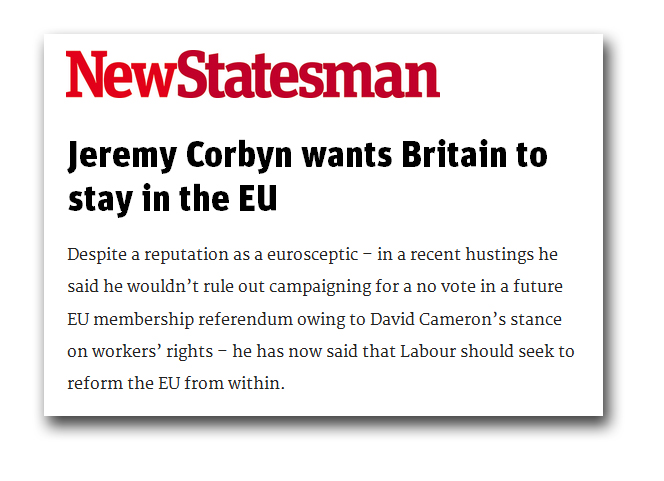
And with that admission he's being seen as a eurosceptic. Yet by his own recent interviews that's not what he is at all (my emphasis):
Labour should set out its own clear position to influence negotiations, working with our European allies to set out a reform agenda to benefit ordinary Europeans across the continent. We cannot be content with the state of the EU as it stands. But that does not mean walking away, but staying to fight together for a better Europe.”
Veterans of trying to remove ourselves from a uniquely supranational organisation will not be fooled by Corbyn's comments; they are straight out of the Tory handbook on how to use "reform" as a means to remain in the EU. Cameron would be proud.

Whereas Margaret Thatcher campaigned and voted yes in 1975 and then changed her mind, albeit too late, Corbyn has changed his mind for opposite intentions.

Thus it's worth noting Corbyn has based his vote on being an anti-establishment candidate, but in reality part of the establishment he will become. His supporters will be let down as were Lib Dem ones were in 2010. Probably with no surprise we suspect he will support Associate Membership, or the renamed equivalent, but complain the Tories haven't done enough about reform  - about insignificant detail.

With this in mind it's disappointing then to see Farage endorsing Corbyn:
Ukip leader Nigel Farage has backed Jeremy Corbyn to be the next leader of the Labour party.
An interesting comment from 1975, in the first Parliamentary debate after the referendum, Harold Wilson (Labour leader) noted this:
"Never out on principle; never in on principle [regarding EEC membership]. It depends on the terms and whether it is best for Britain. The country has now decided that it is best for Britain, the Commonwealth, Europe and the wider world."
An illustration on how the establishment never does anything on principle, including Corbyn. We, as a people, have to force them to listen to us.

Wednesday, 9 September 2015

EU Referendum: Cameron's "Reforms" In Tatters

It's interesting that on the day the European Commission President, Juncker, delivers his grand State of the European Union speech we see a headline in the Times (£) which states; "Blow dealt to British hopes of winning Brussels reforms". 

The Times reports that Cameron's well publicised desire to try to attempt to reform the EU to fit in with UK requirements has fundamentally come undone, as told to a House of Lords committee by Chancellor George Osborne. It's worth reproducing the Times' article in full here (my emphasis throughout):
Eurozone countries will gang up on Britain as they did over the Greek bailout unless major changes can be won during renegotiations with the EU, George Osborne claimed yesterday.

However, the prime minister and chancellor have been warned that they could struggle to win such reforms in a report published today by the European Council on Foreign Relations (ECFR), which says that they have yet to win round key allies.

Mr Osborne told a House of Lords committee yesterday that the 19 eurozone countries decided in a meeting in July — to which the UK was not invited — that Britain should pay a share of the Greek bailout.
Eurozone ministers reactivated a bailout fund known as the European financial stability mechanism (EFSM) to make an emergency €7 billion loan to Greece. Britain thought that this fund had been wound down and the decision put about £850 million of UK taxpayers’ money at risk.

“When the EFSM was decided on there were no non-euro members in the room,” Mr Osborne told peers. “When we first raised this issue, the European Commission said to us in a written document we have a QMV [qualified majority vote] now, so we don’t need to pay any attention to you. Lots of member states disavowed that. But it’s just a straw in the wind of what’s coming our way.”
Although eurozone countries used the fund, Britain struck a deal that meant UK taxpayers would be protected in the event of losses. “The treaties of the EU did not envisage a large number of member states in a single currency and a large number of states who are never likely to join,” Mr Osborne added. “The treaties do not really accommodate that situation. Any person looking rationally at that decision can see something needs to be done.”
In its report, the ECFR presents a bleak outlook for Mr Cameron’s renegotiations, declaring that the prime minister still has to convince partners that Britain “will not seek to destroy the DNA of the European Union”.

The ECFR has spoken to 100 leading politicians and thinkers in ten key European capitals about Britain’s plans. It has concluded that Mr Cameron has support for barely a third of his objectives, with his high-profile initiatives to slow the flow of European migrants to Britain among the most difficult to achieve, with none of the ten countries yet won round.

The report says that plans to block welfare handouts for new EU migrants for four years is still opposed in France, the Netherlands and Poland and agreement on the issue is “absolutely not doable” with Germany.

German opposition is so entrenched, the report says, because “the largest political parties oppose the idea of limiting social benefits for migrants because this is against the principle of free movement”.

Another objective for Mr Cameron is to opt-out on “ever closer union” and forge clear boundaries between eurozone members and the rest of the EU that would prevent a repeat of the Greek bailout surprise.

Only two countries — Bulgaria and Denmark — were deemed by the think tank to be “convinced”, with France, Germany, Italy and Sweden labelled “unconvinced”.
By Osborne's own words it's clear that Cameron has failed in his objective to try to 'reform' the EU and certainly before the UK referendum. None of this comes as a surprise but it's encouraging that we have further confirmation, as we noted before, that Cameron has as a consequence had to change strategy three times. The Minister for Europe said back in July:
"The key principle is that the reforms need to be legally binding and not reversible at the drop of a hat … it is not at all likely that by the end of 2017 one could have completed national ratifications of changes to the treaties, but part of any treaty process has to be agreement on the substance and then on the process of ratification … So we say that there would need to be absolutely clear agreement by all 27 countries where they have solemnly committed themselves to deliver on that package. That would be a unanimous decision of the European Council."
All of this leaves now Cameron vulnerable to the timings of the European Union over a new treaty which provides the Associate Membership option - his only get out. We are now beginning to get a firming up of Cameron's strategy.

And here Juncker's speech today takes on a new significance. While Farage concentrates his response to Juncker on his comments on migrants, ranting about "closing borders", aided and abetted by the myopic nature of the UK media, the real agenda of the speech has clearly passed him by. For example a key passage, of many is:
"I want to ensure we preserve the integrity of all four freedoms of the Single Market and at the same time find ways to allow the further integration of the Eurozone to strengthen the Economic and Monetary Union."
We can see clearly then Juncker has fired the starting gun for a new EU treaty; the asylum seeker crisis rather like Greece is being used as a "beneficial crisis" to facilitate a new treaty and so more EU integration.

Throughout the speech Juncker regularly refers to needing "more union", he's being clear about the need for further integration while also having a "fair deal" for Britain with the opportunity for us to participate in further integration should we wish. It looks all a bit familiar - it's the associate membership option we'll be fighting in the referendum.endum EU Referendum EU Referendum EU Referendum EU Referendum EU Referendum EU Referendum EU Referendum EU Referendum EU Referendum EU Referendum EU Referendum 

Tuesday, 8 September 2015

EU Referendum: Bloggers 1 Cameron 0

Despite the BBC trying to report last night's vote, yet again, through the prism of Tory splits (contrary to the criticisms of the Wilson report of 10 years ago) what we actually saw was a cross party consensus of Parliament holding the executive to account over purdah. In other words Parliament doing its job. EUReferendum.com notes:
It is a measure of how much the Government had misjudged the House that its removal of purdah was opposed by MPs who supported membership of the EU and wanted to see the UK remain. But they were insistent that the referendum should be fair, and seen to be fair, otherwise it would lack legitimacy.

Sadly, this victory can't ensure that the referendum will be fair, but at least after the joint efforts on many MPs, we can say that, after last night's "spectacular victory", it will be a little less unfair.
Naturally many will try to take the credit, but in truth the dispute over purdah originated from a comment on EUReferendum by Tony_E reproduced below:
A brief look at the Bill reveals this little gem in the schedules:

25 (1) Section 125 of the 2000 Act (restriction on publication etc of promotional material by central and local government etc) does not apply in relation to the referendum.
The 2000 Act, the Political Parties, Elections and referendums Act states in 125/2
(2)Subject to subsection (3), no material to which this section applies shall be published during the relevant period by or on behalf of—
(a)any Minister of the Crown, government department or local authority; or
(b)any other person or body whose expenses are defrayed wholly or mainly out of public funds or by any local authority.
Now of course, as both sides of the campaign will be in receipt of public money, naturally 125/2/b would have to be addressed. But the addition of section (a) into the new bill suggests that the full weight of the civil service and local government will be at the disposal of the YES campaign, and during the declared campaign period.

If I'm reading this correctly, as predicted, the government is stacking the deck in favour of it's own chosen course.

Free and fair referendum?
It's interesting and encouraging that a comment on a blog then became information which then found its way to Owen Paterson, who via the Times and the Daily Mail alerted other MPs to Cameron's deception. And as a consquence with cross party consensus we saw a 37 Tory rebellion and a defeat for the government.

As we've seen before blogging and the internet works, and Cameron shows no signs of fully understanding it.

Monday, 7 September 2015

EU Referendum: How Cameron Can Circumvent Purdah

Today is the report stage of the EU Referendum Bill. As Eureferendum.com notes there are 38 pages of amendments tabled, with some crucial amendments including one which seeks to prevent campaigners from taking part if they get money from the EU.

Cameron has signaled in advance that the government is willing apparently to concede ground on purdah - the period where taxpayer's money cannot be used by the government to publicly campaign in a referendum:
David Cameron is backing down on his refusal to impose a period of “purdah” in the runup to the EU referendum in a concession to his Eurosceptic backbenchers.
One of the reasons is Cameron is no longer pursuing purdah so vigorously is he has changed his strategy. Instead of going for "Article 48" reform, mainly because the EU has told him no, he's adopting the Associate Membership option available in a future EU treaty - a treaty which can only happen after the UK's referendum. Purdah, or its removal, thus becomes less important to him.

In addition he has the use of statutory instruments. After the Referendum Bill has passed, statutory instruments can be used to amend the Act at a later date to "water down" purdah restrictions under the radar of media coverage. He may seem to give in now but statutory instruments allows the government to achieve its aims with less media attention at a later date.

In effect it would be the use of salami tactics to nullify purdah and it would be a tactic taken straight out the EU guide book, which they call engrangé (gearing). Engrangé is where Monnet initiated the drip-by-drip process of integration by pushing a series of harmonising regulations to bring the economic activities of the member states closer together. So regulation is not the consequence of the process of integration - it is the means by which it is achieved.

In other words "engrangé, engrangé, engrangé, onwards" (with apologies to Tennyson). Monnet would be proud of Cameron...

Sunday, 6 September 2015

EU Referendum: £55 Million A Day?

It's disappointing to say the least to see consistently that the majority of eurosceptic arguments largely hasn't moved on in decades. The above picture is from "The_Know" - above is a screen grab from their Twitter account - a campaign which has failed to anticipate a change in the EU referendum question, despite significant financial resources.

To illustrate further of The Know's failure to move on by misunderstanding the 21st century we can see neatly by the satire in the 1980's in the BBC programme Yes Minister, titled Eurosausage:


To argue over EU membership costs invites not only the implication that membership would be ok if only it cost something like £22:50 a day but also that the cost comprehensively encourages europhiles to negate the "leavers" campaign by arguing about detail. We've seen exactly the same problem with the argument over the percentage of EU laws. All of which begs the question is 65.4% better than 66.9% of laws made etc etc?

This ensures that arguments are conducted on europhile territory thus negating our own position. There is nothing better for the europhile camp, who have the "status quo" effect in their favour to bog us down in detail, particularly when such detail is wrong:
It’s reasonable to describe £55 million as our “membership fee”, but it ignores the fact that we get money back as well. In other words, £55 million a day represents the UK’s ‘gross contributions’ to EU institutions. Our net contributions are the equivalent of £33 million per day on these terms.
This is precisely why Nick Clegg uses the £3million "job loss" line should we leave. He is not concerned if his facts are wrong, instead he knows full well that when one is voting in the ballot booth - a significant number will decide at the last minute; "I understand the £3 million figures are wrong but...but jobs are at risk, let's vote to "remain".

The EU is so much more than the economy, it's about democracy. We need to negate the economic argument to win, the issue is not about cost but about freedom and the right to decide who governs us.Referendum EU Referendum EU Referendum EU Referendum EU Referendum EU Referendum EU Referendum EU Referendum EU Referendum 

Saturday, 5 September 2015

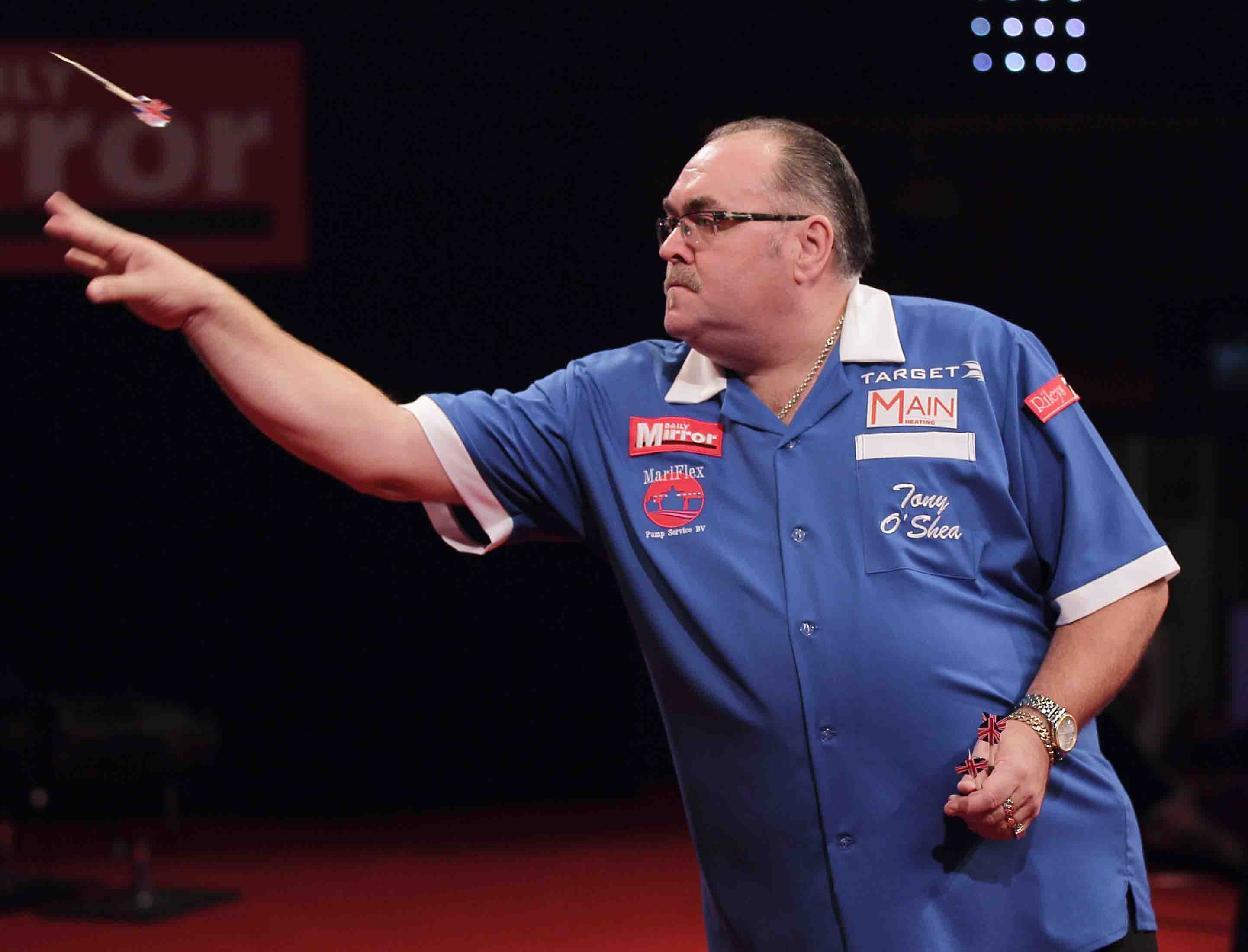
Is Darts A Game Or A Sport?

Ironically when the popularity of darts has suffered from the decline in the numbers of pubs with a changing culture, the above question still resonates within pub conversation.

So is darts a game or a sport? This blog generally concludes that for something to be considered a sport it has to fulfill the following two crtiera:
  • Is the result subject to boolean outcomes, i.e. either win or lose.
  • Does it require physical activity and does such continued physical activity improve the potential of winning boolean outcomes.
Clearly examples such as football, rugby, cricket and athletics meet this criteria of being a sport. Regarding darts though "physical activity" is not a requirement, so it only fulfills the boolean outcomes option making it come into the same category as snooker, billiards, bowls, chess, backgammon and Subbuteo. This makes it simply only a game. The physical activity in addition is necessary to elevate it to a sport.

Conversely robust physical activity without boolean outcomes but instead subjective marking such as ice skating and synchronised swimming can only be considered an activity, not a sport. Subjective marking is notoriously subject to bias and corruption.

Boolean outcomes and physical activity combined is something to consider given the challenges ahead in 2017...We either win or we don't.

Friday, 4 September 2015

EU Referendum: The Concise Exit Plan

"A few [participants] noted that the word ‘leave’ had potentially negative connotations. Some felt that this could encourage people to vote for the UK to remain a member of the EU, especially if they feared the unknown or changing the status quo."  
Assessment of the Electoral Commission on the proposed referendum question, September 2015

As Alex Salmond in the Scottish Independence referendum found out to his cost the lack of a credible exit plan is a sure way to losing. This is a mistake we seek not to repeat in the EU referendum. In Flexcit we have a plan albeit one which runs to 419 pages, not unsurprising given the complexity of the subject.

However there is now a less daunting concise edition at a mere 44 pages - a Flexcit lite. Here's how we can leave.Referendum EU Referendum EU Referendum EU Referendum EU Referendum EU Referendum EU Referendum EU Referendum EU Referendum