Saturday, 30 June 2012

Battlelines Drawn?

"The one who does not remember history is bound to live through it again" George Santayana
For part of this afternoon, I've been reading the two-day debate in Parliament in 1991 which took place before the [EU] Intergovernmental Conference to produce what would become known as the 'Maastricht' treaty. It's fascinating stuff which often beggars belief - the same old arguments but more importantly the utter arrogance. It is a goldmine of quotes (some of which I'll add to my sidebar later). Here are just a few examples:
[Douglas] Hurd: Norway has not yet made a decision on whether she wants to enter the Community. She held a referendum that went the wrong way, but my hon. Friend is right in thinking that Norway may find an opportunity to reconsider. I do not yet know. 
And:
Mr. Cash : [Mr. Kaufman] said that, when he went to the European Parliament in 1987, he was, to say the least, a reluctant European. Could he explain how, in the following five or six years, he has made such a massive transformation? Is it because he is hoping that there will be a socialist Europe?
 And:
Mr. Edward Heath: Today we must welcome the fact that the three major parties in this country all agree about the importance of the Community... It is in the interests of our businesses to have a single currency. Imagine what would happen if the rest of the Community had a single currency, and we were the only country without it. What would happen to our business men and our investment? The consequences would be unthinkable.
And: 
Rev. Ian Paisley: I also took part in the vote in the House in 1972. It comes ill from the lips of  [Mr. Heath] to say that he had a mandate to do what he did. I remember the cursing and threats--I saw one hon. Member being hammered over the head with an Order Paper. There was certainly no democracy in the House when it took that vital vote to go into Europe. Every hon. Member who took part in the debate knows that perfectly well. 
In just two days of debate, the sham of our so-called representative democracy was laid bare 21 years ago. Ted Heath correctly points out all three major parties agree with our membership. We were taken in on a lie, our continuing membership is based on lies, if not the complete truth - yet those in Parliament 'decide' that is in our interests regardless - that it believes that we must be governed by someone else - MP's giving power away lent to them temporarily by the voters.

As such, as Witterings from Witney consistently argues we now live in a form elected dictatorship - a view shared by Thatcher in the above debate:
Now, it looks to me as if three parties will be for a single currency and for sacrificing a great deal of the work that it has previously been the right of Parliament to do. How are the people to make their views known in this absence of choice? That was the particular point. My right hon. Friend will remember that our right hon. Friend the noble Lord Hailsham, made an interesting speech on elective dictatorship.
It's with this in mind that I refer to Cameron's article in the Telegraph (published Sunday) yet again promising a referendum (we've been here before) despite ruling out an in/out one a couple of days ago:
The Prime Minister uses an article in The Sunday Telegraph to say that Britain is in danger of getting swamped by EU legislation and bureaucracy which he would like to see scrapped. He makes clear for the first time that changes will need the “full-hearted support of the British people” down the line and adds: “For me the two words 'Europe’ and 'referendum’ can go together.” 
 'Real change' he calls it, but:
Mr Cameron argues that an in or out referendum is not the right choice because the “vast majority of the British people” wants changes to the current relationship with the EU.
Today was Armed Forces day, an opportunity to thank those who gave their lives trying to defend a system which meant that future generations could change their government without having to do the same. Cameron is one of many that is an example of how that sacrifice was betrayed.

The consequence of which are the rules of the game no longer apply, as Autonomous Mind writes
Dear reader, if you want power then it has to be taken back.  Our servants have made themselves our masters.  They will not give power away.  Rejecting these people is not enough, we have to defeat them.  The game has to be played differently.  The rules of the game no longer apply.
Cameron, Parliament nor the main parties are any longer the future - we have to defeat all of them.

Tuesday, 26 June 2012

Amateurs


I can't remember the last time a budget was still being talked about, and still controversial, months after it was delivered. But as the BBC reports, George Osborne has engaged in yet another Tory U-turn - I've now lost count:
The government has announced it will postpone its 3p-a-litre rise in fuel duty in August until January next year.

The move follows a campaign by road users' groups, who argued the increase would damage the economy.

Fuel duty will be frozen for the rest of the year, Chancellor George Osborne told MPs, adding that this would benefit families and businesses.

Labour, the SNP, Plaid Cymru and MPs from other parties had threatened to force a Commons vote on the issue.

The Sun newspaper and several Conservative MPs have also been pushing for a change of heart, amid concerns that prices at the pumps are squeezing living standards.
What's abundantly clear is that Westminster is infested by a bunch of amateurs, which at a time of Eurozone meltdown and an attempted power grab by the EU bodes well....

Sunday, 24 June 2012

Quotes Of The Day

From Tony Blair (who he?):
“I think most sensible people in Britain can see immigrants have made a great contribution to our country.”
At a stroke, he insults the core working class support of the Labour party who are most affected by immigration by overtly suggesting they're not 'sensible'. And:
"I would have been happy taking the European job as President of the EU".
Perhaps someone should remind Blair that he has absolutely no hope of that job...because it doesn't exist.

Saturday, 23 June 2012

Is Britain On The Way Out Of The EU?


Harold Macmillan allegedly replied to a journalist's question of what is most likely to blow governments off course, with the response; "Events, dear boy, events".

Such is Cameron's position now. He was desperate to 'park the EU' issue for the Tory party, but now it has blown up in his face big time. So much so that within less than six months the question of an EU referendum of sorts is increasingly being touted as being inevitable. This was unthinkable before the 2010 election in political circles.

But, as with the issue of immigration, which is being discussed by Labour eight years late simply as a token gesture so it is with our EU membership. Our political class are still stuck in a time warp of 'renegotiation' and 'common market' rhetoric, however events move fast and the EU tectonic plates have shifted very rapidly. The EU is about to go for the leap into full political integration (as was always intended) - more quickly than it will probably get away with but necessary because of the severity of the Eurozone crisis.

As Richard North points out, the key date is June 28th next week when the EU Council (not Summit) takes place, and political integration proposals are likely to be announced. With the severity of the Eurocrisis preventing the original intention of salami tactics (step-by-step) regarding integration as per the Monnet method, they are having to go for it all in one go - a bold move which will inevitably mean that Britain's relationship with the EU will have to change. A significant treaty change is due and thus a referendum here. This leaves three options:
  • Accept full integration including the Euro - a non-starter.

  • Attempt to veto the forthcoming treaty at an IGC, unless Cameron demands we repatriate powers. Yet not only does Cameron have no influence regarding the EU Council agenda, it will also leave him open to accusations of destroying the EU project for 'selfish national interest'. Again a non-starter.

  • So all that's left is option 3, leave via article 50 of the Lisbon Treaty to try to renegotiate a new relationship entirely, which essentially means exit, in all but name.
As Dr North argues; "Britain is on its way out". At times like this, the official advice regarding a possible breakup of the Euro is to stock up on canned food. Me? I'm stocking up on beer - I might need it...it's been a long wait.

Friday, 22 June 2012

3%

As regular readers know I'm in the process of trying to move house. Despite being in an area of the South East where house prices have generally held up, as demonstrated by the rapid increase of new builds in my area, the market in my case is somewhat slow - and for one good reason, according to my feedback from estate agents - fucking stamp duty.

Now, I'm not moving house because I want to nor necessarily for profit - I love my current house - it's a necessity. Sadly Mrs TBF is struggling, due to health reasons to make the stairs and very soon it will no longer be an option. A move to a single story property is therefore essential.

The difficulty is my house comes over the £250,000 (3%) threshold but not worth enough not to be a problem. Wonderful. That results in potential buyers being very reluctant to pay the significant duty increase in order to purchase my house - thus stalemate. This has ultimately distorted the market - making my house too cheap or too expensive. There are, of course, ways of navigating around this which unintentionally puts me into more murky territory than Jimmy Carr, through no fault of my own. Thus I couldn't agree with Martin Lewis more:
I hate stamp duty. It’s not that I object to a tax on purchasing property. It’s this distortive tax that has absurd cliff hangers meaning an extra penny on a house’s price can cost thousands.
So when Osborne talks about more aggressive measures on stamp duty avoidance in a populist attempt to clamp down on the rich using loopholes there seems to be silence when it comes to those who aren't so well off and are forced to 'avoid the tax' as a necessity. And at the same time he wants to try to promote a strategy for growth - not moving because of 3% surely equals 0%?

He hasn't a clue.

Carr Tax

The 'outrage' over Jimmy Carr's tax affairs has been rather amusing. On one level much fun can be had seeing a lefty comic, who only makes jokes about the 'right kind' of minorities, squirm as he gets caught out.

Now if ever there was a story that resembled to politicians an oversized can with the label 'worms, do not open' this was it. So while Downing Street initially told journalists that the Government does not normally comment on the tax affairs of individuals, Cameron in Mexico City had other ideas, and in with both feet he went:
Prime Minister David Cameron has said the tax arrangements of comedian Jimmy Carr are "morally wrong".
Good ol' populist stuff...which inevitable would mean the papers would investigate others close to the PM. And as a result he's now having to beat a hasty retreat:
David Cameron was in full retreat over his condemnation of celebrity tax avoiders last night, following warnings that his attack on Jimmy Carr could open a Pandora’s Box.

The Prime Minister refused to criticise the tax affairs of Take That star Gary Barlow, despite allegations that the singer was involved in a similar scheme to the one Carr used to cut his liabilities.
And the man is supposed to specialise in PR?

Then of course there's the outrage in the comments. One wonders how many of them have paid builders cash-in-hand thus avoiding VAT, and not declared it. A practice, unlike Carr, is not avoidance but evasion and so entirely illegal....

Empty Rhetoric

Newspapers, having clearly been briefed, are reporting that today Ed Milliband will give a speech about immigration in attempt to reposition Labour being on the side of working class voters' concerns.

Apparently:
“They are worried about the future. They want there to be good jobs, they want their communities to grow strong once again. And they worry about immigration,” he will say

“Worrying about immigration, talking about immigration, thinking about immigration, does not make them bigots. Not in any way. They are anxious about the future.”
In a move that makes the phrase 'stable doors and horses' seem inadequate, Ed Miliband will admit Labour's past mistakes on the issue. The crucial question though is what does he and Labour intend to do about it?

Well the short answer is nothing, and nor can he while we remain EU members. Thus we get feeble measures such as; 'restrictions' on countries joining under a new treaty (which can only apply for a maximum of 7 years), better enforcement of minimum wage and new measures to force medium and large employers to declare if they employ more than 25% of foreign workers.

So meaninglessness drivel that doesn't address the core problem. If we didn't know better we could have mistaken it for a Tory speech...oh wait, they have.

Meanwhile as they flap about delivering nothing, history is in the making on the European continent - rather soon, as Richard North highlights Britain's relationship with the EU is going to change significantly, and that change is likely to be defined by them not by us. And what do we hear from Labour and the Tories? Silence.

Wednesday, 20 June 2012

An Angry Barroso

"Those in the EU are democracies" Monty Python type satire from EU Commission President (unelected) Barroso


hattip for the video: Muffled Vociferation

Feel That Narrative

After watching England's dreary but 'got-the-job-done' performance last night, I'm rubbing my eyes at some of the newspaper reports this morning (and not just because I've got hay fever).

Much of the focus in today's papers is on Ukraine's goal that wasn't - the ball clearly crossed the line and would have meant that Ukraine equalised if given. That it wasn't, apparently meant that England could progress to the next round. As a consequence many reports are lauding England's 'Lady Luck and 'rub-of-the-green' - just some of the clichés bandied about this morning. James Lawton in the Independent has this:
Lucky devil Hodgson must have done a deal with fate. He escaped what should always be known as the siege of Donetsk. England conceded a goal that was as authentic as the one they were denied in the World Cup two years ago...
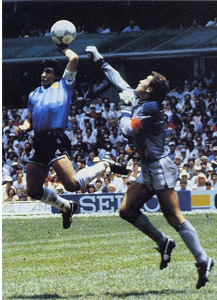
This fits in with the narrative that England have always previously exited major tournaments because they've been unlucky or robbed; Maradona 1986, Sol Campball 1998 and 2004 and Frank Lampard in 2010, to give just a couple of examples. The facts though belies another story.

One of the favourite footballers' clichés is that luck, and referees' decisions, even themselves out over a season. Well if that's the case imagine what luck does over 46 years (the last time we won a major international tournament). It's hard then not to conclude that we don't win stuff because we're not good enough. Take 1986, yes Maradona cheated but then he scored an amazing second goal and we were poor until the last 15 minutes during which England striker Lineker missed an open goal to equalise. In the 1996 Euro (Football's coming home) tournament; we were poor against Switzerland and Scotland until Gazza's famous effort. And yes he was unlucky to miss against Germany in the semi-final to send us through to the final, but England shouldn't have been there anyway because Spain scored two legitimate goals in the previous round against us that were wrongly ruled out.

Then there's Lampard's goal against Germany that wasn't in 2010. Germany didn't thrash us 4-1 one because that goal was disallowed, they did so because England were utterly woeful in the second half and had an abysmal tournament all round

Yet it's Lampard's effort that fills today's papers, not only to argue that it's atonement for 'luck' we've always been denied for so long but also use it to campaign for 'goal-line' technology - which tries to justify our exit in 2010 and is also used as a convenient stick with which to hit the less-than-candid-English-hating FIFA President Sepp Fatter with, who is opposed to the idea

Therefore the narrative becomes England's luck. Or, instead, another way of looking at it:
  • Ukraine outplayed us but despite numerous scoring opportunities, they had a strike force that couldn't hit a cow's bottom with a banjo.

  • England had a number of decisions go against them, notably a clear foul on England striker Andy Carroll in the penalty box.
     
  • Even if the goal had been allowed a draw would have still meant we qualified and would be top
     
  • That the 'goal' Ukraine allegedly scored was in fact offside
And it's the last point that's most important. Right across our media it has been comprehensively ignored - despite the game being watched by an average of 12.69 million with a peak of 18 million, that ITV pointed it out several times last night and that the clips are available on YouTube, the dead tree press have decided on a different agenda regardless of the facts (my emphasis):
England conceded a goal that was as authentic as the one they were denied in the World Cup two years ago
No it wasn't authentic, it was offside. Two human errors - failing to flag that as well as not spotting the 'goal' led to the right outcome. Even the usually erudite and award winning Telegraph journalist Henry Winter underplays the significance:
So [Rooney] is back and so is Lady Luck, fluttering her eyelashes at the grateful English. When Terry stretched out a leg to hook Marko Devic’s shot clear the ball had crossed the line.

The Hungarian officials failed to notice it. Oleg Blokhin did. Ukraine’s coach was understandably enraged, even if there had been a hint of offside.
It wasn't a 'hint', it was. Indeed readers' comments under the articles have pointed out, in droves, the omission, But no matter, sod the facts, feel the narrative and put your fingers in your ears saying 'la la la I can't hear you'.

Sunday, 17 June 2012

A Red Herring

The percentage of laws that stem from Europe is a (rather phoney) passionate debate that often involves statistical deception on both sides, but most particularly among those that favour our membership. One of the classic quotes used by those in favour is that only (circa) 9% of laws come from the EU - this is a favourite of the so-called 'evidence based' blog Left Foot Forward (his emphasis):
6. Successive British governments have refused to say what proportion of domestic laws come from Brussels, but a thorough analysis by the German Federal Justice Ministry showed that 84 per cent of the legislation in that country came from the EU.
This is plainly nonsense, both the claim that the Government “have refused to say” the proportion of laws that come from Brussels, and the figure he quotes. The House of Commons Library states that only 9.1 per cent of UK laws stem from the EU.
The House of Commons Library, however, made no such claim, it instead only referred to the number of Statutory Instruments passed as the result of EU legislation. It did not include things like EU regulations nor primary legislation. A point made by Peter Lilley (via Tim Worstall):
I have heard hon. Members claim that only 10 per cent. of our laws are made in Brussels—a figure that they attribute to a Library paper, but that paper says no such thing. It remarks that the number of statutory instruments laid under the European Communities Act 1972 amounts to about 10 per cent. of all the statutory instruments passed by the House, but points out that EU statutory instruments typically enact a whole directive, which is often the equivalent of an Act of primary legislation, whereas domestic statutory instruments implement regulations. To compare the two is like comparing apples and pears, or rather pumpkins and pears given the disparity in their size. It also ignores the most plentiful fruit that comes from the European orchard—regulations, most of which are never considered by this House and which hon. Members find difficult even to obtain.

The total scale of EU legislation is enormous. Last year, the EU passed 177 directives, which are more or less equivalent to our Acts of Parliament, and 2,033 regulations, which become directly enforceable in this place, not to mention 1,045 decisions.
Arch- Europhile blogger Nosemonkey, to his credit, accepts the 9% deception, but still he uses the percentage argument for EU membership; implicitly arguing that if he can prove that EU law accounts for lower than the eurosceptics claim then ergo our membership is a good thing.

This though raises two obvious questions. If he is right and the EU has such little influence then why does it need to exist, and more importantly why then does it need so much money?

Then of course there's the question that Nosemonkey never answers (to my knowledge) What percentage of EU laws is a good thing? Is 21% better than 22%? Is 34.999% better than 51.9998%. And so on.

It matters not the correct figure - what is clear is that the EU makes at least some, if not most of our laws (the figure largely unknown) and what needs to happen instead is that 100% of laws should be made by a Parliament that is is elected and accountable to the people. The EU is not...9% or otherwise.

100% of laws made by the consent of the people - is that too much to ask?