Showing posts with label Farage. Show all posts

Friday, 8 January 2016

Farage: I've Made A Terrible Terrible Mistake

Under the scrutiny of the media, and potentially more crucially the harsh spotlight of the internet, Nigel Farage has had to embarrassingly backtrack on his allegations that attempts on his life were made.
The Ukip leader said he should never have spoken out about the wheel falling off his car, after questions were raised about the so-called assassination attempt
Such accusations clearly should never be made without substantial evidence. It appears that Farage has "shot from the hip" as he always has been inclined to do. It's a trait he has played on within the concept of being "honest" in contrast to other politicians. It's a strategy that worked when speaking to the converted and outside mass media scrutiny.

However with a higher profile and the intense spotlight of the forthcoming referendum it's difficult to conclude that his comments could be anything other than damaging for Brexit if he's associated with the leavers.

Farage's comments also leaves UKIP's de facto mouthpiece Breitbart in a difficult position:

 Rightly it criticised the hypocritical media when it comes to mistakes:
If Breitbart London had made a faux pas as large as the Guardian, the Independent, LBC, and the Huffington Post – we’d be laughed out of every shitty, Westminster drinks reception for weeks on end.
But then whoops:
I confess, UKIP leader Nigel Farage told me about this specific concern [assassination] over his car in November of last year. Off the record, not for reporting. “Fine,” I sighed. After the, “Oh my God, are you okay, mate?” obviously.
Farage has now admitted such claims are a "terrible terrible mistake". If true then Raheem Kassam is not the first, nor will be last, to be dropped in it by Farage where loyalty is an unusual concept. I wonder if Breitbart will follow its own advice.

That such a story made the rounds does though neatly illustrate the decline in standards in the UK media. The Mail on Sunday published the claims without critical content; a claim which was reproduced by the mainstream media at the time with no critical analysis. It took the internet to take the claims apart.

Ironically for a man who understood the need to bypass the legacy media when trying to establish UKIP as a credible political party in the late '90s - he used public meetings as a means of negating the hostility of the media - the internet has passed him by.

Of additional concern is news that Farage, having made a "terrible mistake", has now gone public regarding advocating a "public protest" on new alcohol guidelines - this from a man who spends a lot of time in the pub.

This then is all about Farage and not Brexit. It's becoming clear that the sooner he is distanced from the leave movement the better.

Thursday, 7 January 2016

UKIP: The Wheels Come Off?

I didn't particularly want to write another piece about UKIP as this blog prefers to concentrate on campaigning trying to exit from the EU - we have much bigger fish to fry. However following on from our piece regarding the Mail on Sunday headlines, we note an understandable determination of the legacy media this week to probe further Farage's "claims".

The Mirror reports that Farage's car was not part of a widely publicised recall:
A Volvo spokesman later said: "I can confirm that Mr Farage’s car was not part of that recall, so no such work was required."
The Mirror was following up the story and despite clearing Farage of ignoring a possible recall the story as published by the Mail still has significant question marks hanging over it. With this in mind we see that the Times reports (I quote a substantial part of it as it's behind a paywall):
[Farage's] version was challenged by the prosecution service in Dunkirk, which said that a police report said it was an accident and made no mention of sabotage. A spokesman said that prosecutors would have started a criminal investigation if there had been any suspicion of foul play. They did not.

Farage, who was not hurt, said that he chose not to file a lawsuit following the crash. The prosecution service in Boulogne-sur-Mer said: “In France, prosecutors can investigate even without the victim’s agreement.”

The Ukip leader said that the mechanic called to repair the car had told him that the nuts had been unscrewed deliberately.

Philippe Marquis, a garage owner, told Libération that he had said nothing of the sort. He told the newspaper that the nuts were loose but that he believed that this was because of shoddy repair work. He added that he had been unable to communicate with Mr Farage because neither spoke the other’s language: “We only spoke with our hands.”
Farage's account is now being directly contradicted by reports in the Times.

And it's no surprise there is scrutiny. To make an accusation of an assassination attempt is a very serious charge. One that should not be made without substantial evidence. That the French police failed to investigate and Farage never made an official compliant calls into significant doubts over the claim.

However oddities of the story could also be due to the case that UKIP has now split in two, albeit unofficially, so reports of "Farage assassination" may reflect that split and may not be what they seem.

Not that it matters anymore. If we are to win an EU referendum it's going to be the people who matter, not the internal politics of a party supposedly dedicated to EU exit.

We have more pressing issues to deal with...

Hattip for image scribblingsfromseaham


Friday, 11 September 2015

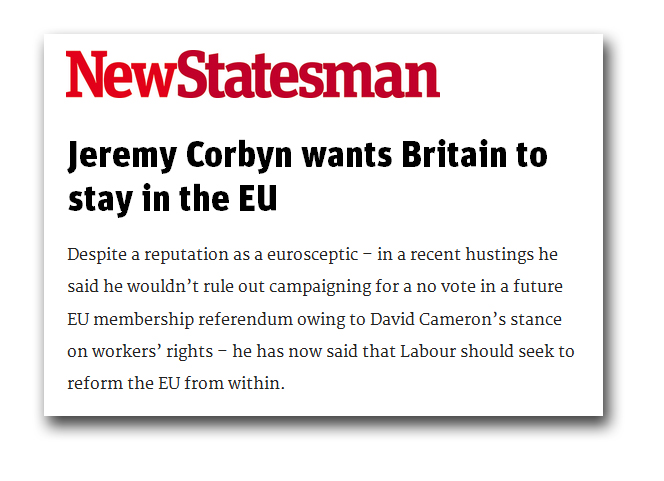
EU Referendum: Corbyn's Not Our Friend

It's depressingly familiar that the British media and Westminster cannot debate the EU without communicating it through the prism of a domestic London bubble.

A clear example was neatly illustrated recently by European Commission President Juncker's State of the Union speech earlier this week, a speech which was reduced down to reporting it as an announcement on migrants. The term State of the Union, if it was used at all, was done so in UK media with inverted commas. That the real point of the speech was to fire the starting gun for a new EU treaty which has been signalled well in advance was largely overlooked.

Westminster media though has more 'pressing concerns', mainly that of the ongoing contest over the summer within Labour of candidates jostling for leadership of the party. All indications suggest that it will be Jeremy Corbyn who wins, against his Parliamentary party's wishes and indeed, by his admission, his own.

Within such tittle tattle, we see the question being asked of Corbyn, with an impending EU referendum, how he voted in the EEC referendum in 1975:
The man expected to win control of Britain's opposition Labour Party said on Thursday that he voted 'No' to Britain's membership of the forerunner to the European Union in a 1975 referendum.
And with that admission he's being seen as a eurosceptic. Yet by his own recent interviews that's not what he is at all (my emphasis):
Labour should set out its own clear position to influence negotiations, working with our European allies to set out a reform agenda to benefit ordinary Europeans across the continent. We cannot be content with the state of the EU as it stands. But that does not mean walking away, but staying to fight together for a better Europe.”
Veterans of trying to remove ourselves from a uniquely supranational organisation will not be fooled by Corbyn's comments; they are straight out of the Tory handbook on how to use "reform" as a means to remain in the EU. Cameron would be proud.

Whereas Margaret Thatcher campaigned and voted yes in 1975 and then changed her mind, albeit too late, Corbyn has changed his mind for opposite intentions.

Thus it's worth noting Corbyn has based his vote on being an anti-establishment candidate, but in reality part of the establishment he will become. His supporters will be let down as were Lib Dem ones were in 2010. Probably with no surprise we suspect he will support Associate Membership, or the renamed equivalent, but complain the Tories haven't done enough about reform  - about insignificant detail.

With this in mind it's disappointing then to see Farage endorsing Corbyn:
Ukip leader Nigel Farage has backed Jeremy Corbyn to be the next leader of the Labour party.
An interesting comment from 1975, in the first Parliamentary debate after the referendum, Harold Wilson (Labour leader) noted this:
"Never out on principle; never in on principle [regarding EEC membership]. It depends on the terms and whether it is best for Britain. The country has now decided that it is best for Britain, the Commonwealth, Europe and the wider world."
An illustration on how the establishment never does anything on principle, including Corbyn. We, as a people, have to force them to listen to us.

Tuesday, 1 September 2015

EU Referendum Question Is Set To Change

Following on from concerns by the Electoral Commission this morning over the wording of the current yes/no question, Cameron has announced that he is prepared to change the question in line with the advice:
[The EC] said that the question should set out the alternative option of Britain "leaving the European Union", while giving people the option of choosing whether they "leave" or "remain" rather than a simple "Yes/ No".

Within half an hour of the announcement a Downing Street spokesman confirmed that the government will table an amendment changing the question in line with the commission's proposals.
The Electoral Commission has always been consistent, since 2013, on the question it prefers:
Should the United Kingdom remain a member of the European Union or leave the European Union?'

The responses would be ‘Remain a member of the European Union’ / ‘Leave the European Union’.

Research participants found this the most neutral of all the versions tested.
Given the report stage of the Referendum Bill comes up next week where further amendments can be made, the EC's timing also seems perfectly reasonable. 
Interestingly this leaves Arron Banks's pet project, TheKnow.EU, in a rather awkward position. This blog has yet to be impressed with "The Know". Their Twitter account contains misleading and selective quoting of newspaper articles, jingoistic rhetoric, and as Autonomous Mind says: "completely inaccurate assertions about the additional EU budgetary contribution demanded of the UK".

Despite the name it's clear Banks knows nothing about the EU and now it seems he knows nothing about getting the name right for a referendum either. It's entirely his fault - the consequence of being presumptuous by jumping in before the Referendum Bill has even been passed. If they can't get their own name right then there's not much hope for anything else from them.

The jostling for position by Farage, Banks and Mathew Elliot for leading the campaign to leave has only revealed what a low grade position we are currently in. Everything from Farage announcing the launch of a "no" campaign on the day the EC releases its advice to fundamentally misunderstanding the terms of being designated the official campaign to leave shows a complete lack of understanding of even the basics of what a referendum campaign will look like.

The location of amateursville is being determined by a triangulation of egos; Farage, Elliot and Banks. They want it about them not us and if it continues we will lose.
EU Referendum EU Referendum EU Referendum EU Referendum EU Referendum EU Referendum EU Referendum EU Referendum EU Referendum EU Referendum EU Referendum EU Referendum

Saturday, 9 May 2015

EU Referendum: A UKIP Free Zone

It's does seem rather incredulous that as the starting gun has been fired on an EU referendum, UKIP - supposedly an anti-EU party - vacates the debate completely. Their website's "very latest" reduces mention of the impending referendum down to a footnote without being a main piece, Farage its leader decides to take four months off on vacation, setting up the party for civil war in the form of a leadership challenge. And with no exit plan, the party now seems more interested in electoral reform than actually taking any interest in trying to win a referendum.

With this in mind, this blog will now become largely a UKIP free zone. Regarding exit from the EU they have become an irrelevance. Ancient history. Instead, for the rest of us, we have a "out" campaign to organise - to do the job that UKIP was set up to do.

Instead we will now concentrate on issues that will be relevant to the forthcoming referendum campaign. And to relect the slight change in emphasis, this blog has undergone somewhat of a makeover. One major change is that I've embedded Disqus for comments. However by doing so it has removed from public view all previous comments. We will try to upload them to Disqus in due course.

There will be further changes to come and any observations, suggestions or criticisms of the new look are most welcome.

More importantly though we now have a referendum to try to win.

Tuesday, 31 March 2015

UKIP: Thanks For Nothing

We've noted before on this blog UKIP's increasingly toxic tendency to blame "everything on immigrants". Previously it was Farage's assertion that he was held up on the M4 motorway due to the fact that "open door immigration has meant that the M4 is not as navigable as it used to be'".

That he was traveling by car early evening on a Friday around a notorious bottleneck on the M4 wasn't taken into consideration. Thus "bloody immigrants" was dog whistle politics writ large.

With this in mind it therefore comes as no surprise to see that Farage believes that immigrants are to blame for children not playing in the streets:
Britons are so ill at ease with levels of immigration in their towns that their children do not play football with their neighbours in the streets, Nigel Farage has said.
The UK Independence Party leader said people in eastern England felt a “deep level of discomfort” about the millions of immigrants who have settled in the UK in the past decade.
He said: “I want to live in a community where our kids play football in the streets of an evening and live in a society that is at ease with itself.
And I sense over the last decade or more we are not at ease"
It's not unfair in our view to believe that Nick Griffin would have been proud of these sentiments. That children may not, or cannot, play in the streets is often down to a myriad of factors, not least its illegal, it's unsafe and that many roads simply have too many cars - ironically Farage's children couldn't play outside his own house, in the street, for this reason alone.

In trying to remove ourselves from the EU however Farage's language is toxic. With what began as a eurosceptic party, has been hijacked by a man who has turned it into a self-promotional vehicle and is prepared as a consequence to condemn the eurosceptic movement in terms which hinder significantly the argument of getting out. So much so that we are set to lose before we even start.

With such language and thus with effectively a self-imposed glass ceiling on support, no wonder the media have begun to catch up with bloggers by noticing belatedly that UKIP's trend is on a downward trajectory.

With so-called 'UKIP strategy' we get a measure of the man when we see this:
“If we went to every town up eastern England and spoke to people about how they felt, their town, their city had changed in the last 15 years, there is a deep level of discomfort, because if you have immigration at these sorts of levels integration doesn’t happen.” 
Note the words "eastern England". It's an odd statement to make for a leader of a party named the United Kingdom Independence Party. What about Scotland, Northern Ireland and Wales where immigration is not necessarily such a vote winner - immigration has an uneven effect across the country.

But within "eastern England" is the constituency of Thanet South; where Farage is standing to be elected as an MP. It's also next door to where UKIP held its Spring Conference in Margate which had no mobile signal nor internet access.

A professional party with workable facilities at its conference less important than Farage's own campaign it seems. So no policies, no strategy, no exit plan just dog-whistle soundbites to get Farage elected.

Perhaps in this sense it will work and this will please the cult, but in getting us out of the EU no chance.

What a waste of 20 odd years...

Wednesday, 25 March 2015

Why A 2015 EU Referendum Cannot Happen (Update).


Following on from our previous post regarding the impossibility of a 2015 referendum, we contacted the Electoral Commission to try to clarify a number of further potential technical issues.

While, like most quangos, the Electoral Commission displayed a deep reluctance to commit themselves to answering certain questions posed, their first response confirmed our initial points that, contrary to Farage's assertion, a referendum cannot happen in a few weeks (quoted from the Electoral Commission's email):
Currently, we cannot say how the designation process will work at any future referendum until Parliament passes the legislation setting out the rules for that referendum. 

Our role is to regulate the referendum and designate campaigners under the rules for each referendum. The rules that applied at previous referendums required the Commission to designate campaigners that sufficiently represented those campaigning for the outcome they support, or, if more than one, represented those campaigning to the greatest extent.
This reiterates precisely our point that it means campaigning groups can't begin to officially campaign until they submit bids for the official "in" and "out" campaign and have been approved. With Scotland a campaign period of 16 weeks was the recommendation.

However the approval process is likely to take six months as also recommended by the Electoral Commission. This six month process cannot happen until after the referendum bill becomes law which in itself at best will take months.

Thus with the Electoral Commission's recommendations which considered the experience with Scotland (for recommendations, read demands) it becomes clear that a 2015 referendum is simply out of the question.

Friday, 20 March 2015

Why A 2015 EU Referendum Cannot Happen.

As noted in the Independent last Sunday, Nigel Farage has indicated that he will support a minority Conservative Government if Prime Minster David Cameron promises a referendum in 2015:
"The terms of my deal with the Tories would be very precise and simple. I want a full and fair referendum to be held in 2015 to allow Britons to vote on being in or out of the European Union. There would be no wiggle room for 'renegotiation' somewhere down the line'.

"The EU is facing an existential crisis and, given that it only takes a few weeks to launch and organise a referendum, it should be held in 2015.”
Although we would largely agree with the sentiments of a "full and fair" referendum, we would take issue with the "very precise and simple" demand that a referendum should be held in 2015 and "given that it only takes a few weeks to launch." For the very precise and simple reason that it can't be done. Farage is offering impossible terms on the practicality of timescale.

To support Farage's demands comparisons are sometimes made with the 1975 referendum where it is claimed that it is possible to have a referendum in a few weeks, the timeline often quoted is as follows:
December 1974: Harold Wilson requests renegotiation of EEC membership terms.

European Council agreed to new terms for UK in Dublin by 11 March 1975 and renegotiation largely ended.

26 February 1975: White Paper announcing referendum to be held after result of renegotiation was known

26 March 1975: Referendum Bill published.

31 March 1975: White Paper setting out the results of the renegotiation of the UK membership of the EC.

9 April 1975: after a three-day debate on the Government’s recommendation to continue Britain’s EC membership, the Commons voted 396 to 170 to continue in Common Market on the new terms. At the same time Government drafts Referendum Bill, to be moved in case of a successful renegotiation.

On 22 April 1975 the House of Lords approved continued membership by 261 votes to 20.

Post-legislative referendum held 5 June 1975. Referendum not directly related to White Paper on renegotiation, but preamble referred to renegotiation. Question much broader: “Do you think the UK should stay in the European Community (Common Market)?” The result was 67 per cent in favour on a 65 per cent turnout.
As we can see in 1975 the passage through Parliament to holding a referendum took circa 10 weeks (26 March - 5 June) from publishing the Bill to holding the Referendum. The 1975 Referendum book though notes (p.66):
"But the real reason for the unexpectedly easy passage of the Bill was political: pro-Marketeers were in an overwhelming majority in the House of Commons and they had belatedly realised that the referendum would go their way."
Even with an easy passage it still took two and half months to have a referendum. The election in 2015 is in May, then there's a summer recess so we can expect it to take longer. Especially when we consider that due to the complexity of an EU that has significantly evolved in over 40 years of UK membership and the less certainty of a referendum result, that its passage through Parliament will be more turbulent and difficult.
 
We have noted before regarding trying to win a referendum, 1975 is not 2015. The country has moved on in forty years. Procedures are now different, for example in 1975 the campaign started in January 1975 long before the Referendum Bill had been passed - with self-appointed "umbrella" groups.

However unlike 1975 referendums are now the responsibility of the Electoral Commission, which was established under Political Parties, Elections and Referendums Act 2000. Thus on that alone the timescale in comparison to 1975 has changed.

With the establishment of the Electoral Commission it means that campaigning groups can't begin to officially campaign until they submit bids for the official "in" and "out" campaign and have been approved. This process cannot happen until after the referendum bill becomes law.

There has to be a reasonable period to allow the Electoral Commission to invite submissions and make the designation, and then the lead organisations must be given time to organise themselves.

As we can see from the Electoral Commission December 2014 report on the Scottish Independence Referendum held on 18 September 2014, it recommends (my emphasis):
... that in planning for any future referendums, not only in Scotland but also those held across or in other parts of the UK, governments should aim to ensure that legislation (including any secondary legislation) is clear at least six months before it is required to be implemented or complied with by campaigners, the Chief Counting Officer, Counting Officers or Electoral Registration Officers.
Thus "a reasonable period" according the Electoral Commission amounts to six months, as it argues to allow for (again my emphasis):
The benefit of this additional time was passed on to campaigners, EROs and COs in preparing for their respective roles at the referendum:
Campaigners were able to engage constructively with the legislative process and had time to develop an understanding of the relevant guidance and rules, before they came into force. EROs and COs benefitted from sufficient time to put robust plans in place for the delivery of their responsibilities under the legislation, from targeted public awareness activity to the booking of polling places and the training of staff.
In addition the Electoral Commission also recommends (again my emphasis):
2.39 Following the 2011 referendum on additional powers for the National Assembly for Wales and the Parliamentary Voting System for the House of Commons, we recommended that for future referendums the detailed rules should be clear at least 28 weeks in advance of polling day, based on a statutory regulated referendum campaign period of 16 weeks.
Although the Electoral Commission cannot demand, where it recommends will be taken into account should there be a challenge to the Bill and it goes to a Judicial Review as undoubtedly it would should there be any form of corner cutting or fast-tracking.

Yet even with a relatively smooth process by the Electoral Commission's recommendations there would be a ten month delay between an Act of Parliament and a vote: that obviously takes us well into 2016.

In addition Farage thinks he can determine the referendum question:
 "Do you wish to be a free, independent sovereign democracy?"
Despite the fact that the Electoral Commission has already put forward its proposals for the referendum question - its full report is here, Farage's suggestion wouldn't even pass the unambiguity test let alone the neutral one.

At this point I don't know what to conclude. Either Farage is very poorly briefed which is a reflection on a lack of a decent research department despite having (now) 22 very well paid MEPs or he knows this and is deliberately demanding conditions that Cameron (or indeed anyone else) cannot possibly meet.

The latter of course allows UKIP to put forward the criticism that Cameron cannot be trusted which conveniently helps prop up Farage's position. If one is to be cynical there's nothing better than having a perpetual enemy to oppose to justify your own existence, especially in the absence of any party polices.

Either way the eurosceptic movement is being very poorly served by UKIP.

Saturday, 14 March 2015

Shameless And Cynical?

The fine line between which areas are appropriate or not with which to criticise a politician is sometimes difficult to ascertain. For example are the family members of politicians off limits to criticism? It could be considered that politician family's privacy should largely be respected. Michael Portillo put this point rather forcefully earlier this week to Daily Mail columnist Sarah Vine over her vindictive criticism of Ed "two kitchens" Miliband.

But in contrast what happens when said "happy family" is used as electioneering material such as by Cecil Parkinson and Chris Huhne only then for us to later find out what a sham it all was? Does criticism then become justified?

Very obviously the bereavements suffered by both Gordon Brown and David Cameron over the loss of a child should be completely off limits. Yet while both men would understandably at times wish to be open about such a loss, there is always the difficulty of determining if such openness is being done for political reasons.

And this brings me onto Farage. I always remember that leading up to the 2010 election, Farage gave an interview to Camilla Long of the Sunday Times. What stuck in my mind was not that clearly the article in question had an agenda to undermine Farage but that it did so by openingly mocking the fact that he reportedly had testicular cancer in his youth.

In terms of the depths that the media can sometimes plummet to we can compare this to the media treatment of the great Victorian statesman, Gladstone. He was at times vitriolically disliked - Queen Victoria famously commented that "[Gladstone] speaks to me as if I were a public meeting". Yet despite the remorseless abuse from such satirical publications as Punch rarely, if ever, was Gladstone's disability mocked - that he lost fingers on one hand due to a shooting accident.

Interestingly where Farage is concerned we move on five years from 2010, where we see today in the Telegraph it has extracts from Farage's new book, where very 'candidly' he talks about his health:
Mr Farage, now 50, says the plane crash, combined with the effects of another car accident in his twenties, “has left me with a body 20 years older”.
It's worth noting that the car accident in question was the consequence of being too drunk and walking out in front of a moving vehicle. However:
The National Health Service “almost killed me”, Nigel Farage says today as he reveals that his body is now so frail that he could be registered disabled.
It is indeed curious that while UKIP still haven't publicly put forward any coherent polices in the lead up to a general election, despite a promise to have a manifesto published by their Spring Conference in Margate, Farage has managed to have another 'leader's book' published - essentially an updated version of 'Fighting Bull'. Maybe it's a coincidence but it conveniently ensures that the spotlight is largely on him running up to an election.

So we have to consider that with 'timing' being everything in politics whether the release of his new book, titled 'Purple Revolution' is candid or simply just shameless and cynical. A line seems to have been crossed over whether Farage and his health difficulties are now being exploited as an attempt at electoral gain. The title alone suggests an attempt to own the rise of UKIP and the eurosceptic movement.

It's also interesting that Farage has agreed to have the book be serialised for money in the Telegraph - a paper which is usually hostile to UKIP and nominally a Conservative supporting paper.

With this in mind it is indeed interesting that Farage has a great to say about his poor health, including revealing that his body is now so frail that he could be registered disabled. This rather contradicts his message at UKIP's Spring Conference at Margate recently:
There has been a lot of speculation about where have I been, why have not been on the television all the time. This has been led to my opponents to spread some speculation about my health that I am seriously ill and that is why I have not been seen.

I hate to disappoint my opponents but can I make it clear that rumours of my demise have been greatly exaggerated.” 
So not only is the timing curious but someone it appears is making things up as he goes along. Farage then continues:
An MRI scan followed at the private London Bridge Hospital, and I was referred to Mr Bhupal Chitnavis, a top-dollar consultant neurosurgeon. He said he was shocked by the damage to my neck and that, if I wanted, he would sign me off as being partially disabled for the rest of my life. I certainly did not want one of those blue badges — it would be conceding defeat — but it was a shocking moment.
Now there's no doubt Farage suffered injuries as a result of the plane crash:
Where the issue lies is his casual link deployed between being a Blue Badge holder and being registered partially or fully disabled.

Leaving aside the sentiment that apparently being a blue badge holder means conceding defeat - no doubt that 2.58 million blue badge holders would contest otherwise and would probably take offense at the term "those blue badges", being registered disabled is different and is a misleading term.

Under the Equality Act it has such a varied broad definition, that it could apply to anything, including those perceived to be disabled and those associated with a disabled person (e.g. a parent or partner). The principle of the Equality Act is that discrimination on grounds of disability happens in all sorts of ways to all sorts of people.

The real test in our view of being genuinely disabled is whether you qualify for a Blue Badge and or DLA/PIP benefits. Here the criteria is far more strict; as an example if you have a permanent or substantial disability which means you can’t walk or find walking very difficult you are still required to take further assessments before a blue badge is issued.

As is obvious by the above photograph with Farage walking away from a plane crash and his current twitter status - "back on the campaign trail" - he would have absolutely no chance of being eligible for a blue badge.

We only conclude then that what we have is a rather shameless and cynical appeal for the sympathy vote.

Saturday, 7 February 2015

London

Mrs TBF and I have just returned from spending a nice relaxing few days in London, not only celebrating our anniversary, but a chance to be away from work - and in this blog's case politics.

Thus with this in mind, I'm keen to leave aside temporarily the political problems of the "Westminster bubble", and begin with what can be described in an unusually English upbeat observation that London as a city to explore and visit is, in my view, one of the finest in the world...albeit with some understandable failings.

I have visited London on so many occasions since my childhood and have frequented not only most of the usual tourist parts, but sporting venues, conferences and other copious personal related ventures. Yet it constantly amazes me that no matter how many times I visit, there are always great areas and places that I have never been to or even heard of.

One of the reasons, and the most obvious, is that London is rather large, not as much as some other world cities admittedly but its size is significantly disproportionate to the size of a relatively small island. But alone this cannot describe London's appeal. Los Angeles is also a large sprawling city yet it is the worst in my experience I have ever visited - in short it's a dump.

Many tourist city guides tend to recommend visitors stay in relatively safe 'tourist areas' - with a dash of common sense - and in contrast warn of the dangers of completely separate "never visit after dark" areas. LA manages to combine the two along just one street (Hollywood Boulevard) ...epitomised by the Hollywood film Pretty Woman, where the film attempted to glamorise the best bits of LA by having Julia Roberts play a prostitute. So size is clearly not everything.

Another advantage with London is that it simply has a lot of history; peppered as it is with thousands of historic properties, as well as four World Heritage Sites (Greenwich, Tower, Kew and Westminster) adding in scheduled ancient monuments and historic parks. What other major world city has such a comprehensive and informative blue plaque scheme allowing casual visitors to connecting buildings with the past?

This is the city I have long known, yet despite being largely familiar with London it was interesting that on this occasion it was the first time we visited the capital properly while utilizing a wheelchair. Navigating a city with the limitations that a wheelchair poses reveals a different aspect of a city, its culture and all the nuances which emerge. Not all of it initially obvious.

In our post in June last year criticism was made of wheelchair access regarding Brussels and in particular - and rather ironically - EU buildings. In contrast it can be safely argued that wheelchair access on London's public pavements is largely spot on in comparison.

Gently sloped dropped kerbs with tactile paving are abound. It's worth noting that tactile paving not only helps those who have sight disability to find the edge of the kerb but also acts as "foot traction" for those pushing trying to tame a 'runaway' wheelchair on a slope in wet weather which could otherwise lead to slipping and falling over.

And blimey isn't London 'hilly'- perhaps memories play tricks but it isn't as flat I had always thought it was. I guess it should be obvious that being on a flood plain, and much of it being built around the Thames, that areas of London unsurprisingly slopes significantly towards the river, but it doesn't truly become apparent until you have to push a wheelchair away from the river - essentially uphill.

Whenever I have previously visited London I have opted to use the Tube to travel around London. For obvious reasons on this occasion due to better accessibility we stuck to London taxis. I'd forgotten how good they were.

Each taxi came with its own ramp, the drivers were unfailing polite and helpful and they put themselves out to the most extraordinary inconvenience to drop us off to make Mrs TBF's life a little easier, to the extend of holding up a road of busy traffic. Another 'interesting' feature of them, as Bill Bryson noted, is they cannot drive more than 200 feet in a straight line before charging down another obscure street you never knew existed.

Another attraction of London, and a major tourist one is its pubs. Old London pubs can be a particular nuisance if you are tall, as most of the toilets are 'downstairs' which requires not only navigating restricted stair access but low ceilings when in the facilities.

Invariably also these same pubs have steps outside the front door which provide a further obstacle for wheelchair bound customers. Yet many pubs were helpful with ramps and lifting. However it's with some irony that the more modern pubs which had removed steps for a slope for the front door didn't carry on that thinking for the rest of the pub.

A classic example was the Slug and Lettuce in Leicester Square, despite no steps into the premises, all of its 'wheelchair access available seating' was of the tall chair variety, pictured below:

And that helps a disabled person how? We suspect it's not malicious just a lack of thought- undoubtedly they've figured out, along with many other 'concept' pubs, that tall chairs and standing increases the alcohol consumption.

Public buildings, in contrast tend to be better and go out of their way to help even if for very obvious reasons medieval ones like cathedrals and castles do not lend themselves fully to those who don't have complete mobility. Here Westminster Abbey was no exception.

Of all the major London attractions I've always been reluctant to visit the Abbey in the past due to its ongoing standing prohibitive cost, despite being someone who greatly admires and extensively enjoys visiting medieval buildings. The Abbey, even by London standards, is expensive. It is sad that this is the case for anyone interested in British history, architecture and as an active place of worship. The expensive entrance price doesn't allow photography inside even without a flash.

However for a wheelchair user, along with a carer, the entrance was free - mainly due to large parts of the building being inaccessible. Thus, after many years, I was able to take in, and appreciate, the internal architectural delights of the Abbey (in the absence of the somewhat overpriced entrance fee I gave a voluntary donation).

The volunteers within the Abbey though couldn't have been more helpful, even with little details like providing, without prompting, a hands free version of the audio guide to those whose hands are tied up with pushing wheelchairs.

So what to make of Westminster Abbey itself? Oddly despite its religious heritage, and more recently the wedding of William and Kate, the Abbey really feels more like a memorial to Britain’s more famous figures than a place of worship.

What is noticeable from the outset is the incredible number of memorials, plaques and statues to famous rulers, artists, and poets that has been packed into the building. In this sense no other Abbey or Cathedral in England is like it and as consequence the religious imagery is much less noticeable here.

Given the overwhelming tributes within the building to leaders of establishment - Prime Ministers, Kings etc - it leaves us puzzled why the tribute is not reciprocated in the form of formal contributions to its upkeep:
What is less well known is that Westminster Abbey receives no regular funding from the Crown, the Church of England or the government.Neither a cathedral nor a parish church, Westminster Abbey was established as a ‘Royal Peculiar’ in 1560 by Queen Elizabeth I. The Abbey is outside the jurisdiction and responsibility of the Church of England and the Government. In short, this means we must seek our own financial support.
So instead an overpriced ticket paid for by the hoi polloi it is. The Abbey, among many others, serves as the final resting place of Queen Elizabeth I, Mary Queen of Scots, Isaac Newton, Charles Dickens, Charles Darwin, and Laurence Olivier, and also features memorials to William Shakespeare, Admiral Horatio Nelson, Jane Austen, and Oscar Romero (who are all buried elsewhere - Jane Austin for example in Winchester). 


My personal view having wandered around is this desire within an Abbey to have so many plaques, especially in Poets' Corner, largely of non-religious nature contrary to its function becomes borderline tacky and I would include, slightly controversially, the grave of the Unknown Warrior pictured above. More a tourist existence than a dignified tribute.

An interesting architectural feature, and again rather unique and largely unseen on television coverage of royal occasions, is use of iron stabilisation bar supports around the central part of the Abbey to prop up the pillars which disappointingly suggests a fundamental instability of the original Gothic structure.

Anyway I'm glad I've seen it and equally pleased it didn't cost Mrs TBF and I £40 to enter.

Moving on from Westminster Abbey, just along the road, we had a quick look at New Scotland Yard. Not surprisingly for a fortified Police Station the place was adorned with CCTV, fences and intimidating looking Policeman guarding every entrance. They probably guarded the front entrance as well but it was hard to tell where the front entrance was. Unwelcoming NSY was, and as I've noted before much can be garnered from a building about an institution's culture.

But still there was always the iconic revolving triangle sign to observe:

Which now appears right in the middle of a public pavement; outside the confines of NSY, on its own, which at the time I visited was patrolled by a PCSO:


So the iconic sign is in a public space with plastic plod to look after it, but the rest of the building is not easily accessible by members of the public and is guarded by proper plod. It's not quite how it looks on television. We should know our place.

Ultimately though London, despite its quirks, is pretty kind to those who are wheelchair bound, including the British public who were very helpful.

Mrs TBF and I rounded off a pleasant few days by going to see Shaun the Sheep The Movie - this review is pretty much right. What a delightful, funny and 'British' film it is.

Essentially it is a 90 minute silent stop motion film made for under 10's which is an impressive feat in itself. It's obviously been made with loving care and to keep the adults amused it sneaks in plenty of references to films such as Taxi Driver, Shawshank Redemption, Silence of the Lambs and Chopper.

After it had finished we caught a cab only to hear Farage on the radio regarding a little local difficulty in Rotherham.

And so back to the real world with a bump...

Tuesday, 3 February 2015

Parish Notice

I had intended to have part 2 up of the EU and Telecoms piece up this evening (Tuesday), however time is short this week and I would like to do the so far unfinished piece justice rather than rush it, not least because I have recently come across documentation that shows Norway has more say within its EEA agreement then the UK does over telecommunications; notably its Electronic Communications Act and also its Personal Data Act.

What becomes very obvious when researching the impact of the copious regulations on our country is the ridiculous myriad of EU and international competences which have seemingly no end and it can become quickly rather bewildering trying to follow and make sense of it all. But make sense of it and try to win a referendum we must.

We also note that the more we investigate Norway's EEA arrangements, the more it becomes apparent that not only does it have a much better deal than us within the Single Market (albeit not perfect) but it exposes further the deception or even ignorance of our own politicians regarding this issue.

And with that in mind, and this maybe harsh, I do rather resent that it's taking a small number of bloggers who are attempting to address these issues...unpaid...in their own time, in preparation for a possible referendum than a party which has significant funding via its now 23 MEPs yet literally pisses it up against the wall. This is all we get for our money.

We can win a referendum - we have many advantages over 1975 but we're in danger of needlessly repeating many of the mistakes.

But that said, time is currently short because Mrs TBF and I will be in London for the next few days celebrating our 10th wedding anniversary. In a few days we will return to normal service on this blog.

Monday, 17 November 2014

UKIP MEPs Falling Out With Farage?

When UKIP celebrated their "European Election win" back in May of this year, those with a more experienced eye instead wondered how many of the 24 MEPs would be left in 2019 by the time of the next elections, and with good reason. Farage, as Dr Eric Edmond observes, historically; "has a long track record of losing MEPs rather quickly as he rounds up the EU Euros".

Of the original intake in 2009 UKIP lost nearly half of its MEPs with a small consolation of only one defector to the party - Roger Helmer from the Tories. The reason is obvious and has been well documented - Farage sees off anyone he perceives as a threat;
“He cannot tolerate anyone in the party who he feels is or might be in a position to challenge him. He prefers to surround himself with incompetents and deadbeats. Anyone who emerges who might show an independent streak, he ruthlessly eliminates, to ensure that they cannot be seen as competition.” 
As Bloom warned UKIP MP Carswell last month "watch your back". UKIP is a one-man party by design not by accident.

O'Flynn of course has not covered himself with glory not only with his so-called "Wag Tax", which was dismissed within 24 hours by Farage himself but with his stupidity over the 1st November nonsense. Another example of UKIP bringing in someone and promoting them to roles where they are completely unsuited, in this case to the role of "economic spokesman". It's worth noting though in view of O'Flynn's comments on VAT that UKIP has this on its website under "Policies for People":
Houses on brownfield sites will be exempt from Stamp Duty on first sale and VAT relaxed for redevelopment of brownfield sites.
Thus confirming that official UKIP policy is to retain an EU tax (or remain EU members). But O'Flynn's biggest problem was always that he had a high profile, particularly as a former journalist with contacts - thus he's a threat to Farage. He came top of those who had a list of MEPs mostly likely to fallout with Farage. And so it's coming to pass, the briefings have begun:
"Senior members of UKIP are campaigning behind the scenes to have Patrick O'Flynn MEP removed as economic spokesman after his appearance on the BBC's Newsnight programme last Monday night. In the interview O'Flynn called for higher taxes on business, having previously called for a tax on the turnover of companies so they would pay even if they did not make a profit."
Deja Vu all over again and it's completely of no surprise. We've seen it all before and then some... With no coherent polices and a leader desperate at all costs to shore up his bank account by virtue of being leader, this is no way to run what desires to be taken seriously as a political party.

And certainly it is not going to win an EU referendum, in fact quite the opposite - it will only help the side which wish us to remain in.

Monday, 29 September 2014

EU Referendum: A Free Bet?

This blog has no ulterior motive other than to campaign to exit the EU a reflection of myself who was inspired to object to membership during the Maastricht debates and the ERM crisis. And as I made clear internally when I first joined UKIP, and stood as a PPC in 2010, my loyalty is to the cause not to any party.

However events change as they often do in politics. What I thought was not possible five years ago was that a major party would offer a referendum on EU membership as Cameron has done. Those who took part in very lonely campaigns over the last 20 years must be invigorated by the fact that the question of EU membership is starting to take centre stage.

In some ways UKIP can take the credit for this and for the about turn by Cameron. Despite Cameron previously refusing a referendum on the basis he wanted to stay in and deploying a three-line whip on the same basis, he has performed a very significant u-turn.

And he has done so as a result from pressure from his own party who in turn feel the heat from the rise of UKIP. It’s odd therefore that many in UKIP having extracted this concession now dismiss the Tories offer. One wonders what they actually want. Perhaps this is a reflection of UKIP’s long standing fundamental indecisiveness of whether it is a pressure group or a fully fledged party.

The latter seems to have won out and has a consequence become a party that not only jumps on every bandwagon going (when Nigel is not falling off it) but performs consistent rapid backtracking on party polices withing 24 hours as per VAT on luxury goods. Then in addition it often makes clear that it simply wants to destroy the Tories and nothing else. Somewhere in the mist the party's mission of exiting the EU has become somewhat lost.

Now it is understandable given Cameron’s track record of many not “trusting” him on this issue – an unprincipled, shallow, useless chancer he is. For me this for the eurosceptic side is a bonus – not only does his lack of authority and principles make him very vulnerable to his party’s whims but having an incompetent “general” in charge of the “in” camp is beneficial.

Thus for me it's not a question of trusting Cameron but strategy.  Like most in the country I don't trust politicians in general. Well actually more accurately I should emphasise that I do trust them…to do precisely what they’re told when they absolutely have to, for example the consequences of marginal seats concentrates the mind no end. That’s the nature of true power and democracy.

The EU referendum then becomes one that is more of a question of strategy and having a punt (worth noting that certain UKIP supporters bet against their party)

The brutal reality for those who wish an EU referendum is, as it stands, voting for any other party in 2015 will guarantee that we won’t get one, thus we stay in the EU for another 5 years. Labour won’t give us one, UKIP can’t and nor can any other party.

However… a Tory victory has given the possibility of a referendum in 2017. And in my view political reality says Cameron won’t have a choice but to deliver. If he wins the general election it will only be with a small majority giving rebellious backbenchers a lot of power. These backbenchers will consist partly of those who have campaigned for a referendum during this parliament and others who also simply just don’t like Cameron. Thus if he fails to deliver it is very likely that he will be out on his ear sharpish.

Of course despite this Cameron may be able to wriggle out of a referendum but in the event of that what would we have lost? Nothing other than 5 more years in the EU; the same as would be by voting for anyone else anyway.

So in betting terms what we have if we want a referendum is a free bet.

Wednesday, 28 May 2014

Cameron Tries To Block UKIP Funding

Mary Ellon Synon reports that "Cameron is trying to sabotage UKIP’s influence at the European Parliament, just days after trying to appear sympathetic to euroscepticism by telling the British people that their message at the polls was “received and understood.”
Instead of accepting UKIP's victory, Cameron has started a drive to cut off the legs of “the people’s army” in Brussels and Strasbourg. He has assigned Conservative Party fixers to do deals with hard-right and populist parties which, until now, the Conservatives claimed were “unacceptable.”
Conservative moves which have the full support of 'Judas Goat' Hannan:
Last week Conservative MEP Daniel Hannan was in Denmark telling Copenhagen television that the Danish People’s Party (DPP), which sat with UKIP’s group in the outgoing parliament, would now be welcome to join in the Tories’ Europe group at the European parliament.
But in 2009, Conservatives rejected an approach from the DPP to join their group, “because of their unacceptable views in a number of areas.” Thus far from listening to the British people we have yet another example - which undoubtedly comes as a large shock to everyone - of the complete contempt held by those in Westminster have of UK voters. Farage has it right when he says:
There is a big dissident voice now in this parliament. And yet, I just sat in a meeting where you wouldn’t think that anything happened at all.
It does though neatly illustrate a number of intriguing observations. That the EU Parliament is used by UK parties (and other countries) to try to manipulate domestic audiences politically. Cameron is willing to align himself with "undesirables" in order to try to shore up his election chances at home - by depriving UKIP of money - regardless of reputations. He accurately calculates that most in the UK couldn't care less about the EU Parliament and how it works.

It also demonstrates that the very understandable desire to give the main three parties a "kicking" in the Euro elections by UK voters is one that has been shown to be largely impotent, a sentiment that is echoed by Farage himself.

The EU Parliament via groupings and the use of money ensures that it is just another EU institution whose primary function is to facilitate the further progress of the supranational project rather than be an independent "check and balance" on the executive or other bodies:
For example, in the 2012 budget, UKIP and the MEPs from ten other countries in the Europe of Freedom and Democracy group, had an allocation of more than €2.5m, with €881,000 still in the bank carried over from the previous year’s grant. This was on top of all the expenses individual MEPs were given to run their offices, research and travel.

By contrast, the giant pro-EU powers European People’s Party (EPP)...was allocated €21m.
Is it little wonder that the EU are so lax about expenses allowances; there is nothing better than easy money to turn people "native". Then there's the European Court of Justice, who rather than be an independent judiciary has instead the primary role of extending and reinforcing the supranational authority of the EU Commission, its "coup d'etat" was this judgement from 1964 :
It follows from all these observations that the law stemming from the treaty, an independent source of law, could not, because of its special and original nature, be overridden by domestic legal provisions, however framed, without being deprived of its character as community law and without the legal basis of the community itself being called into question.

The transfer by the States from their domestic legal system to the Community ... Treaty carries with it a permanent limitation of their sovereign rights, against which a subsequent unilateral act incompatible with the concept of the Community cannot prevail.
Obviously it's clear that UK exit is not going to materialise from Brussels or MEPs contained within nor indeed many members of Westminster. Our exit is likely to come via a referendum and to win that requires negating many of the lies, deception and FUD that has characterised over 40 years of membership. To do that requires a proper, well thought-out exit plan:

It's interesting that despite Cameron's continuing deception on the EU, in terms of how it works regarding treaties he appears to be pretty naive - in fact he's made a substantial strategical cock-up.

Cameron gave a promise of a referendum in 2017 after claiming that he would negotiate reforms with the EU. As has been well noted on many occasions such reforms cannot be done without approval of other member states nor without Treaty change nor within the time frame.

Cameron then said on Andrew Marr that a referendum would be held anyway in 2017:


Essentially this means that any referendum in 2017 won't be based on a fudged reform (because there isn't time) but instead it will be a straight in/out. Here we have a fighting chance. But it is only one chance and one chance only. To win needs co-operation and planning among eurosceptic groups to ensure victory. Without that we lose.

Rather like Neil Armstrong et al going to the moon, they either got it right or they died. There were no second chances.

Sunday, 18 May 2014

Losing The EU Referendum

Let's not beat around the bush, without a fully worked-out policy and strategy on how to leave the EU any referendum on EU exit will be lost for those who wish out. It's as simple as that. And should the "outers" lose it's game over for at least a generation, probably more. We won't have another chance - it won't be a "best of three".

We don't actually need to have a referendum - there was no referendum to enter the EEC (EU) - and there needs to be no referendum to leave. Yet we must acknowledge that the reality of current political momentum which suggests strongly that our exit will hinge very decisively on one being called.

So should a referendum be called, we face an extremely unfair fight against a pro-EU and ignorant media (including the Express and the state broadcaster), an unfair fight against all of the main political parties, an unfair and dishonest fight against FUD and the need to overcome the "status quo" effect which has an inbuilt advantage of around 20%.

It's imperative therefore that there should be a reassuring policy on EU exit which attempts to alleviate any concerns. This involves invoking Article 50, parking the economic issue temporarily via EFTA/EEA membership, and campaigning on the political (democracy) issue alone giving us a fighting chance.

On Article 50 at least we thought that the UKIP's position was settled when Farage confirmed at least twice that the Article would have to be invoked. But despite being a one man party he clearly isn't in total command when UKIP literature is being distributed contradicting him in the run up to the Euro elections.

Such confusion and a lack of available policy on UKIP's website means the "Life on Mars" option is still alive and kicking as Witterings from Witney notes:
Yesterday evening The Boiling Frog and I spent some time on twitter trying to convince three Ukip supporters that that which they were tweeting was pure fantasy. We were presented with statements such as the old canard that repeal of ECA 1972 meant the UK was free of EU membership; that abrogation of ECHR would mean the EU would promptly rescind the UK’s membership of the EU; and that a new trade agreement could be placed on the table within 24 hours for signature. In our attempted ‘debate’ matters are not helped when it is suggested that I should Go and smoke another spliff – leave it for the rest of us to sort out the mess; neither when I am called a supercilious tit in the comments to this post. Such ignorance is indeed a tad terrifying. 
That somehow 40 years of integration and hugely complex international agreements can just be undone in 24 hours really does defy belief.

More crucially failure to confront the nature of our exit by UKIP inevitably leads to split messages. And split messages don't win referendum campaigns, in the same way split parties don't win elections as per the 1906 General Election when the Conservatives lost by a landslide which was largely attributed to a party split over free trade.

The lack of a policy by UKIP leads this rather incoherent interview with UKIP councillor - who defected to UKIP from the Tories - Suzanne Evans. She was asked by Andrew Neil on the BBC's Sunday Politics if UKIP had published a "roadmap" if the vote was a yes to leave.

Suzanne Evans response was; "wouldn't that be great?" Well yes it would actually, which begs the question why has it not been done?

Some argue that UKIP is an "amateur party" with limited funds in contrast to others, but that of course is no excuse. Seventeen shortlisted entrants to the Brexit prize produced papers on precisely that issue within four months including one from a 15 year old boy. A damning indictment on UKIP's failure to produce one in twenty years with well-paid MEPs.

As Christopher Booker observes in the Sunday Telegraph:
It is equally disturbing that a party founded on a desire to extricate us from the EU should have no properly worked-out policy for how this could be done. Ask Ukip what are the practical steps whereby we could achieve a successful exit from the EU, and the answer is little more than a blank stare and empty platitudes. 
Andrew Neil pressed Suzanne Evans further on whether UKIP had a "roadmap". Her answers remained very unconvincing stating that she's "not a legal expert on this" and that "we could come out quickly or there's a longer route as well". Then the question put to Suzanne was "but have [UKIP] published any of that detail". The response being;
"well...not, not that I have read but there are ways to do it..."
Then Suzanne continues that UKIP want to revert back to 1975 to "what people voted for". This despite the EEC was never an economic project nor a common market. The Treaty of Rome makes this perfectly clear:
"Determined to lay the foundations of an ever closer union among the peoples of Europe"
With Suzanne's statement to effectively revert back to a "golden age" that never existed she then gets caught out...Andrew Neil rightly asks her that the vote in 1975 involved the "free movement of people" which goes against a party which is now chasing the BNP vote on immigration. What a mess...

No doubt some will see this as another gratuitous anti-UKIP piece. My philosophy though was always been clear right from the outset when I joined the party - "my loyalty is to the cause not to any party". In its present guise UKIP are damaging the cause and for that reason I can no longer support them.

UKIP's current stance will lose us the referendum, the choice is increasingly becoming clear; it's either the party or EU exit. The two are no longer compatible.

Wednesday, 2 April 2014

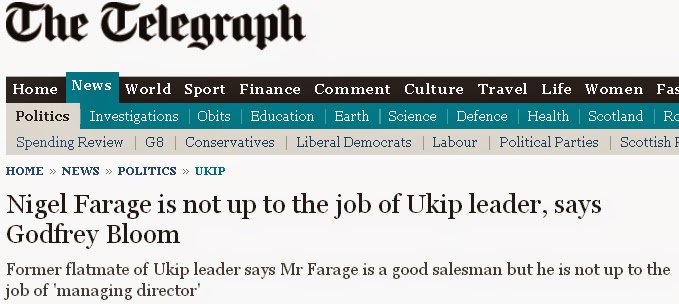
Nigel Farage Not Up To The Job


Not my words but those of Godfrey Bloom. With Clegg vs Farage Round 2 about to commence we have Bloom coming out of the woodwork with an interview in the Telegraph. He makes some pretty disparaging comments about Farage:
[Bloom] said that although Mr Farage acted as a "charismatic" and "articulate" salesman for the Ukip brand he is not up to the role of "managing director or chairman of the board."

Asked if he believed Mr Farage was intelligent, Mr Bloom replied: "In what way?"

By contrast, Mr Bloom said there were many "bright young people" waiting in the wings of Ukip but that Mr Farage was blocking their chances of coming "to the surface" of the party. He added: "Nigel has been doing it for twenty years, I think perhaps one might argue that's too long.”
This is not the first time that Bloom has criticised Farage, and it is probably not lost on most that these comments have only happened after Bloom fell out with him. He was more than happy to be on the gravy train and keep quiet when it suited. Now he's seen which way the wind is blowing out he comes.

Nor are we sure Bloom is the right man to criticise others for “not being up to the job” given his ban from hotels after relieving himself in the corridors and being caught in public cavorting with prostitutes.

When we look at his interview in full (at the bottom of the Telegraph article) it's 46:30 minutes long yet nearly 42 minutes of that time is spent with Bloom defending his attitude to women. His comments about Farage don't come until near the end. How this is supposed to further the Eurosceptic cause boggles my mind.

That said the nature of the messenger doesn't always negate the message. With UKIP more prominent, more scrutiny comes with the territory. And under such intense scrutiny Bloom is right Farage is clearly coming up short. With Farage also currently under a very serious Police investigation we wonder how long he will be around as leader.

Friday, 28 February 2014

Farage Standing Down?

From the International Business Times:
Nigel Farage dramatically raised the stakes in Ukip's quest for political power by vowing to resign as leader if his party fails to get any seats in the 2015 general election.
Farage made the pledge on the day he told the anti-EU party's spring conference: "This is our moment.
After speaking in Torquay of "ruthless targeting" to win seats at the general election, Farage put his own future on the line.
"I said in my speech we could get several MPs, or a good number of MPs, in Westminster in 2015 provided, and I made it absolutely clear, that would not happen unless we clear this hurdle effectively on May 22 [the local and European elections this year].
"I stand by that. This is the election Ukip has waited 20 years for."
When asked if he would stand down in the event of the party not returning any MPs to the House, he said: "I would have thought so, good lord yes. I would be out the door before you could say Jack Robinson."