Showing posts with label Lisbon Treaty. Show all posts

Saturday, 29 November 2014

The EU Game Cameron Plays

It is a truth universally acknowledged that when it comes to all matters EU, Cameron - the cast iron Prime Minister - is not to be trusted.

Yet he is also a man under political pressure not only from his own party but what he perceives as the UKIP threat for his general election chances. This is evident with his 2017 referendum promise which was made under duress while he had previously been anxious to avoid one at all costs.

So as we enter the final straight leading up to May 2015 we had a much-hyped speech on immigration yesterday. Its purpose not only to try to win the election but form the basis of winning an EU referendum in 2017.

In his speech we had the typical Cameron flourishes which were a rehash of his "commitments" over the Lisbon Treaty. With Lisbon he was repeatedly asked what would happen if it was ratified by all member states before he came to power. "We won't let matters rest there" was his response, which as we all know, letting matters rest there was precisely what he did. A U-turn that almost certainly cost him the 2010 election.

Yesterday we had a variation of the same theme.
If our concerns fall on deaf ears and we cannot put our relationship with the EU on a better footing, then of course I rule nothing out.
Cameron repeated the "I rule nothing out" during the questions and answers session which followed his speech. Cameron hinting he would consider exit but not actually specifying it and we think it's fair to assume that he won't.

However the more interesting point concerned how Cameron was going to attempt to wriggle himself out of the hole which he has very firmly plonked himself in, namely that any reforms to satisfy eurosceptics needs treaty change and that can't be done in the two years he proposed, if at all.

Cameron acknowledged during the Q&A session following his speech that his whole package required treaty change (my transcript):
Guardian: Patrick Wintour from the Guardian. You’ve cited Open Europe in your speech. Open Europe’s figures show that even if you’re on the minimum wage and you lose your tax credits a Pole or a Bulgarian will still have a financial incentive to come to the UK. Why are you sure that these measures will repel people from coming to the UK and secondly does this require Treaty change in your mind

Cameron: The answer to the second question is yes. These changes taken together they will require some Treaty changes. There’s a debate in Europe about exactly which bits of legislation which bits of the Treaty you’ll need to change but there’s no doubt this package as a whole will require some Treaty change. And I’m confident we can negotiate that.
Such arguments have been made often on the internet so it's refreshing to see Cameron finally and publicly coming to the same conclusion. It's also interesting that his numerous references to Open Europe effectively outs it as the europhile organistion that it is and that its own purpose is to keep the UK in the EU.

So...how to remove himself from a hole? Well we get a very clear indication of how he is attempting to do it from the superb analysis by Richard North of Cameron's speech:
What the Prime Minister has done is narrow down the "reform" spectrum to cover one subject, and one subject only – immigration. To be more specific, it has been narrowed down to freedom of movement.
This has a number of positives for Cameron. By linking the freedom of movement to the issue of benefits, has made Cameron try to look somewhat tougher on both. Then by concentrating largely on immigration he's turning his fire on UKIP.

With UKIP exiting the EU arena and going for the anti-immigrant vote as its sole purpose, topped off by an all round aggressive undertone that by Farage's admission alienates half the electorate, it's an understandable strategy from Cameron. It's not the definite "ins" or the definite "outs" which matter, it's the more sensitive "don't knows", "couldn't care less", and "could be persuaded either way" votes which win a referendum.

Thus by proposing what "appears" to be more a moderate sensible solutions to a concerned electorate rather than one of a more robust and alienating policy of repatriation (nevermind confusion) it would leave UKIP with nowhere else to go. It's a similar scenario to countries such as Cuba whose economy used to rely mainly on one export- sugar. Any failure for whatever reason in the product and you're buggered.

Another positive for Cameron is that there are mechanisms within EU membership which are "already possible without treaty change, or even additional EU legislation". Those which do require treaty change conveniently can be achieved via Article 48 without the need for an IGC (Intergovernmental Conference):
...Article 48 – which deals with treaty change – also allows for a "simplified procedure". Potentially, this would allow the procedure to be completed on a rainy afternoon in Brussels, perhaps on the margins of a European Council. There is, though, a small condition. The changes permissible are confined to Part Three of the Treaty of the Functioning of the European Union (TFEU) which, just as it happens, include freedom of movement. Against all the odds, therefore, Cameron could pull off a quickie treaty and come home in triumph, waving a piece of paper.
What we can see here therefore is Cameron relying on the rather misleadingly named "self-amending" parts of the Lisbon Treaty. He will attempt to return from 'negotiations' claiming he's reformed the EU via Article 48, in this Cameron is attempting to do "a Chamberlain". It's as transparent as it's dishonest.

However there are also some significant negatives with Cameron's strategy. The hurdles for Cameron are not over. Article 48 is limited to what it can and can't do and it cannot just change the Treaty of the Functioning of the European Union (TFEU) on a whim as and when, despite some of the eurosceptic rhetoric.

While Article 48 by-passes the need for a complex full-blown EU treaty and an IGC, any amendments still require the UK Parliament's permission (along with the other 27 member states):
The amendments shall enter into force after being ratified by all the Member States in accordance with their respective constitutional requirements.
And under Article 48.7 we can see an implicit approval clause
Any initiative taken by the European Council on the basis of the first or the second subparagraph shall be notified to the national Parliaments. If a national Parliament makes known its opposition within six months of the date of such notification, the decision referred to in the first or the second subparagraph shall not be adopted. In the absence of opposition, the European Council may adopt the decision. 
In short it means Parliament always agrees to amendments unless it specifically objects within a certain time period. Therefore as we can see from Article 48 the key point is that Parliament still has a say in any potential amendments to the Lisbon Treaty.

Thus we could be in an interesting position where Cameron's much fabled "piece of paper" is rejected by Parliament. Realistically this is unlikely. With all main parties supporting EU membership, the likelihood is Parliament will support it, but with lots of pantomime - Labour and the Lib Dems complaining it didn't go far enough. Here would be a repeat of ERM membership - all parties supported it, for example Labour as represented by a future Chancellor known as Gordon Brown in 1990 although their criticisim was that membership didn't go far enough:
We needed an investment Budget to deal with the problems of training in industry, a Budget that would pave the way for negotiations to enter the European monetary system [ERM], a Budget that would do something about the problems that industry now faces, with investment flat and falling away.
While permission from the UK parliament maybe assured, Cameron also requires unanimity within the European Council as this Parliamentary document makes clear in its conclusions; "...any Treaty revision by means of simplified procedures, and any changes to decision procedures by means of passerelles, will be subject to veto by the Government in the European Council or Council of Ministers."

Thus initially Cameron has to have the approval of the other 27 member states, via the European Council and then via their own respective individual parliaments as well. Here we can probably expect likely objections to Cameron's proposal to limit immigration to come from countries such as Poland or Romania both of which have a veto (a proper one unlike a phantom one).

Another difficulty for Cameron is, and one that has always been present, if the UK requests too much then it leads to other countries demanding concessions as well. And has always been the way through the horse trading (and consensus) which typifies EU politics the UK will give up more than it achieves.

So it is more than likely that Cameron's package will be whittled down to non committal "declarations", "protocols" and "technicalities". All accompanied by theatre, marching bands and cheerleaders...but no substance. Wilson's "New Zealand butter" writ large. All helpfully promoted by our europhile media.

Encouragingly, and somewhat revealingly, while Cameron acknowledged Norway was a part of the single market he did not specifically mention during his speech that it was "governed by fax" which he has been prone to do in the past. This is possibly a new development. And so we wonder if Witterings from Witney's meeting with Cameron in August on this and other matters (coupled with Owen Paterson's recent speech) had a far more reaching resonance than we might have fully appreciated. Certainly Cameron has not used the phrase since. Instead he noted:
Those who argue that Norway or Switzerland offer a better model for Britain ignore one crucial fact: they have each had to sign up to the principle of freedom of movement in order to access the single market and both countries actually have far higher per capita immigration than the UK.
Which seems to suggest the Prime Minister knows full well (or has been informed by one of his constituents) that we can have single market access without being members of the EU, thus removing ourselves from the political union baggage which he claims he wants to do. It appears that we are beginning to establish the Norway option within the public debate.

Rather incoherently he then argues that EEA membership is not an acceptable option because it has to sign up to the principle of freedom of movement, but at the same time argues that within the EU and the single market he can negotiate restrictions. A claim that becomes even more absurd when the EEA agreement, under Articles 112-3, allows greater scope to place restrictions on immigration.

And further danger emerges for Cameron that by narrowing his reforms down to one issue he risks alienating those who wish "further and deeper reforms" such as big business represented by the likes of the CBI or members of his own side. It's also a tacit admission from the Prime Minister that he has somewhat painted himself into a corner - he has nowhere else to go either.

With this in mind we increasingly wonder if Cameron has simply just changed the hooks on which he has impaled himself and in this he is entirely beatable.

Monday, 24 November 2014

Owen Paterson On EU Exit

It says something of Cameron's lack of political judgement that his cabinet reshuffle in July as a token gesture to promoting women removed Owen Paterson from collective cabinet responsibility which had kept him largely silent. Now removed from such responsibility Paterson is now able to express his views much to the discomfort of Cameron.

A long time criticism of UKIP is that they do not, despite 20 years in existence, have a credible plan to exit the EU. A criticism which they still fail to address. The very same accusation of course can be leveled at David Cameron. He reiterates if he can't get the reforms he wants he will campaign for exit.

However not only are Cameron's many promises of renegotiating our membership by his 2017 referendum promise unworkable -  and cannot be delivered in time even if they were - like Nigel Farage Cameron does not have a workable roadmap for EU exit in the event of inevitable failure. On a hook he very much is.

Enter Owen Paterson who today gave a speech on the UK's relationship with the EU. The essential content of his speech, which will be very familiar to regular readers of EUreferendum - with the conclusion that "Cameron should cut to the chase and commit to invoking Article 50 the moment a Conservative government takes office after the election (page 16).
Once the decision to invoke Article 50 has been made, agreement should be concluded as rapidly as possible. But speedy negotiations impose certain constraints. We should remember that the Swiss bilateral agreements with the EU took 16 years to negotiate. The much-vaunted EU - South Korea FTA took almost 18 years to come to fruition – in the form of a 1,336 - page trading agreement. 31 We need, therefore, to pick a proven, off - the - shelf plan.

However, our participation in the Single Market is fundamental to protecting the UK's economic position. This brings us to the only realistic option, which is to stay within the EEA agreement. The EEA is tailor made for this purpose and can be adopted by joining EFTA first. This becomes the "Norway option". We have already seen that Norway has more influence in international decision - making than we do as an EU Member State. Using the EEA ensures full access to the Single Market and provides immediate cover for leaving the political arrangements of the EU. To ensure continuity and avoid any disruption to the Single Market, would also repatriate the entire Acquis and make it domestic law, giving us time to conduct a full review in good order.
With an electoral mandate at a general election, there is no need for a referendum to invoke Article 50, but instead have one after exit negotiations have been concluded. 

Using the Norway option / Flexcit as a 'stepping stone out' any referendum would then be a straight choice between the deal done or re-applying to join the EU which would include joining the Eurozone minus also all the lost opt outs involved in previous Treaty negotiations. As a consequence the status quo effect would then very significantly shift to the "outers". This strategy would be similar to our entry in the early '70s but for obviously opposite intentions.

Of course it's unlikely that Cameron will adopt Paterson's arguments, although it's not unknown for Cameron to change his mind on EU matters. The key point though is we now have a major politician discussing Article 50 and the Norway option publicly in a way which has rarely, if at all, been done before. That in itself is huge progress.

Paterson's arguments are also a way of allowing Cameron to remove himself from the hook on which he's impaled himself. Article 50 has the two year clause which fits in neatly with a promise of a 2017 referendum, Cameron's desire to repatriate powers and Cameron's to remove the UK from "ever closer Union.

Whether Cameron listens is another matter - we obviously remain sceptical, but the debate regarding Article 50 and Norway is now out in the wider public domain. And that is progress, no wonder the Europhile Mats Persson looked miserable on the BBC's Daily Politics show (10:40 mins in)

Monday, 29 September 2014

EU Referendum: A Free Bet?

This blog has no ulterior motive other than to campaign to exit the EU a reflection of myself who was inspired to object to membership during the Maastricht debates and the ERM crisis. And as I made clear internally when I first joined UKIP, and stood as a PPC in 2010, my loyalty is to the cause not to any party.

However events change as they often do in politics. What I thought was not possible five years ago was that a major party would offer a referendum on EU membership as Cameron has done. Those who took part in very lonely campaigns over the last 20 years must be invigorated by the fact that the question of EU membership is starting to take centre stage.

In some ways UKIP can take the credit for this and for the about turn by Cameron. Despite Cameron previously refusing a referendum on the basis he wanted to stay in and deploying a three-line whip on the same basis, he has performed a very significant u-turn.

And he has done so as a result from pressure from his own party who in turn feel the heat from the rise of UKIP. It’s odd therefore that many in UKIP having extracted this concession now dismiss the Tories offer. One wonders what they actually want. Perhaps this is a reflection of UKIP’s long standing fundamental indecisiveness of whether it is a pressure group or a fully fledged party.

The latter seems to have won out and has a consequence become a party that not only jumps on every bandwagon going (when Nigel is not falling off it) but performs consistent rapid backtracking on party polices withing 24 hours as per VAT on luxury goods. Then in addition it often makes clear that it simply wants to destroy the Tories and nothing else. Somewhere in the mist the party's mission of exiting the EU has become somewhat lost.

Now it is understandable given Cameron’s track record of many not “trusting” him on this issue – an unprincipled, shallow, useless chancer he is. For me this for the eurosceptic side is a bonus – not only does his lack of authority and principles make him very vulnerable to his party’s whims but having an incompetent “general” in charge of the “in” camp is beneficial.

Thus for me it's not a question of trusting Cameron but strategy.  Like most in the country I don't trust politicians in general. Well actually more accurately I should emphasise that I do trust them…to do precisely what they’re told when they absolutely have to, for example the consequences of marginal seats concentrates the mind no end. That’s the nature of true power and democracy.

The EU referendum then becomes one that is more of a question of strategy and having a punt (worth noting that certain UKIP supporters bet against their party)

The brutal reality for those who wish an EU referendum is, as it stands, voting for any other party in 2015 will guarantee that we won’t get one, thus we stay in the EU for another 5 years. Labour won’t give us one, UKIP can’t and nor can any other party.

However… a Tory victory has given the possibility of a referendum in 2017. And in my view political reality says Cameron won’t have a choice but to deliver. If he wins the general election it will only be with a small majority giving rebellious backbenchers a lot of power. These backbenchers will consist partly of those who have campaigned for a referendum during this parliament and others who also simply just don’t like Cameron. Thus if he fails to deliver it is very likely that he will be out on his ear sharpish.

Of course despite this Cameron may be able to wriggle out of a referendum but in the event of that what would we have lost? Nothing other than 5 more years in the EU; the same as would be by voting for anyone else anyway.

So in betting terms what we have if we want a referendum is a free bet.

Friday, 27 June 2014

Article 50: The Premier League Of Exits (Part 1)

With the England football team's, not entirely unexpected, dismal early exit from the World Cup in Brazil, we see the usual media post-mortem analysis of where it all went wrong. Two themes always emerge when attempting to analyse what went wrong; that footballers are paid too much and that there are too many foreigners in English football.

However given England's international record since 1950 both theories can be seen to be clear fallacies. 1966 aside, England's record in international tournaments has generally been very poor. England has never reached a final on foreign soil and they have won only five knockout games in any World Cup played outside their own country; none of them against any so-called 'football superpowers' such as Germany or Italy.

This poor record occurred during the maximum wage era - ended by the landmark Eastham case in 1963 - as well as during the far more prosperous English Premier League (EPL) incarnation. And no one could argue that a half-fit Luis Suarez playing for Uruguay against England only showed passion because he is on minimum wage when playing for Liverpool. Thus that the fault lies with players' lack of passion due to being paid too much doesn't stand up to scrutiny.

The other criticism is of too many foreigners in the EPL (foreign players currently make up over 60%). However when the English leagues consisted of almost only British players during the '70's and '80's it's worth noting England failed to qualify for the World Cup in 1974 and 1978, and as for the European Championships in 1988...well that's best forgotten.

England's record has been largely abysmal regardless of how many or how few foreigners play in the English game. And as Soccernomics argues England's record has actually improved since 1992 (the beginning of the EPL) - averaging 1.69 points per game up from 1.4 per game pre-1992.

Yet the obvious fallacies behind the proposed reasons of England's poor international record doesn't stop the likes of the 'award winning' Telegraph football correspondent Henry Winter putting forward 'solutions' to England's perennial abject performances. He complains bitterly:
When England were blown away by the fast, intelligent, ruthless movement of Germany in Bloemfontein at the last World Cup four years ago, this newspaper carried a “10-point plan to save the face of English football following shame in South Africa”. Only three of the points have been achieved, leaving little surprise that England continue to lag behind more sophisticated footballing nations.
And one of his solutions that was not adopted?
The issue of quotas, suggested in Point Eight of “Six plus five adds up”, focused on the influx of foreigners into the Premier League and the blocking of the pathway for younger English players, an issue at the heart of Greg Dyke’s FA commission.
It seems to have escaped the 'award winning' Mr Winter's attention that such quotas, even if they worked, are against EU law. And nor is this an obscure EU ruling. Instead it is one of the most well known infamous moments in English football history - the Bosman ruling. And not just Bosman but also ECJ judgements regarding Dona, Kolpak and Simutenkov.

One of the consequences of Bosman in particular was that it prohibited domestic leagues in EU member states, and UEFA, from imposing quotas on foreign players to the extent that they discriminated against other EU states. The judgement was hardly a surprise given that free movement of people is one of the fundamental freedoms of the Single Market - based on what is now Article 45 (2) of the Lisbon Treaty which established the rights of EU nationals to work on a non-discriminatory basis in any Member State.

Previously UEFA had a rule which prohibited teams in its competitions, namely the Champions League, Cup Winners' Cup and UEFA Cup, from naming more than three "foreign" players in their squads for any game - a rule which had led to the embarrassing defeat by Barcelona of Manchester United in 1994. After the ruling, quotas could only be applied to non EU-players only.

Mr Winter should (and I suspect does) know better but it's revealing that he fails to acknowledge this. Thus it appears that it is not just Telegraph political correspondents who have myopia when it comes to the UK's membership of the EU but football ones as well.

The Bosman ruling had profound consequences right across the EU - in all sports but one of its greatest impacts was felt in the Premier League. To maybe understand why, we need to revisit the consequences of the establishment of the Premier League in the early '90s.

The Hillsborough disaster in 1989 was a watershed in British sport and it essentially resulted in two main legacies - safer stadiums and its more dubious cousin the birth of the Premier League. 

Football in the UK has largely been governed since the 19th century by an uneasy alliance between two bodies; the Football Association (FA) and the Football League (FL).

The FA can rightly claim to be the first such football body in the world which not only first codified the rules but helped develop the popularity of the game. And, not unusually for a Victorian sporting institution, it has always retained an amateur ethos - a determination to remain a "purity" different from commercial interests. It was a public school cocooned world.

This 'purity' was challenged in the late 19th century by the establishment of the hugely popular football league, a league competition led mainly by the rise of working-class northern clubs who could not afford such luxuries as 'amateurism'. Professionals they had to be out of necessity. In very simplistic terms such a divide between the FA and the FL can be seen as a north/south one, not too dissimilar to the divide which was more explicitly expressed in the form of two sets of codes in rugby.

Most other countries in the world which started from scratch avoided this seperation of the governing body and the League. Instead they established a single football federation governing the lot...this mistake, not replicated by other countries, would come back to haunt the UK.

From the start the FL was concerned about ensuring a degree of equality between its member clubs - on almost a socialist model it wanted to ensure that money was divided equally within the whole league structure on the basic premise that every club needed each other for a basic competition to exist. A model that largely worked for circa 100 years.

But with the influx of television money in the 1980s the bigger clubs (then known as the big five) in the top division wanted to break away from the FL's rigid formula of distributing money throughout the leagues and instead keep all the money for themselves. Despite initial resistance from the FA the big five's opportunity to breakaway came via Hillsborough.

Lord Justice Taylor, in his Final Report, had identified that one of the many failings in football at the time was due to a lack of leadership, a lack of vision, due to the inherent archaic conflict between the FA and the FL. What football badly needed was one strong governing body. In the spirit of Lord Taylor's report the FL produced a document called, one game, one team, one voice. It proposed an end to football's historic divisions and the establishment of one joint board, six members from the FA and six for the FL to run football.

However the FA, with self interest most acute, saw this as 'parking tanks on its lawn' and thus in response betrayed their own game by instead allowing the breakaway of the top division with its permission in a selfish attempt to destroy the power of the FL.

The result was a Premiership division, under FA governance, with clubs standing on the threshold of undreamt riches intoxicated by the injection of further money by Sky television. No longer would money have to be distributed throughout the leagues, instead the PL kept most of it if not all. But the unintended consequence was that the FA created a monster which it could no longer control.

This PL monster, now greedily independent of the rest of the football league, was then given a substantial steroid injection by the Bosman ruling in 1995.

After the ruling, a player was free to leave as soon as his contract expired. Thus power moved away from clubs towards players; they could now demand very large signing-on fees and salaries, on the basis that the club they were joining had not had to pay a penny in transfer fees. Clubs became powerless to stop their best players leaving at the end of their existing deals. Wages soared and in the UK this was funded by more and more television money. Not expectantly this attracted ever greater numbers of foreign players into the EPL - over 1,500 in the last 20 years and most from the EU. 169 players have come from France alone.

Yet while we take the view from a purist football fan perspective the PL has been negative innovation in destroying the integrity of the English league system, we recognise that the PL is a major contributor to the economy, we cannot avoid the fact that the economic figures it generates are staggering.

In 2011/12 for example the revenue of the 20 Premier League clubs was over £2.3 billion, while five clubs each generated revenue greater than that of the entire First Division twenty years previously.

Last year the contribution of the EPL clubs alone - just 20 of them -  to the Exchequer was over £1bn. Just Premier League football in Manchester on its own rakes in the equivalent of an Olympic and Paralympic Games combined for the economy every four seasons and English clubs spent a record sum last summer in transfers amounting to a total of more than half a billion pounds.

The financial behemoth that is the EPL means it is extremely popular with both domestic and foreign fans. In England, for example 32 per cent of the adult population state that they are actively engaged Premier League football. And it was a sector which remained resilient when the recession struck.

And in addition the EPL plays an important part in British tourism. In 2012  there were nearly a million foreign football tourists who visited the UK spending £706million – or £785 per fan - around £200 more than the average spend for a visitor to the UK.

The following of the Premier League globally is 1.46 billion – or 70 per cent of the world’s estimated 2.08 billion football fans. The EPL therefore, liked or not, is a most potent instrument of soft power the UK possesses. As an EU Commission paper noted in 2007-08:
...the Premier League has become much more than just the United Kingdom’s most popular regular sporting competition. It has also become an important economic agent, with a significant impact on employment, GDP and national and local economies. A number of related industries have benefited from the Premier League’s strength, including broadcasting, marketing and other communications industries, and the travel, tourism and hospitality industries. Premier League Clubs have become the social focus of many urban communities and are often the most prominent symbol of their cities in the UK and around the world.

The economic success of the Premier League generates significant taxation revenues for national and local government, giving the Government and local authorities a direct interest in the continued economic health of our competition. It is therefore important to bear in mind that, in considering the impact of the EU on sport, the relevant policies include employment, the internal market, economic development, trade, judicial and legal services, social inclusion, and regional policy as well as sport itself.
Thus if we are to win a referendum, reassurance needs to be made that the world's most watched league is not adversely affected.

What Margaret Thatcher seemingly failed to appreciate, but largely her Prime Ministerial successors did (albeit some superficially, not naming names - Cameron) is that the majority of football fans, and indeed sports fans in general, are above all else taxpayers and voters. Thus millions in the UK who follow the EPL need to be onside in order to win.

The Bosman ruling is by no means the only EU interference in domestic sport and interestingly there has been long running disputes between the international regulator FIFA and EU law. These we will address in part 2.

Sunday, 1 June 2014

Article 50, QMV and November 2014

Yesterday we had a Harrogate Agenda strategy and planning meeting in Warwick to discuss the Euro elections and preparing for a potential referendum in 2017. At the meeting I managed to procure a copy of 'The 1975 Referendum' by David Butler and Uwe W. Kitzinger. Having a quick read last night, it was striking throughout the book how little has changed in 40 years with the EU debate - in arguments, the use of FUD and the lack of coherence in the campaign by those who wished to leave as neatly illustrated by the cartoon above. 

This time though we do have a number of potential advantages over the 1975 campaign. The 1975 referendum was the first ever in the UK, thus they had no real direct experience to draw upon. In contrast we have the opportunity to learn from the mistakes of 1975 and endeavor to try not to repeat them. 

There is also an off-shelf economic model in form of the EEA which can successfully nullify FUD in a referendum, and we also have a very workable and credible exit plan. The other rather powerful advantage is of course the Internet. Yet despite all of this it appears it is still not enough - as this poll tracker from YouGov shows since March of this year those who wish to remain EU members is greater than those who wish to leave:
We suspect one of the big reasons for this is the lack of coherence in the eurosceptic message which leads to the inability of the "outers" to get their message across effectively. A lack of policy detail by the only eurosceptic party, which has largely dropped the EU as an issue and gone for anti-immigrant vote instead, compounds the problem.

Here then the internet becomes very much a double-edged sword. Misinformation can spread very quickly and any fault lines and lack of coherence in the "outers" camp is ruthlessly and mercilessly exposed as a result.

It's often of some puzzlement, for example, that Article 50, despite being one of the easiest clauses to read in the Lisbon Treaty, remains one of the most misunderstood by not a few eurosceptics. It is no exaggeration to suggest that the Article is actually easier to understand than Rule 11 in football.

We have had further evidence of this in the last few days with the old canard that has been doing the rounds for years rearing its ugly head again - that changes to QMV in November will "prevent" the UK from exit . On Booker's column today, the 'best rated' comment is but one such recent example:
On 1st November 2014 new EU laws on Qualified Majority Voting (QMV) come into force.
The Transitional Arrangements for the new system still allow Member States to opt out of any decision until March 2017.
So even if we do get a referendum in Summer 2017, and even if the voters decide to leave, the Europhiles may simply block the exit plans until another referendum provides the right result.
Cameron cannot be trusted. There has to be a reason why he's waiting until late 2017 when the new voting system comes into operation and the reason must benefit those who want to remain in the EU, as he does.
These assertions have been debunked on here before, but it's worth repeating them again, First we must note that a more plausible reason Cameron chose 2017 is due to the UK taking over the rotating presidency of the Council of the European Union in the second half of that year. In practical terms this doesn't mean much in terms of renegotiating a new Treaty but it allows Cameron to 'grandstand'. He can claim to be at the heart of Europe and spin the conclusions of meetings hosted in the UK to give the appearance of Britain 'reforming Europe'.

It’s true that from the 1st November many areas are changing to “Lisbon Treaty QMV rules”. The main effect of this is to change to QMV those clauses which required unanimity according to the Nice Treaty. Yet, and what is often overlooked, is this doesn't apply to withdrawal because crucially Article 50 wasn't in the Nice Treaty. Instead it is an innovation of Lisbon and is listed as a "new item". As such it began life already under QMV rules, alongside other "new items" such as the election of the President of the European Council. This is made clear by Article 50 (2) (my emphasis):
In the light of the guidelines provided by the European Council, the Union shall negotiate and conclude an agreement with that State, setting out the arrangements for its withdrawal, taking account of the framework for its future relationship with the Union. That agreement shall be negotiated in accordance with Article 218(3) of the Treaty on the Functioning of the European Union. It shall be concluded on behalf of the Union by the Council, acting by a qualified majority, after obtaining the consent of the European Parliament.
Article 50 therefore has never been under a unanimity decision, it has always been subjected to QMV rules. All that happens is that Article 50 will change from “Nice QMV rules” to “Lisbon QMV Rules” "in accordance with Article 238(3)(b) of the Treaty on the Functioning of the European Union." (page 156):
As from 1 November 2014 and subject to the provisions laid down in the Protocol on transitional provisions, in cases where, under the Treaties, not all the members of the Council participate in voting, a qualified majority shall be defined as follows:
  • (b) By way of derogation from point (a), where the Council does not act on a proposal from the Commission or from the High Representative of the Union for Foreign Affairs and Security Policy, the qualified majority shall be defined as at least 72 % of the members of the Council representing the participating Member States, comprising at least 65 % of the population of these States.
Yet the misunderstanding doesn't stop there. Our actual exit is not subjected to QMV. Article 50 is not an "Oliver Twist" kind of request, instead it is a notice telling the EU we're leaving...we're off...bye! QMV only applies to the outcome of any possible negotiations - secession almost certainly requires a new Treaty because it alters the founding treaties and as such requires approval of both parties (the UK and the EU) by ratification. In the EU's case part of ratification internally is QMV.

But as Article 5 (3) makes perfectly clear, failing to come to a withdrawal agreement still means the UK leaves by default after two years anyway:
3. The Treaties shall cease to apply to the State in question from the date of entry into force of the withdrawal agreement or, failing that, two years after the notification referred to in paragraph 2, unless the European Council, in agreement with the Member State concerned, unanimously decides to extend this period.
Thus the changes to QMV in November 2014 have absolutely no bearing on whether we can exit or not.

We face a massive uphill battle as it is to try to leave the EU; misinformation and failing to have a coherent message makes the already difficult task almost impossible. One despairs...

Update: And now we have a petition protesting that QMV blocks our exit. Jesus wept...

Sunday, 18 May 2014

Losing The EU Referendum

Let's not beat around the bush, without a fully worked-out policy and strategy on how to leave the EU any referendum on EU exit will be lost for those who wish out. It's as simple as that. And should the "outers" lose it's game over for at least a generation, probably more. We won't have another chance - it won't be a "best of three".

We don't actually need to have a referendum - there was no referendum to enter the EEC (EU) - and there needs to be no referendum to leave. Yet we must acknowledge that the reality of current political momentum which suggests strongly that our exit will hinge very decisively on one being called.

So should a referendum be called, we face an extremely unfair fight against a pro-EU and ignorant media (including the Express and the state broadcaster), an unfair fight against all of the main political parties, an unfair and dishonest fight against FUD and the need to overcome the "status quo" effect which has an inbuilt advantage of around 20%.

It's imperative therefore that there should be a reassuring policy on EU exit which attempts to alleviate any concerns. This involves invoking Article 50, parking the economic issue temporarily via EFTA/EEA membership, and campaigning on the political (democracy) issue alone giving us a fighting chance.

On Article 50 at least we thought that the UKIP's position was settled when Farage confirmed at least twice that the Article would have to be invoked. But despite being a one man party he clearly isn't in total command when UKIP literature is being distributed contradicting him in the run up to the Euro elections.

Such confusion and a lack of available policy on UKIP's website means the "Life on Mars" option is still alive and kicking as Witterings from Witney notes:
Yesterday evening The Boiling Frog and I spent some time on twitter trying to convince three Ukip supporters that that which they were tweeting was pure fantasy. We were presented with statements such as the old canard that repeal of ECA 1972 meant the UK was free of EU membership; that abrogation of ECHR would mean the EU would promptly rescind the UK’s membership of the EU; and that a new trade agreement could be placed on the table within 24 hours for signature. In our attempted ‘debate’ matters are not helped when it is suggested that I should Go and smoke another spliff – leave it for the rest of us to sort out the mess; neither when I am called a supercilious tit in the comments to this post. Such ignorance is indeed a tad terrifying. 
That somehow 40 years of integration and hugely complex international agreements can just be undone in 24 hours really does defy belief.

More crucially failure to confront the nature of our exit by UKIP inevitably leads to split messages. And split messages don't win referendum campaigns, in the same way split parties don't win elections as per the 1906 General Election when the Conservatives lost by a landslide which was largely attributed to a party split over free trade.

The lack of a policy by UKIP leads this rather incoherent interview with UKIP councillor - who defected to UKIP from the Tories - Suzanne Evans. She was asked by Andrew Neil on the BBC's Sunday Politics if UKIP had published a "roadmap" if the vote was a yes to leave.

Suzanne Evans response was; "wouldn't that be great?" Well yes it would actually, which begs the question why has it not been done?

Some argue that UKIP is an "amateur party" with limited funds in contrast to others, but that of course is no excuse. Seventeen shortlisted entrants to the Brexit prize produced papers on precisely that issue within four months including one from a 15 year old boy. A damning indictment on UKIP's failure to produce one in twenty years with well-paid MEPs.

As Christopher Booker observes in the Sunday Telegraph:
It is equally disturbing that a party founded on a desire to extricate us from the EU should have no properly worked-out policy for how this could be done. Ask Ukip what are the practical steps whereby we could achieve a successful exit from the EU, and the answer is little more than a blank stare and empty platitudes. 
Andrew Neil pressed Suzanne Evans further on whether UKIP had a "roadmap". Her answers remained very unconvincing stating that she's "not a legal expert on this" and that "we could come out quickly or there's a longer route as well". Then the question put to Suzanne was "but have [UKIP] published any of that detail". The response being;
"well...not, not that I have read but there are ways to do it..."
Then Suzanne continues that UKIP want to revert back to 1975 to "what people voted for". This despite the EEC was never an economic project nor a common market. The Treaty of Rome makes this perfectly clear:
"Determined to lay the foundations of an ever closer union among the peoples of Europe"
With Suzanne's statement to effectively revert back to a "golden age" that never existed she then gets caught out...Andrew Neil rightly asks her that the vote in 1975 involved the "free movement of people" which goes against a party which is now chasing the BNP vote on immigration. What a mess...

No doubt some will see this as another gratuitous anti-UKIP piece. My philosophy though was always been clear right from the outset when I joined the party - "my loyalty is to the cause not to any party". In its present guise UKIP are damaging the cause and for that reason I can no longer support them.

UKIP's current stance will lose us the referendum, the choice is increasingly becoming clear; it's either the party or EU exit. The two are no longer compatible.

Wednesday, 26 March 2014

Brexit: Not Shortlisted

"The European Union is, and always has been, a political project, even though this has not been something that has been as openly acknowledged as it should have been in Britain" Labour MP and IEA judge Gisela Stuart

Today we learnt the names of the final six to go forward to the IEA Brexit prize. Unfortunately the entry by Richard North was not selected; it can be read or downloaded from here.

In many ways it was not a surprise. We had doubts from the start that a submission which aims to negate the economic arguments in order to win a referendum against FUD would be in direct contrast to the economic bias of the IEA.

Despite that a number of the judges acknowledged publically that the EU is a political project not an economic one, a feeling persists the IEA in general and indeed this country still cannot get to grips with the true nature of what the European Union is. This is reflected in the obvious concentration of economic interests in the final six.

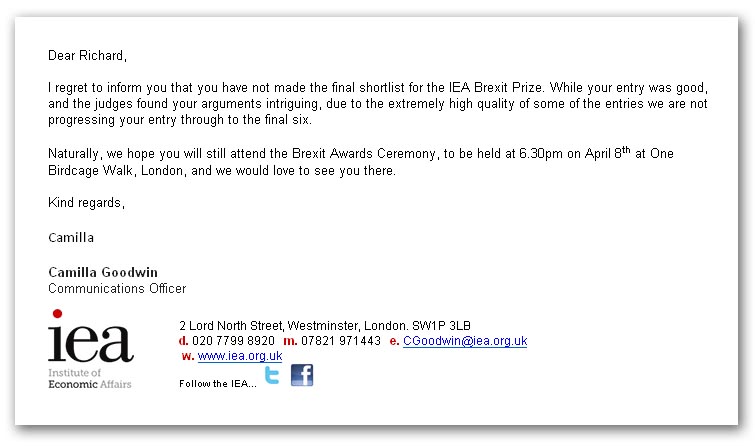
What compounds the disappointment though is that after many months of hard work the news was received by a rather terse email from a press person:

The words "good and intriguing" are rather patronising to say the least. "Intriguing" is clearly a euphemism for not what we were looking for. After months of hard work by Richard researching a very complex and important subject and producing an original thesis of "Flexcit" contestants deserve much better than a patronising, bland and standard email.

Despite that it's encouraging that we now have a very detailed, layered and practical document on how the UK can exit the EU, that in itself is progress.

Finally I would like to thank Richard for his enormously hard efforts since October, much of it unseen, in producing a very valuable and useful piece of work. One that needs to be re-read a few times to fully appreciate its scope.

Wednesday, 12 February 2014

Brexit: And In It Goes

Nearly four months after being shortlisted for the Brexit prize by the IEA - covering the actual process of withdrawing from the EU and the post-exit position of the UK globally - Richard North's submission has now gone in today in anticipation of tonight's midnight deadline.

With 17 papers shortlisted in the prize they will hopefully provide a quality and genuine debate on the best way to exit the anti-democratic monstrosity that we are members of - a debate that has been severely lacking in other, sometimes surprising, quarters.

With the submissions still anonymous and now under judges' consideration I'm reluctant to give away too many details publically (having read it) which may give an indication who wrote it and thus maybe affect the outcome.

Just to be shortlisted was an achievement in itself but given the massive prodigious, mostly unseen, efforts by Richard over the last months the submission should walk away with the prize on merit alone. It could have very easily been over 100,000 words - given the complexity of EU exit - way above the 20,000 word limit.

Despite the merits of Richard’s paper, the outcome of the prize is too difficult to call. Especially given that exit from the EU is primarily a political problem, and process, not an economic one – a point that encouragingly some of the judges appreciate. Yet to produce a paper that argues that the economic consequences must be neutral potentially goes against the economic bias of IEA as a whole, especially given the economic arguments of NExit endorsed by judge Roger Bootle.

The paradox is the IEA remit was on the basis that the referendum had already been won, but the “Norway option” is there largely to help win the referendum in the first place by negating the fear of exit on economic grounds.

Yet the Norway (EEA) and the Swiss current arrangements are essentially a fudge. The EEA has among other problems a veto - a 'temporary' solution that tried to reassure the Norwegians on the merits of entering the Single Market while really trying to "bounce" them into full membership of the EU.

The Swiss agreements have similar intent but with the recent referendum on immigration, the Swiss model of bilateral agreements is set to unravel - especially given the guillotine clause which exists between the EU and Switzerland. Both Switzerland and the EU consider the arrangement very unsatisfactory.

What then is clear is if the UK exit and adopt the Norway model, it can be only temporary. Yet the UK's exit will be of such magnitude, with the addition of regaining our position at the "top table" of international organisations (without the EU to represent us), the UK can as a result play an important role in re-ordering the European post-war settlement. Britain would have the ability to take an active role in shaping the European landscape. We need not resort ourselves to a passive role.

Thus the submission offers a very positive outlook for the UK's role in the world. One hopes it wins.

Sunday, 12 January 2014

EU's New Treaty - A Great Leap Forward

Christopher Booker writes in his Sunday Telegraph column today:
As our “Little England” politicians continue to squabble over David Cameron’s pie-in-the-sky talk about holding a referendum in 2017 on a new treaty relationship with the EU, the real puzzle is why no one in Britain is talking about the rapidly advancing plans of the EU establishment for another much more important treaty of their own, designed to take the EU a huge step further forward to becoming a fully fledged “Government of Europe”.
And to make the point for him, today we have in the same paper, Chirs Grayling arguing that "Britain needs a completely new relationship with the EU", Tory MPs demanding a veto on EU laws, then Iain Duncan Smith in the Times saying "he wants to change EU law over benefits and migrants, and the Guardian reporting that "President of European parliament says UK has 'no chance of curbing basic principle of free movement'".

No doubt this kind of nonsense about "repatriating powers" will intensify until May in anticipation of UKIP's predicted success in the Euro-elections at the cost of Tory votes.

Yet the real story of the 2014 elections won't be UKIP but instead it will be used as justification for a major treaty which has designs for the next great leap forward in EU integration. EU Commission President Barrosso has called for an EU-wide debate on proposals to deepen Economic and Monetary Union, and to create a legitimate political union. Conveniently 2014 is also the 100 year anniversary of the First World War which the EU will undoubtedly use as justification:
Barroso says next year will be the 100-year anniversary of the First World War, which affected Belgium greatly. The war, however, began in the Balkans – and Barroso believes this underlines the fact you cannot turn inwards and ignore the world around you.
And as with all things EU its desire for further integration is no big secret. The 300 page draft of the new treaty can be found here. Angela Merkel's first speech to Germany’s parliament when she was re-elected made clear the need for a new Treaty:
In the first speech of her third term, German Chancellor Angela Merkel urged European partners to tackle flaws in their currency union by ceding control over economic policy and making politically sensitive changes to the bloc's treaty.
"I know that pushing through treaty changes in the member states can be difficult, but if you want more Europe, you have to be prepared to develop it further. In a world that is constantly changing, we can't stand there and say that at some point we agreed the Lisbon Treaty and there's no need to change it again. This won't work."
With the release in October of the draft we are given a very clear picture of what this treaty might look like. A 300-page draft of the treaty by the Spinelli Group entitled “A Fundamental Law of the European Union” sets out in detail just how the EU can take another huge step towards political integration.

Interestingly at its core it revives former EU Commission’s President Jacques Delors's vision in 1990, when he proposed that the Commission should become the “executive”, the Council of Ministers the “Senate” and the Parliament, given new powers, elected by the people. A plan that was dismissed by Margaret Thatcher's famous “no, no, no” speech which triggered her downfall:


Within the draft are also proposals for much closer integration of foreign, defence and energy policies, more control by Brussels over national finances and budgets, particularly in the eurozone, more power to impose measures “to combat climate change”.

In short, this new treaty –  backed behind the scenes by Delors himself - is designed to complete the task which so humiliatingly fell short when that earlier planned EU “Constitution” was rejected by the voters of France and Holland in 2005, only to be smuggled in again three years later as the Treaty of Lisbon.

The draft even wants to reinstate the European anthem and the EU flag (page 19):
The Fundamental Law brings back the symbols of the Union (the flag and the anthem) which were jettisoned from the Treaty of Lisbon
So while our "Little Englander" media and politicians squabble about reforming little bits of the EU, the EU itself is concerned with getting on with major reforms that have complete different objectives and outcomes. Mr Cameron’s bluff on negotiating a “new settlement” for Britain is about to be called out.

Aside from the fact that a fundamental principle of the EU is powers once given up are never returned, even if they could be, as Richard North consistently notes, Cameron hasn’t got the faintest chance of meeting his 2017 deadline for a referendum anyway:
...if there are changes to the treaty, we have to go through four stages.

First, we have to secure a simple majority. That means that we need to find 14 member state governments who agree with us. We have not started that task and it looks as though we are not going to start it until after the election. Secondly, we have to get a consensus in the necessary convention. The last convention took 18 months. The third stage is that we have to get unanimity in the intergovernmental conference - Maastricht took a year - and the final stage is ratification.

Actually, the last (and only) convention process started with the Laeken declaration in December 2001 and effectively ended the start of the IGC in October 2003 – just two months short of the two years. The IGC then finished in June 2004 – the door-to-door treaty process taking two-and a half years.

Transpose that onto the current situation and assume that David Cameron gets re-elected in May 2015, that brings us to November 2017 on the same timescale. But then there has to be a referendum campaign, bringing us well into 2018.
The EU instead will be entirely focussed on their own, more important treaty, while Cameron dances about on the touchline waving his arms frantically trying to gain attention. Ignoring him the EU will get on playing their much more important game. The UK will be sidelined whether we like it or not.

And this process of sidelining the UK will be given official status under the new Treaty in the form of a new construct “Associate Membership” (page 284 - Protocol No 9 Associate Membership of the Union). Clearly this is offered as a solution for countries which cannot go along with the further drive to create “a country called Europe”, but which still want full trading access to their Single Market; countries like (obviously) the UK but also Ireland and Denmark and also for non-members Norway, Iceland, Switzerland and possibly even Turkey.

What is interesting is such flexibility in the past has always been resisted on the basis that it creates a dangerous precedent where other member states start asking for a change in terms and conditions such that the entire project comes crashing down. Thus the EU must now be very confident that it is now not possible for most member states to take the 'Associate’ option.

However the trade-off with the 'Associate’ option means limited participation with EU institutions and the deal itself can also be limited in duration, for example under Protocol No 9:
Article 1
The agreement will set out the terms, conditions, scope and limits of associate membership and the adjustments to the law of the Union which such association entails. The agreement may be of limited duration.
Article 3.1
The agreement shall specify in which of the Union’s policies and functions the Associate State is to participate, and the terms and conditions, financial and institutional, which shall apply to that participation.
Article 6
An associate membership agreement may be suspended, in whole or in part, in accordance with the procedures laid down in Article 133. 
EU membership with limited participation - a new twist on their favourite phrase "government by fax". Thus what it offers Cameron, and indeed Clegg and Miliband is poisonous; a chance to remain part of the EU – which they say they never wish to leave – but only on its outer ring. We would in effect just be a second-class member.

Cameron, and the rest of our political class who are equally adamant that they could not allow Britain to leave the EU, would be reduced to campaigning in a referendum arguing that Britain should become just a second-class member of the EU, excluded from its central counsels. They will be horribly caught out.

Such a confrontation was always inevitable, the UK's 'sort of in, sort of out' position - topped off with lies and deception - was always incompatible with EU membership when it continued to do what it does best - politically integrate. For many decades the UK establishment has embraced the idea of European economic and political co-operation, but has never been able to persuade the UK people about the idea of political integration.

Instead of indulging in empty political gestures and wishful thinking, we are going to be brought sharply down to earth - to decide whether we really wish to become second-class citizens of the EU, or to find a wholly different way forward.

Whether Cameron likes it or not the EU is going to take the next big leap foward in integration with a new Treaty and leave us behind, effectively placing us firmly in the lounge marked "departure." Perhaps we might then have a proper grown-up discussion over the best way forward.

Wednesday, 8 January 2014

A United States of Europe


Above is the cover sheet of a pamphlet from 1923 arguing for political union within Europe written (ironically) by an English civil servant called Sir Arthur Salter. As is readily obvious by the title it proposed a plan of a “United States of Europe” - a plan which Jean Monnet was able to execute into what is now known as the European Union.

Political union has always been its goal and as the copious quotes on the right side of my blog make very clear the EU has never hidden this from view. Thus one reads with a wry smile Bruno Waterfield's article - 90 years later - in the Telegragh which states:
Voters must decide for or against a United States of Europe during EU elections this spring, says vice president of the European Commission


The article continues to quote Viviane Reding:
[she] has called for "a true political union" to be put on the agenda for EU elections this spring.
"We need to build a United States of Europe with the Commission as government and two chambers – the European Parliament and a "Senate" of Member States," she said last night.

"This debate is moving into the decisive phase now. In a little more than four months' time, citizens across Europe will be able to choose the Europe they want to live in," she said.
"There is a lot at stake. The outcome of these elections will shape Europe for the years to come. That is why voting at these elections is crucial.
While it's easy to mock Viviane Reding's comments, and they are not new, they make sense when we consider that a new EU treaty is on its way, a point Waterfield fails to make.

As Richard North has consistently noted the signs are very much that the next big leap for integration has already been started begining with the federalist Spinelli Group and German think-tank Bertelsmann Stiftung publishing a draft treaty called "A Fundamental Law of the European Union". This is in preparation for a treaty Convention, in line with Article 48 of Lisbon, which is likely to start in the spring of 2015. If so this will blow Cameron's EU "renegotiation" strategy for the UK General Election out of the water.

Spring 2015 allows for the Euro elections process to be completed - after the elections the 2014 European Parliament will have to “elect” the next Commission President. and for the first time, the main European parties are planning to propose candidates for the job.

Here then we see Reding's comments in context. Reding and by extension the EU, are trying to use 2014 to give legitimacy to the next big leap forward in integration by announcing the elections as a chance for citizens to express "a Europe we want to live in". This is democracy EU style.

Our politicians, and certainly our media, have not yet woken to the prospect of the impending EU Treaty, though I guess when they eventually do they will trot out the old line again that we need a "frank, honest and open discussion that we've never really had".

Saturday, 7 December 2013

An Internal Dilemma?

For research purposes I'm currently having a read through Hansard regarding the passing of the Lisbon Treaty. As a result I came across this question by Labour MP Gisela Stuart during the debate:
The right hon. Gentleman is a genuinely committed European, and I believe that he would like to take the people with him in his vision of Europe. Does he not think that a referendum would provide a much better opportunity to extol the benefits of, and to make the case for, the European Union, rather than blackmailing people by simply asking, "In or out?"?
Malcolm Bruce Lib Dem MP responded: 
No. Perhaps I should not be surprised by the way in which the hon. Lady’s relationship with, and attitude to, Europe has changed because of her experience of the negotiating process. 
This refers to a pamphlet by Gisela Stuart titled; The Making Of Europe’s Constitution which was heavily critical of the process involved drafting the original EU Constitution - which then became the Lisbon Treaty.

It’s worth reading if only for the chapter on page 23 called, Consensus? What Consensus? The architect of the original draft Valéry Giscard d'Estaing told Alojs Peterle, ’the invitee’ from Slovenia, that “his vote did not count” when he had a casting vote that would affect the consensus.

Malcolm Bruce continues (my emphasis):
I would have thought, however, that she would understand that if the United Kingdom decided now, in the present circumstances, to hold a referendum on the Lisbon treaty, and if we failed to ratify the treaty as a result, we would be faced with an internal dilemma, in that two thirds of Parliament would have voted one way, while the people would have voted the other way. That would be a domestic problem, as the right hon. and learned Member for Rushcliffe has articulated.
In a properly functioning democracy of course it would not be 'an internal dilemma'; the people have voted no and that is it. Not to Mr Bruce though, the people voting differently to MPs in Parliament - who are supposed to represent those very people - presents a problem. Not only that he continues:
Also, we would certainly have created a degree of resentment among our European colleagues for having held up a difficult process at a crucial moment. I think that the hon. Lady knows perfectly well that those would be the consequences of such a decision.
Oh dear what a shame we upset our European colleagues. We can't have democracy getting in the way of that. In light of this 'dilemma' he of course knows best:
I am articulating my party’s view, which is that after 35 years, it is appropriate to say to people, “The European Union has been modified by treaties. This is actually a good reforming treaty, which will leave it in better shape than most of the previous ones—certainly Nice and Amsterdam—did,” and to ask them, “Will you vote for Britain to be in Europe, but as a package, on the understanding that that is with the Lisbon treaty?” The Lisbon treaty is not optional. We cannot be in Europe and not ratify the Lisbon treaty.
Not much illustrates our broken democracy more than this arrogant shower.

Friday, 8 November 2013

The "Norway Option"


Above is a trailer for the video of the Norway Option, which can be purchased here. I will be attending a Bruges Group meeting on Saturday (£20 on the door), along with Witterings from Witney, which has a discussion on the best way to exit the EU. Speakers include Richard North, Christopher Booker, Mary Ellen Synon, Professor Tim Congdon, Kieran Bailey (the 15 year old who's made it onto the shortlist for the Brexit prize).

Given the fundamental disagreements between Tim Congdon and Richard North on how to exit, it will more than likely prove to be a lively affair.

Wednesday, 30 October 2013

Shortlisted In The Brexit Competition


As described in the above video showing a BBC Daily Politics interview with Lord Lawson back in July this year, the Institute for Economic Affairs launched a competition for submissions on the best way to exit the EU. As an encouragement the competition came with a cash prize of 100,000 euros (rather ironically) for the best submission:
Against [the background of an 'out' vote] competitors are invited to compose a Blueprint for Britain outside the EU, covering the process of withdrawal from the EU and the post-exit repositioning of the UK in the global trading and governance systems,
Naturally, when looking at the list of judges where the concentration of their expertise was largely economically based, there was some reluctance to submit a paper when in reality the primary reason for EU exit is political. The founding father Jean Monnet always made it clear the EU was a political project. Ted Heath described it as a "common market" knowing full well it was a Trojan horse to facilitate political union. The Euro for example is a political project disguised as an economic one - with disastrous consequences.

In this context the primary objective of any withdrawal by the UK is to stop and then reverse the progress of political integration between the UK and the rest of the EU member states. This means that a successful "out" vote will be more a political event rather than an economic one, albeit one with considerable economic consequences.

Thus a twin-track approach has to be adopted. Not only to win a referendum, to negate the fear, lies and "cling onto nurse" tactics which have been used so effectively by, for example, the dishonest Europhile Nick Clegg - but it's also an acknowledgment that political withdrawal will be much quicker than an economic one. Should the UK public vote for a withdrawal from the EU they will be understandably impatient for a relatively rapid exit.

In this spirit as not to delay attainment of political objectives the economic question should be "parked". The primary aim is to deal with political issues while clearing the way for a favourable economic settlement in the future, which given the enormous and fiendish complexities of international economic treaties will take time.

The best way of achieving a reasonably quick political exit while acknowledging the economic difficulties is the Norway option - a ready made solution that allows the UK to leave the EU while remaining within the Single Market. It means no immediate disruption to trade but allows us to exit politically.

This was the fundamental premise of Richard North's submission, written with some help from fellow readers and bloggers. The publication of the shortlist of the 20 best initial submissions to the IEA are made today and Richard North's "Norway option" has been shortlisted. To be shortlisted to just 20 out of 149 entries is an achievement indeed, and an endorsment that the "Norway option" arguments is seen to have merit. Particularly important given our Prime Minister argues against it using a lie.

As I understand it UKIP did not submit an official paper (though some members may have done so independently). It's not unreasonable to assume that this would be their meat and drink; leaving the EU is their raison d'etre. But apparently not. The lack of a credible exit plan from UKIP is a frustration I’ve echoed before.

Revealingly it takes a few unpaid bloggers to be on the shortlist, while UKIP doesn't bother. Being on the shortlist now means writing a full submission of between 10,000 and 20,000 words by 10th February 2014 in order to win the IEA prize. More than anything winning means having the possibility of a document - an EU exit paper - that has "prestige", a document that would be taken seriously by virture of its IEA status.

Any contributions by readers to the final full submission are very welcome here and/or on the Eureferendum forum.

Sunday, 29 September 2013

Europe Without Britain


Europe Without Britain (Assessing the Impact on the EU of a British Withdrawal) is the title of a paper by Tim Oliver from the German Institute for International & Security affairs. A paper very kindly brought to my attention by Sean O'Hare in the comments of my previous blog piece.

Undoubtedly the irony will not be lost that the Germans appear to have considered the wider implications of the UK leaving more than the UK itself, despite us being by some distance the most Eurosceptic of all EU nations, a feeling promoted often by ill-disguised German-phobia. As yet we still haven't seen an official 'EU-exit' paper by the biggest Eurosceptic party in the UK.

Instead, as Mark B observes on the same blog piece, when it comes to all matters EU "[the UK's] political class have a tendency to talk to the electorate as if we were like children. The "let's give them one last chance", sounds like a mother warning their wayward child before punishment".

Onto the paper itself, regular readers will recognise many of the themes that run through the paper - themes which have been rehearsed many times on numerous Eurosceptic blogs - only in this case it has been fleshed out to 30 pages and largely concentrates on the impact on the EU of a UK exit.

What the paper acknowledges, far more than our own House of Commons research paper, are the problems the EU itself would face were the UK to leave. It's tempting to take an indifferent view to this, but the fact remains that it will still exist on our doorstop, and we would still have to trade and deal with it. Further exacerbating the EU's problems, and consequently the Eurozone, is not in our own self-interest given that circa 40% of our exports depend on it.

Tim Oliver specifically highlights three problems for the EU on UK exit. The first of these is that it will be unprecedented and until now "something of a taboo". As the report notes:
The withdrawals of Greenland in 1985 and Algeria in 1962 had prompted concerns they set precedents for the withdrawal of a member state, but as overseas territories they provided little by way of a guide to how an actual member state might withdraw.
Not only would the EU be concerned with future relations with the UK but far more pressing for itself and its own survival are internal problems and their resolution. The necessity to prop up a fragile Eurozone would be paramount but also, as the report notes, negotiations would need to take place within the EU to amend its own institutions, voting allocations, and quotas. These are issues which are rarely settled easily. Not least the EU budget which would need to be rebalanced, requiring inevitably more contributions from France and Germany undoubtedly to the dissatisfaction of their taxpayers.

There would also need to be decisions on changes to the system of QMV, so as to reflect the disappearance of the UK with its 29 votes. In the ensuing negotiations, all the nation states will be mindful of the numerous scenarios for how this could change the balance of power within the Council. Undoubtedly this would cause conflict and protracted negotiations between smaller states versus large states, northern countries versus southern ones, protectionist versus more liberal and so on. Given the enormity of the consequences and ramifications both economically and politically of the UK leaving and the uncertainty and vagueness of Article 50 one wonders whether it would better for a smaller country to leave first, ahead of the UK, as a kind of dry run.

The UK's 73 seats in the European Parliament would need to be redistributed. The report notes that the process of allocating seats has always been an unclear one, subject as it is to numerous formulas, solutions and political horse-trading. Depending on the date of a UK withdrawal arrangements may need to be put in place for British MEPs to leave the Parliament before the elections due in 2019.

Other institutional changes would mean the loss of an EU Commissioner, the loss of UK judges from the ECJ. Then the question would be whether English would remain the working language of the EU, as a UK exit would leave only Ireland and Malta remaining as the only countries where English is the official language. Given France's track record on that issue this would be in serious doubt - putting the Eurozone at further disadvantage in trading relations with the rest of the world. All of these problems leave us in no doubt that a new EU treaty would be required as changes have to be made to the founding treaties.

The second issue the EU faces is the lost of one of its biggest members. A country that provides an important link to the United States, a country that holds a unique position in the world and one that gives the EU extra credibility, as a member. The EU is bound to lose self-confidence, feel more isolated and probably move further towards protectionism as a result. It would also alter the balance of power within the EU...
A British withdrawal raises a whole host of possibilities about changes to the balance of power and leadership of the EU. A withdrawal could boost the Franco-German axis. This, however, ignores that both Paris and Berlin have often used London to balance the other, something London has often gone along with in the hope of turning the axis into a triangle. Even with other states such as Poland or Italy filling the UK’s place, we cannot overlook how the Franco-German axis has struggled to provide leadership thanks to the widening of the EU. The Franco-German axis and the wider EU have also struggled to adapt to Germany’s increasingly dominant position. The disappearance of a large state such as the UK, one often willing to use its weight to challenge EU thinking, could further embolden Germany’s position and agenda.
The final issue is how the EU deals with the UK after exit....
Despite what British Eurosceptics and Britain’s critics in the rest of the EU might wish, Britain and the EU will remain deeply interconnected. Indeed, the title of this paper itself highlights a common way of thinking that needs to be qualified: a withdrawal could never mean the end of Britain in Europe, only of the United Kingdom’s membership of the European Union. A withdrawal itself may take several years to action, and there exists the possibility of formal relations continuing afterwards in some way
Both the EU and UK would need to come to terms with the ongoing relevance each would have for the other. For the EU, the UK would remain a European power if not an EU-power. A European power that would remain part of the Commonwealth, the UN and NATO. If the UK leaves it sets a precendent, clearing the way for other members to do so thus unravelling quickly the project itself.

The paper is by no means comprehensive, issues such as; free movement of people, civil aviation, overland transport, agriculture, technical barriers to trade, public procurement, scientific research, Schengen, fraud, education, statistics, environment, media, taxation of savings, pensions, Europol and Eurojus are not discussed in detail.

But what it does illustrate is that negotiations of our exit will be just as taxing for the EU as it will for the UK – a point made via a German paper.

Meanwhile in the UK we have to suffer the superficial nonsense of Cameron at a Tory party conference.