Showing posts with label Harrogate. Show all posts

Friday, 20 February 2015

The Decline Of The Westminster System: The Fusion Of Powers

 
As we edge closer to the general election in May, it is rather inevitable that the polling would show a trend in decline regarding UKIP's support, which has been consistently argued by EUReferendum:
Talk of a major Ukip "revolution" at the general election looks to have been seriously overblown, says Politics.co.uk, a view based on new constituency polling released by Lord Ashcroft.

The data show that Ukip is not on course to win any of its key target seats currently held by the Conservatives. Most worrying for the party, we are told, in the poll of Boston and Skegness - where Ukip won its largest majority in last year's council elections – it has been pushed back into second place.
There are a myriad of reasons for a decline in UKIP's poll rating. As has been well documented here and elsewhere, such as Complete Bastard, is that UKIP's problems have in the main been self inflicted. There is a fundamental lack of coherence, a geographical divide in message - depending on Labour areas or Tory ones, no fully worked out policies, and u-turns in under 24 hours at the whim of the party's leader.

So-called policies which do manage to remain intact, on its website, are almost identical to the ones contained within the 2010 manifesto which Farage infamously dismissed as drivel.

Thus, with the decline in UKIP support, we can note with wry amusement that UKIP will be having their Spring Conference in Margate - where apparently we will see the launch of UKIP's manifesto. For those who may have not visited Margate recently, it would be described by estate agents euphemistically as 'tired'. Many of its attractions, like the Winter Gardens, are in need of urgent repair.

However we also consider that the UKIP has an inherent problem, which is not entirely its fault, and that is the failings of the "Westminster System" and First Past The Post. 'Winning' the Euro elections is one thing, but with the business end of a Parliament coming to its end, and a looming election, the electorate have real choices to make. Ultimately they have to make a decision on who they would like as Prime Minister. UKIP is going to face a squeeze in an electoral process that is a Presidential System by proxy.

As Tory Michael Heseltine noted on BBC's Question Time last night (04:30 mins in):
"There's only one choice Cameron and Tories and economic recovery or Miliband and Balls the people who caused the economic problems in the first place."
The Westminster System is no longer about electing MPs but electing Prime Ministers by proxy. Further confirmation comes with the forthcoming leaders' debates which we have criticised here.

Interestingly we can also look back to the 19th Century to make our case with Chartism. Chartism: A New History by Malcolm Chase is a fascinating account of a British mass movement for democratic rights in the 19th Century.

Chartism was one of the very rare moments in British history where it is legitimate to speculate how close the country came to revolution. And what is interesting is Chase's attention to detail which allows the story to come alive for those in the 21st Century. One intriguing passage was this regarding the presentation of the first petition:
The Petition was finally presented to the House of Commons on Friday 14 June 1839. Few Chartists had expected it to make a difference to parliamentary attitudes and in this respect 14 June did not disappoint. No indication was given whether MPs would formally debate it, and when Attwood and Fielden...rolled the giant [petition] into the Commons chamber it was greeted with laughter.
And Chase then describes the attempts to present the massive second petition in 1842:
[It was arranged] to bring 'the Chartist leviathan petition' direct to the Commons chamber while it was in session. But...Parliament's officials had realised the physical problem this posed. The Petition became jammed tight in the Members' Entrance. Attempts were made to dismantle...part of the door frame; but eventually the Petition had to be disassembled and taken into pieces into the Commons. Heaped up on the floor of the chamber, it dwarfed the clerks' table on which, technically, it was supposed to be placed.
One senses here the familiar futility of lobbying a system that would not listen. But those with a keen eye will notice that the Chartists' leviathan petitions, in 1839 and 1842, were delivered to Parliament. Not to Government, not to Number 10, but to Parliament - to representatives.

In stark contrast we now see petitions presented to the Prime Minister (government), and with the rise of e-petitions such process is now made official:
Alone this little detail illustrates that the people now, perhaps unconsciously, have appreciated how the power has been consolidated and fused between the government and Parliament. Bypass the monkeys - the middle men - and go straight for the organ grinder. And it's with great irony, that Chartists tried to petition representatives when they had no vote and now in the age of universal suffrage we no longer bother.

Thus if we want an effective 'people's army' and a 'revolution' we need to fundamentally change our failed parliamentary system. Demand #3 of the Harrogate Agenda is as good as place to start as any:
3. Separation of powers:
The executive shall be separated from the legislature. To that effect, prime ministers shall be elected by popular vote; they shall appoint their own ministers, with the approval of parliament, to assist in the exercise of such powers as may be granted to them by the sovereign people of England, Wales, Scotland and Northern Ireland; no prime ministers or their ministers shall be members of parliament or any legislative assembly;

Wednesday, 14 January 2015

Leaders' Debates: UK Democracy's Failings In Plain Sight

Within our 'representative democracy' expressed by so-called Parliamentary sovereignty the idea of Prime Minister debates, first instigated in 2010, is absurd if not downright objectionable.

The electorate in a General Election do not vote for the PM, instead they vote for their local MP which helps form a Parliament from which a Prime Minster is chosen.

One often consistent criticism of Gordon Brown's tenure up until the 2010 election was that he was 'not elected'. But of course he was elected - by the constituents of Kirkcaldy and by members of his own party - it was that he simply didn't have an electoral mandate (as neither did Major for example in 1990). Brown's position was less a reflection of the failings of himself and more a reflection of the failings of current Parliamentary system.

More seriously the lack of separation of powers represents a system where MPs become hopelessly compromised - by default. After being elected for 5 years their main objective is to achieve a ministerial career rather than attempt to hold the government to account. They want to join the government not listen to their constituents; which one pays more...?

The constituents of Witney, Doncaster and Sheffield will know this best - their own MPs wear two contradictory hats, a situation that Witterings from Witney knows only too well.

And with this in mind we see Cameron and Miliband, among others, engage in unedifying comments regarding a leadership debate without so much as a by-your-leave to the rest of us:
Did you notice that the letter sent to David Cameron about disputed formats for the election TV debates was itself a delicate contribution to pariah politics? Though identical in contents, as Rowena Mason explains, the missives were dispatched separately by Ed Miliband, Nick Clegg and Nigel Farage. Ed and Nick did not sign the same letter as Nigel, oh dear no.
Thus it's acutely apparent that the entire idea of leadership debates is an admission by the establishment that Parliament is failing and that we, as an electorate, are now effectively voting for the executive - the government and the Prime Minister - by proxy.

This becomes even more (offensively) absurd when we consider that Nigel Farage, although leader of UKIP, is not currently an elected MP even though his party has two elected MPs and Farage himself is currently not on course to win South Thanet seat in May.

Thus more than ever the case becomes stronger that we need to directly elect our Prime Minister - and as a consequence separate out more formally the executive from Parliament. This idea is nothing new, it was proposed back in the 18th Century by Thomas Paine. Although born in England, via Common Sense, he was one of the fiercest critics of what he regarded as British tyranny.

The current, and rather childish standoffs over a Prime Ministerial leadership debate merely confirm that such reform is now very long overdue.

Wednesday, 3 December 2014

Stamp Duty

 
I've made my feelings clear before, in rather robust terms, on the complete lunacy of stamp duty on the housing market. Owen Paterson with the launch of his think-tank, UK2020 a month ago acknowledged the problems inherent with it

Stamp duty completely distorts the housing market by having absurd cliff hangers meaning an extra penny on a house price can cost thousands extra. Trying to sell a house, for example, which is worth just over £250,000 then becomes a nightmare. It means a jump in duty from 1% to 3%, which obviously becomes a deterrent to anyone attempting to try to sell or buy a house within a significant range of the £250,000 bracket. At the very least if we are to retain the tax it has to be altered.

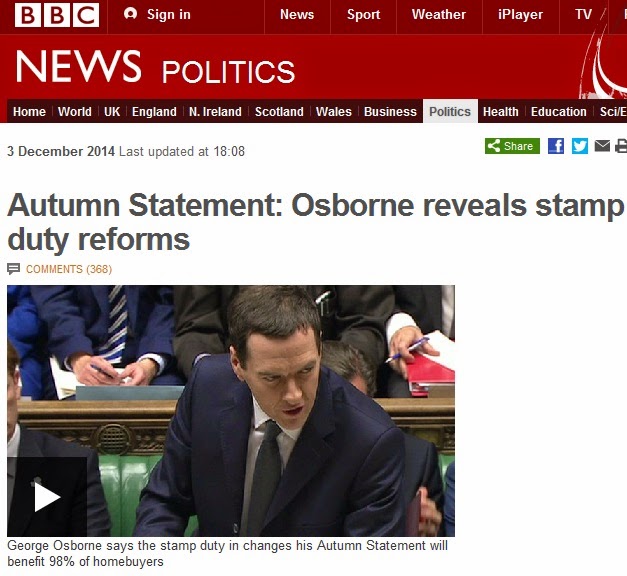
It is welcome therefore that in the Autumn statement that Osborne is attempting to iron out the stamp duty 'jumps'
The chancellor said that from midnight the current system, where the amount owed jumps at certain price levels, would be replaced by a graduated rate, working in a similar way to income tax.
Clearly with the 2015 election in mind Osbourne's headline plan has a multitude of benefits; mainly appealing to "middle England" who are attempting to successfully sell their house, the headline of a tax cut and an attempt to outflank Labour on proposals of the mansion tax:
BBC political editor Nick Robinson said the headline announcements were "real electioneering" by the Conservative chancellor, saying the stamp duty proposals were the Tories' "own version of the mansion tax" proposed by Labour and the Lib Dems.
Thus we can see, along with Article 48 on immigration, Conservative policy is beginning to take shape six months before an election. Policy not aspiration. Contrast this with Ukip whose 'non-existent' policies are in a mess, and unlike the Iron Lady whom Farage alleges he admires, he is for turning, often, and with embarrassing consequences.

Whatever we think of either party, what is clear is with the steady rolling out of policy Tory candidates and PPCs will be prepared well in advance, particularly in hustings. However UKIP PPCs will have a manifesto dumped on them just weeks before and any policies contained within liable to be changed on the whim of its leader. We are thus seeing a repeat of what's gone on many times before. Its grassroot support deserves much better.

That aside we also see the cynicism of the Tories. Osborne could not have been unaware that stamp duty was fundamentally broken, he's been informed before. Thus it is very interesting that he attempts to address the issue particularly just before an election. He's allowed a broken system, and all the difficulties it entails for the rest of us, to continue right until an impending election when he makes the necessary amendments purely for political purposes.

This is of course further evidence that the only mechanism which concentrates politicians' minds is the threat of being removed from office before an impending election. Thus the current representative system of being "lied to on Thursday and ignored on Friday for another five years" does not work. Above all else we need another way.

Monday, 3 November 2014

"Let Them Eat Cake"

If ever we needed further proof that the rot in UK politics is not necessarily due to our membership of the EU but instead one of a domestic making, Denis MacShane's tweet (above) regarding expenses and MPs' cynically shredding documents is it.

Openingly mocking the electorate in this way, I would suggest, is not entirely wise...he might find ultimately that the consequences are far more unfortunate than a mere jail sentence...

Tuesday, 28 October 2014

Total Recall

One possible positive that may be garnered out of the debate yesterday on the Recall of MPs Bill is the fact that the debate is even happening at all is tacit acknowledgment within the Westminster that something has gone wrong with the system.

But it was of no surprise that Conservative MP Zac Goldsmith's proposals, which would have excluded Parliament's standards committee from any role in determining whether errant MPs should face re-election, was defeated - it is entirely within character that MPs would be somewhat reluctant to support reducing their powers with enthusiasm. It therefore was of some amusement the naive astonishment shown in some quarters on social media at MPs unwilling to give up powers.

All of this though misses the point. The debate regarding the recall of MPs is Westminster talking to itself - the proposal nothing more than a tinkering around the edges while in effect maintaining the status quo. Very much a politician's solution then...

Unwittingly Zac Goldsmith betrays this view in his arguments in favour of his proposals by trying to persuade MPs and Ministers that they have nothing to fear from recall decided by the people because it would very rarely be used:
The third concern relates to the fear that Members would face endless recall attempts, amounting almost to a form of harassment, an issue raised several times in last week’s debate. I see no need for a limit, as the experience of recall around the world shows that its use is extremely rare and that it is used only in extreme circumstances. In 100 years of recall in the United States, where there are virtually no financial controls or controls on broadcasters and so on, it has happened only 20 times. There have been 40 recall referendums...
This argument has the backing of Douglas Carswell:
Far from leading to a flood of vexatious attempts to remove sitting MPs, this second stage makes it almost impossible to oust a sitting MP on partisan grounds. Note how few recall attempts have ever been successful in California. 
In other words, vote for this measure because it won't make any difference at all. It's a ... er ... curious argument to make for a democratic device to say the least.

It's safe to assume that the great expenses scandal of 2009/10 is a cloud hanging over the recall debate, with examples such as Labour MP Margaret Moran going into hiding leaving her constituents unrepresented and they having no means to force a by-election.

Yet it is with some irony that the expenses scandal actually show up the ineffectiveness recall would have. While there was a lot of public anger, further provoked by MPs’ attempts to prevent disclosure under Freedom of Information, voters did not punish them electorally in 2010.

Many MPs (and over 50% sought re-election) who were embroiled in the financial scandal were still re-elected in the 2010 election. Take Alistair Darling for example, who abused taxpayer's money by 'flipping' his two houses four times was re-elected in 2010 with an increased majority.

As this report from 2011 finds, titled "Electoral Accountability and the UK Parliamentary Expenses Scandal: Did Voters Punish Corrupt MPs?" the expenses scandal came low down voters' priorities. This chimes with my own experience as a PPC in 2010 when the subject was never raised once on the doorstep nor in hustings.

The report finds instead that there was only a modest 1.5% voting impact on MPs implicated:
We find that implicated MPs received a vote share about 1.5 percentage points lower than non-implicated MPs (after controlling for incumbency, region, and previous constituency results). Intriguingly, we do not nd an association between vote share and either the amount the MP claimed in expenses or the amount an MP was required to repay...
The findings may not be so surprising when we consider that the representative ballot is a blunt instrument to deal with the complexities of voters' concerns such as the economy, immigration and of course partisan competition. Thus the report comes to an interesting conclusion:
The degree to which voters punished individual MPs for expenses abuses (a drop in vote share of about 1.5% on average) is modest in comparison to voters' responses to corruption in the US and other settings, but the lower magnitude seems reasonable given the fact that most British MPs have few individual powers and British voters have no other opportunity to express a party preference at the national level.
The findings thus illustrate the fact that the degree to which electoral accountability can constrain individual politicians depends on political institutions including the electoral system, separation of powers, and legislative organization.
A better example of why recall won't work would be hard to find and further demonstration that something far more radical is need to grap MPs by their goolies - The Harrogate Agenda.

Saturday, 17 May 2014

"Be Thankful I Don't Take It All"

"Prime Minister, the Treasury does not work out what it needs and then think how to raise the money. It pitches for as much as it can get away with and then thinks how to spend it." 
Sir Humphrey, Yes Prime Minister.
That the government views the private purse as a magic money tree is an old age problem - one aptly illustrated by the rather bitter but not inaccurate Beatles' song, Taxman.

And it's a problem that becomes ever acute when under planned new measures in the latest budget. HMRC will have an automatic power to take money from a bank account when the holder has failed to act on four formal warnings requiring payment. Currently such actions can only be done with the permission of a magistrate or judge.

TBF senior still has an ongoing complaint with his local MP on this matter. With this in mind we note that the Telegraph today on its front page has another example of HMRC mistakes that expose deep flaws behind this proposal:
The number of people being investigated by the taxman has doubled in one year, raising concerns that people who have made innocent mistakes are being targeted by the Government.

HM Revenue & Customs made inquiries about the tax affairs of 237,215 people last year, compared with about 119,000 in 2011-12, figures obtained by The Daily Telegraph show.

The number of self-employed people investigated has quadrupled in that time while annual prosecutions have risen sevenfold in three years.
The figures are evidence of the attempts HMRC is taking to minimise the estimated £35 billion of tax lost every year.

Experts have warned that people who have made simple errors when filling out self-assessment tax returns are “an easy target” for HMRC.
Not unsurprisingly HMRC will go after the "low hanging fruit". They are more unlikely to resist and lack the means of fighting back successfully:
Mark Giddens, a partner at the accountancy firm UHY Hacker Young, said HMRC was focused on collecting tax from “soft targets” such as “teachers, doctors..." These taxpayers were more likely to settle without dispute, he said.
As Bill Cosby noted "the government comes for the regular people first".

Other mistakes are not uncommon and HMRC even loses our data. Naturally despite overwhelming objections, we still get the "reassuring" dulcet tones of the Treasury on transmit only:
"Although the vast majority do this, there is still a minority that chooses not to pay, despite being able. The proposed powers will give HMRC another tool to collect tax debt owed. The current consultation includes a range of safeguards to ensure the power is tightly targeted.”
"A range of safeguards". Not that would amount to a tin of beans of course. Who decides how to implement the safeguards? Well HMRC... However those in government tend to enthusiastically support such measures as they rarely experience the downsides of their actions because they have the money and the means to immune themselves from the consequences at the coalface that the rest of us have to endure.

And as the experiences of Complete Bastard fighting with South Gloucestershire Council over council tax very clearly shows not even the law is a defence - especially when it consists of willful corruption by the Police, Councils and Bailiffs in the cause of forcing people to hand over money which the state believes is theirs regardless. He quite rightly notes in conclusion:
Put simply, this is a government at war with its people.
Of course we as a people can rebel...and demand a better way of running our own country.

Monday, 28 April 2014

The Budget And HMRC (2)

Following on from TBF senior's complaint to his MP regarding the proposals in the budget of giving HMRC the ability to take money directly from our bank accounts in the event of a tax dispute, he has had a reply from his MP Andrew Jones and from David Gauke - the current Exchequer Secretary to the Treasury.

Unsurprisingly the responses have not been reassuring. Andrew Jones' letter can be found below (click to enlarge all images throughout):

Andrew Jones acknowledges that the response from the Treasury does not address TBF senior's original concerns; "I recognise that you have made other points which may not be covered by Mr Gauke’s reply". However he reassures us that we can rest in comfort that he does “meet regularly with the Treasury Ministers and will ensure they are aware of the further comments you have made”. That's ok then...


Mr Gauke's response is quite frankly disturbing. What is obvious from the response is that the Tories believe that the money "is the government's" - we have to prove otherwise. And we have to prove it with very much lower funds backing us should we have a dispute.

Never mind that tax avoidance is perfectly legal, and in large part a consequence of the 'wonderful' Single Market. Never mind that the lower limit of £1,000 of tax owed is a limit which is miniscule – thus it is clearly not a measure that is aimed at those deliberately evading large amounts of tax but normal people and small businesses.

But as a 'solution' we instead get confirmation that the Tories are attempting to turn the entire tax system on its head - "we're guilty unless we can prove otherwise"
Anyone who believes that their tax avoidance scheme works will still be able to pursue their claim in the courts. And, if they win, HMRC will repay the tax with interest. However, HMRC’s success in avoidance litigation shows that only a small minority of avoidance schemes are upheld in the courts. This means that it is fair that tax should sit with the Exchequer rather than the taxpayer during a dispute into tax avoidance.
Gauke says: "it is fair...". Who says it's fair? Certainty not us the taxpayer. Has Gauke ever attempted to fight HMRC as a small business owner...? I guess not. And of course HMRC never makes mistakes.

Needless to say TBF senior is not letting this go - belligerent persistence runs in the family.

Saturday, 29 March 2014

The Budget And HMRC

With all the silliness on and immediately after 19th March surrounding the recent Budget and measures regarding Bingo and Beer duty it was tempting to ignore it - very much like Parliament will largely do contrary to their primary duty of scrutinising it.

However one particular measure – tucked away – demonstrated more than anything the absolute need for the Harrogate Demands:
Buried deep in the Budget document, there's a pretty significant HMRC power grab.

If officials decide you owe them money, they now have the ability to take it directly out your bank account. No insolvency proceedings, asset freezes or debt collection agencies. Just the government taking out whatever it thinks it's owed.
Anyone who has dealt with HMRC as part of a SME will read that and quake in their boots. With this in mind I post a copy of an email sent by TBF senior (an independent financial advisor of many decades) to his local MP in response - it articulates many of the deep concerns and frustrations regarding this measure:
The Chancellor’s recent Budget introduced radical pension reforms, a welcome help for savers and encouragement for businesses.  George Osborne continued his theme of ensuring that everyone pays their fair share of taxes.  It's one of the small proposals under the “Debt Recovery” section of the Budget that gives me serious concern.
It is proposed that new powers are given to HMRC so that they are able to access Bank Accounts of people who, allegedly, refuse to pay their taxes.  On the face of it this seems reasonable as people should pay their fair share of tax but this power is a fundamental change in the principle of British Justice.  In the UK, the courts decide the law and who is guilty.  If this power is passed to HMRC then they decide the tax that is due, determine that the person has consistently refused to pay and will then be given the power to raid their Bank Account.  In other words HMRC becomes the Judge, Jury and Executioner.
We have been told that there will be safeguards and this new power will only be used where HMRC have tried to contact the Tax Payer on a number of occasions and receive no response.  It appears that HMRC will decide whether or not these safeguards have been met and regrettably, their reputation for mistakes is well known.  There may be a simple and valid reason why a person has not responded such as they are in Hospital, they have moved house, they may have a mild form of Dementia or indeed HMRC may have the wrong records.
The lower limit of £1,000 of tax owed is miniscule for this draconian measure.  It will affect somebody who may have just had a company car, a change in respect of Child Credit or purely a miscalculation by HMRC in previous tax years.  This is not a measure that is aimed at the person who is deliberately evading large amounts of tax, it is targeting normal people and small businesses.
We are told that HMRC will leave a minimum of £5,000 across Bank Accounts and if this is also going to apply to small businesses, this could be purely the amount that is needed to pay their staff at the end of the month.
My understanding is that the Enterprise Act 2002 abolished preferential status for Crown debts from 15 September 2003.  This proposed measure could circumvent this by allowing HMRC to recover their debt in preference to the other Creditors by taking taxes from the individual’s account prior to insolvency.
HMRC already have powers to recover unpaid debts.  Why are they not encouraged to use them rather than giving them further power?  We are told that Tax Authorities in other countries such as the US and France already have this power.  This is no reason whatsoever for us to follow suit.  After all we live in Britain, not France or the US.
If we give this power to HMRC then what next?  There are many people that do not pay their Council Tax and therefore shouldn’t Local Authorities be given the power to take this money from their Bank Accounts.  After all we all have to pay for people that don’t pay their Council Tax.   How about Motor Insurance Companies.  We all pay additional premiums for people that do not pay for car insurance, so should they be given the power to deduct car insurance premiums from our Bank Accounts.  I am sure that MP’s from all sides of the House would be up in arms if this was proposed.
We have seen powers introduced in the past for what appears to be the right reasons but is subsequently used for other purposes. For example the Regulation of Investigatory Powers Act 2000 being used to catch people putting out their wheelie bins too early!  It might well be that the current Government is bringing in these new powers with every good intention but there is no guarantee that future Governments may not decide to use this power to implement further draconian measures.
As one of your Constituents, I urge you to oppose this new measure.  We do not want to have to wait until there is a public outcry over people who have suffered under these draconian measures.  There will inevitably be an inquiry with the usual infuriating reply that “lessons will be learned”.  For once, let us learn from our history lessons.  It is with some irony that with the 800 anniversary of the signing of the Magna Carta due next year, George Osborne is proposing that we give HMRC the power to determine the tax that is due and deduct it direct from Tax Payers without any recourse to an independent Arbitrator; a very dangerous step.
Of course both of us are under no illusions that any objections will make any difference, especially given the sycophantic nature to Cameron of his local MP. Yet again it demonstrates how broken our so-called Parliamentary democracy has become - at the next election there will really be only two contestants: the political class and the people. Oh how we wish for Demand number 5:
5. No taxation or spending without consent: no tax, charge or levy shall be imposed, nor any public spending authorised, nor any sum borrowed by any national or local government except with the express approval the majority of the people, renewed annually on presentation of a budget which shall first have been approved by their respective legislatures;

Wednesday, 29 January 2014

Carswell Goes Native

On 17th April 2012 Douglas Carswell was interviewed by the BBC regarding his criticism of the government's decision to tax charitable donations. At around 01:19mins in Mr Carswell was asked the following question by a BBC presenter:
"But this is your Government, would you vote against it, if you had a chance?"
Carswell in reply says:
I point out that I'm not a member of this Government...I sit on the backbenches, I'm a member of the Legislature, my job is to hold this Government to account.
We are tempted to be stirred by such sentiments especially as Mr Carswell's commitment to reform and holding the government to account is so 'genuine' he co-wrote with Dan Hannan The Plan: Twelve months to renew Britain which proposed electoral reforms arguing:
I want the voters to have the ability to sack lazy, self-serving MPs by triggering by-elections. I want the people to help set the Commons agenda, and veto politicians and their endless folly. But I still think you need a legislature.
Once you’ve made the Commons properly accountable to the voter - and government properly answerable to the Commons – good luck to any MP who ignored what their local voters thought.
So an impression is made of a man committed not only to EU exit but also significant political reform. Yet fast forward on nearly 2 years (as we get ever nearer to an election) and what a difference. In an interview with the Spectator he has this to say in contrast:
“What is it we now want, guys? We’re going to face a reckoning with the electorate in just over a year’s time. We’re two points behind the Labour Party. We can do this – we really can do this. If we lack discipline, we’re going to have five or six appalling years in opposition to dwell on it”
The Spectator concludes as a result of the interview:
Here’s a sneak preview of what was supposed to be a debate about the wisdom of rebelling – but ended up being Carswell explaining why he believes his colleagues should now stop defying the government, and support the PM.
Thus it becomes clear that when faced with the prospect of the Conservative party losing the next election, Mr Carswell reverts back to type and becomes a loyal party member worried about losing his seat, losing power and the Tories not being in government. "Holding this Government to account" on behalf of his constituents - which he admits is his job - now becomes a 'luxury' he cannot afford. He complains of our "rotten political system" but then as his interview illustrates neatly he has become part of it.

I guess we shouldn't be too surprised, after all this was the same man who stated in 2012 (my emphasis):
One of the reasons I backed David Cameron to be party leader early on in his leadership campaign was because I wanted to see a different kind of Conservatism. I still do – and I’d vote for him to deliver it if there was a leadership contest tomorrow.
The same man who signed a letter proposing for a national veto on EU laws despite that such an idea is a complete non-starter, the same man Witterings from Witney identified as a hypocrite in 2011 and the same man in the Spectator's podcast (6 mins in) who argues that Cameron will give us a referendum in 2017, despite that the timetable is completely impossible to meet.

So rather than being "a member of the Legislature, [whose] job is to hold this Government to account", Carswell merely demonstrates clearly the lack of separation of powers within Parliament, whereby loyalty to a party overrides proper scrutiny of a government.

We need the Six Demands:
3. Separation of powers: the executive shall be separated from the legislature. To that effect, prime ministers shall be elected by popular vote; they shall appoint their own ministers, with the approval of parliament, to assist in the exercise of such powers as may be granted to them by the sovereign people of England, Wales, Scotland and Northern Ireland; no prime ministers or their ministers shall be members of parliament or any legislative assembly.

Sunday, 15 December 2013

Thursday, 28 November 2013

PMQS (2)

Following on from my post yesterday, regarding the lack of relevance of PMQs my point is wonderfully illustrated by the picture above showing MP Michael Fabricant donning what the Telegraph calls “a magnificent moustache” during yesterday's session.

Despite long ceasing to function as such, PMQs is supposed to act as a check on the executive by MPs, Fabricant's actions couldn't more clearly show the function's absence and in addition demonstrate the contempt held by MPS on how the process should work. Paliament's failures laid bare.

Thus one is inclined to agree, albeit reluctantly, with the sentiments of former Labour party member Dan Hodges when he dismisses PMQs as a joke which makes a laughing stock of our nation:
Perhaps it was the sight of Michael Fabricant sitting on the back benches wearing a giant fake moustache. Or the Prime Minister’s joke about Ed Miliband “loving Engels instead”, a reference to Miliband’s Desert Island discs choice of Robbie Williams song “Angels”, which contains the line “I’m loving angels instead”. Or the fact Labour’s leader didn’t have the wit or wisdom to inflict the mercy killing the pun so richly deserved, and instead spent his own time at the Dispatch Box rambling aimlessly from one issue to another.

Anyway, whatever it was, as I sat there delivering my instant Twitter verdict – “Appalling joke aside, Cameron skated through this one. Ed's PMQ's strategy seems to be to meander from one issue to another. Weird” – I suddenly thought “what is the point?” Not just “what is the point of me sending this tweet?” which would have been a legitimate thought in itself, but: “what is the point of PMQs?” 
And:
What precisely do we conduct PMQs for? It’s certainly not for the benefit of the electorate, who think the whole thing is a farce. In fact, this is one of the problems.
Yet while Hodges identifies a failure in the system he is unable to put forward a suitable solution, blinkered by the Westminister Village as he is, he sticks with the status quo:
If we want scrutiny of the executive we can have it without the festival of banality that is PMQs. John Bercow has shown himself only too willing to drag ministers, from the PM down, to the chamber to deliver statements to the House on the important issues of the day. They give the opportunity for the government to set out their case in depth, for the opposition to conduct a detailed and forensic analysis of Minister’s responses, and for backbenchers of all sides to have their say free from the rabble-rousing that in unleashed at noon every Wednesday.
But as we see on a daily basis the status quo doesn't work either. Parliament has long ceased scrutinising the executive; a mixture of conflicting interests between MPs' representing constituents interests but wanting promotion, that Parliament no longer makes a lot of our laws and the lack of power of constituents to hold their MPs to account.

We need something different, we need the six demands.

Friday, 22 November 2013

Breaking The Law?

There are in my view two fundamental objections to the European Court of Human Rights’ judgment on the UK’s position on prisoners’ right to vote.

The first is by allowing an unelected and unaccountable court to effectively act as a legislator as well; telling Parliament what laws it can and cannot pass - against the expressed wishes of the UK population. It is with dazzlingly irony that the judgement doesn’t actually give prisoners’ the right to vote but instead removes that very right from the rest of us.

The second is that the right to vote is not a human right, unlike for example access to food, clothes and medicine. It instead is a contract between the government and its taxpaying citizens. Democracy resides on the basis of the rule of law. As responsible adults we have duty to abide by those laws, even ones we disagree with and in return we have the privileges of being able to make or influence those laws. It should, if it worked properly, allow us to have say in how our money is spent.

Thus if we breach our side of the bargain and break a law we should expect to be removed from the process during a period of incarceration as a consequence of not keeping our side of the contract.

Conversely if we have no means of making law – we simply have no choice- as in a dictatorship run by fear via tanks on the streets then we have a moral right to ignore the law and break it by virtue of the government having not kept their side of the bargain. An example of this is the Arab Spring.

And this leads me onto our membership of the European Union. One of the most insidious consequences of EU membership is it encourages UK citizens to demand that their government breaks the law when we have no moral right to do so. The EU - and this is crucial - does not rule by fear, it rules by our consent.

The UK, by due process via Parliament has chosen to be a member, has chosen to implement EU law and in many ways gold plates such laws, and has chosen to accept EU diktats. Thus Parliament remains sovereign because it still has the right to leave. It simply chooses not to. The fault line in our democracy is between us the people and Parliament, not between us the people and the EU.

The EU is a club we as a country chose to join and as a country we can choose to leave. The basic principles of joining any club are as follows:
  1. Abide by the rules or laws

  2. Change the laws within the context of membership

  3. Or leave
Public opinion is increasingly saying option a) is not acceptable, option b) which Cameron allegedly advocates is not possible as has been pointed out many times, so that only leaves option c). But option c) remains elusive because the UK population has not yet exercised their peacefully, law-abiding right to demand exit via current electoral processes.

And the establishment cannot cope with option c) so they try to work within option b) with unproductive results. It leads to demands to treat EU membership like an a la carte menu; apparently we abide by the laws we agree with and ignore the ones we don’t. But ironically it becomes a demand that says we wish to remain members - because if we left abiding by EU rules would no longer be a problem.

One can see this a la carte phenomenon by today's Daily Mail article on immigration which made its front page:

 
This from the same paper that has continually argued for membership of the same club i.e. the EU:
Let the Mail lay all its cards on the table. This paper has no desire for Britain to pull out of Europe [EU]...
Richard North rightly takes apart its report on the detail of immigration - immigration is a fiendishly complex issue, yet what also is disturbing is the Daily Mail (who supports EU membership) implying very heavily that the Government should break the law as the paper cannot bring itself to argue that we should leave the club:
But the threat of big fines from the European Court of Justice was brushed off by almost two thirds of the public.
They said that – even if it meant legal sanctions – the Prime Minister should keep the restrictions in place to ‘serve the national interest’. And 80 per cent of voters say Westminster should retain the final say over who enters the country. 
And even Tory MPs agree:
But, under EU rules, the arrangements must be lifted on January 1. Any failure to do so would be considered a breach of the free movement directive – a founding principle of the EU.

Britain would most likely face heavy fines, but the European Court of Justice – the EU’s enforcement arm – is notoriously slow moving.
Tory MPs believe the 2015 general election may even have passed before a verdict is handed down.
I most definitely don't want to encourage the government to break the law - it should be subject to the same laws as the rest of us - otherwise therein lies a very slippery slope indeed. Instead what such position highlights is sovereignty or more accurately the lack of.

Such sentiments are also expressed in the view, often in newspaper comments, that other countries ignore EU laws so why don't we? Such sentiments are not true - we are not the most compliant state and nor is it correct that other EU nations flagrantly ignore EU law. We can see this by the latest report by the EU Commission on application of EU law (click to enlarge):

As becomes apparent the UK has more infringements than France, yet is still 9th on the list. And also regarding infringment procedures the UK comes 9th (again click to enlarge):

The implementation of EU law is actually rather good across all member states and so it should be, we chose to join we can choose to leave. But while we remain members we have a duty to abide by the law - EU law or otherwise - so any demands to ignore EU law while we choose to remain members carries with it no moral weight.

We simply just have to leave...

Thursday, 14 November 2013

Revolution?

With membership of the EU comes the free movement of people. This is a fundamental principle of the EU. So when we see apparent regrets over immigration from former Labour Minister Jack Straw, who like many in Labour supports membership, we can only conclude his real regret was not to delay the influx for seven years which would have conveniently dumped the problem on Cameron’s lap:
"Other existing EU members, notably France and Germany, decided to stick to the general rule which prevented migrants from these new states from working until 2011. But we thought that it would be good for Britain if these folk could come and work here from 2004”.
This 'blame the Tories' mentality is illustrated neatly by David Blunkett:
[Blunkett] also accused the government of "burying their head in the sand" over the scale of Roma settlement in the UK.
It’s irrelevant whether they came here in 2004 or in 2011. It’s just a question of time, it doesn’t alter the fact we have lost control of our borders, which is completely in line with EU law. Losing control of borders is both Labour and Tory policy. (Incidentally one notes the more sympathetic treatment Blunkett gets over potentially inflammatory language in contrast with Farage on the issue of immigration).

Thus with the opening of our borders in a few weeks time to Romanian and Bulgarian immigrants (the EU seven year limit expires) we get small-minded Westminster squabbling trying desperately to hide the EU elephant in the room. But squabbling is all it is, nothing will be done, no action taken. Our impotency laid bare. Whether we as a country agree with mass immigration or multi-culturalism is not relevant, the crucial point is we weren’t asked.

But that politicians can get away with this is because our so-called fourth estate fails to scrutinise our Parliament properly. Nothing illustrates this better than Peter Oborne in the Telegraph who writes one of the most stupid bone-headed comments I've read in a long time. A man who has been privately educated, went to Cambridge and gloated over his “predictions” of the failure of the Euro in his "Guilty Men" pamphlet writes the following without any sense of irony: 
The decision will be enforced by anonymous officials and jurists. Without intending to, the European Union is turning into the enemy of democracy
Without intending to? How can such stupidity exist? From a paid journalist? One is inclined to bash the bloke over the head with a copy of the Treaty of Rome or better still batter him with a hardback copy of the Great Deception.

What the immigration question highlights though with great clarity is those at the coal face of everyday life have to suffer the consequences of decisions made by those with the money and means to make themselves immune from those very same consequences.

Our system is broken, it's in desperate need of repair.

Friday, 8 November 2013

The "Norway Option"


Above is a trailer for the video of the Norway Option, which can be purchased here. I will be attending a Bruges Group meeting on Saturday (£20 on the door), along with Witterings from Witney, which has a discussion on the best way to exit the EU. Speakers include Richard North, Christopher Booker, Mary Ellen Synon, Professor Tim Congdon, Kieran Bailey (the 15 year old who's made it onto the shortlist for the Brexit prize).

Given the fundamental disagreements between Tim Congdon and Richard North on how to exit, it will more than likely prove to be a lively affair.

Tuesday, 29 October 2013

The Harrogate Demands

A relatively short interview by former British Prime Minister Tony Blair with the Independent, rather cheekily titled "how I became PM of the world" - echoes of Gordon Brown's "I saved the world" - highlights a great deal wrong with how we are governed. It begins with an acknowledgement from Jack Straw that our constitution is fundamentally broken:  
JOHN RENTOUL: Jack Straw said that he thought that the Prime Minister had too much power in the British constitutional system, and I was hoping you would respond to that.
Quite so. The Prime Minister does have too much power because they are only accountable to a small number of people - their constituents and to party members who elect them as party leaders. Naturally this means that MPs of the ruling party, when elected, owe their job and career to the Prime Minister – indirectly if not directly.

Thus proper scrutiny of government cannot take place when there is a conflict of interest between service to one’s constituents and loyalty to one’s government. This is a conflict that Witterings from Witney knows only too well – Cameron in effect has to scrutinise himself. An MP for Witney but also the Prime Minister.

One of Harrogate’s six demands deals with this conundrum by making the Prime Minister directly elected by the people. In essence, and as a consquence, we separate out the executive from the lawmakers (MPs). 

Despite some criticisms that it leads to an American Presidential type of system, in truth not a lot changes yet a lot changes. The Prime Minister still appoints a cabinet - the same is done now - but crucially those appointments do not come from those within Parliament. So at a stroke it removes the conflict of interest.

The Prime Minister does not become head of state unlike a President so in that sense all remains the same.

And by having the Prime Minster directly elected removes the current system where they are effectively elected by proxy. How many people vote for a local MP because of a good job they do or because they like, or do not like, the potential Prime Minister of a certain party?

This is a very unsatisfactory position which not only was illustrated most clearly by the party leader debates during the 2010 elections but the oft criticism of Gordon Brown that he was not "elected".

Another intriguing part of Blair's interview was this:
... I think there is a general problem in politics, not just in our system but in Western democracy – I mean, it’s a far bigger topic this.  But, I do think it’s really important.

I advise any young person who wants to go into politics today: go and spend some time out of politics.  Go and work for a community organisation, a business, start your own business; do anything that isn’t politics for at least several years. And then, when you come back into politics, you will find you are so much better able to see the world and how it functions properly.
See what he did there, he is arguing that being in politics - being an MP - means being special. To be an MP means having to "qualify" in other aspects of life.

Essentially it's putting MPs on a pedestal, at 18 you can own property, run a company, raise a family but you can't become an MP...unless you "qualify".

This sentiment ironically from the man who was Prime Minister at a time when the Labour Government lowered the age for standing for Parliament from 21 to 18 in 2006 via the Electoral Administration Act 2006.

Being able to vote at 18 and not being to stand until 21 always caused me a great deal of consternation. Society essentially said you're fit, responsible and adult enough to vote for a criminal, adulterous and lying tosspot like Chris Huhne, but said you're not fit, responsible and adult enough to be able to vote for yourself.

There should be no previous qualification on standing for Parliament – implied or otherwise – and if our democracy worked properly it would not be needed. The people would vote for whom ever they thought appropriate, regardless of age. If you're old enough to vote, you're old enough to stand.

Thus Tony Blair’s words are merely confirmation that it’s all gone wrong.

Thursday, 29 August 2013

Another Fine Mess...

 
Witterings from Witney makes an excellent point about the lack of mandate for Cameron to intervene in Syria. More than most - for obvious reasons - he’s acutely aware of Cameron’s lack of mandate or accountability to constituents.

It's a wonder that Hague can keep a straight face when talking about "democratic nations", given that the coalition government wasn't elected, that Cameron is Prime Minster but only received support from less than half of his own constituents - no-one else voted for him - and that he is using the Royal prerogative to go to war. A mechanism which allows a Prime Minister to act like an unaccountable monarch.

Unsurprising then that Cameron has the freedom to display such arrogance and contempt to the lessons of history, to evidence (or lack of), to his party, to Parliament and to the British people; a level of contempt which really does beggar belief. It’s obvious that Cameron had privately promised Barack Obama that Britain would stand “shoulder to shoulder” with the United States - to intervene in a hugely complex conflict with unknowable, but undoubtedly grave consquences, to stand firm with a President who clearly doesn’t like us nor respects our military interventions. And he did so without first bothering to consult the British people.

So how refreshing is it to see a rare outbreak of democracy (sort of)? Despite assurances to the Americans, Cameron was then to be told "no you can't" by Parliament and the British people, the latter's views laced with outright hostility to the idea. A situation that has left the embarrassed Cameron, and British officials, having to inform…
…their counterparts in the US last night to explain that President Obama would have to go it alone or wait to see if Mr Cameron can persuade MPs to back him in the coming days. It could leave President Obama to go it alone and order an attack as early as this weekend.
It’s rather uplifting to see that the only mess Cameron has embroiled himself in is a political one entirely of his own making. One that has led to "government insiders" using less than Parliamentary language to describe the situation.

Yet despite this rare outbreak of democracy (let's hope it's contagious) fundamental problems remain and are exposed. It is possible that the UK will still become involved; Cameron is not bound by Parliament, he can still invoke the Royal prerogative. MPs also can ignore their constutients as wonderfully illustrated by Tom Harris in the Telegraph:
Strike on Syria: the enviable, alarming certainty of the MPs whose minds are made up. I'm not yet sure how I will vote tomorrow. That is allowed, isn't it? 
Well actually no it shouldn't be. As an MP you should be guided by your constituents wishes not by how many books you've read. What's obviously most important to Tom is that his personal conscience is clear, not that the rest of us end up with the bill and any potential fallout as a result.

Sunday, 25 August 2013

Without Consent

From the Telegraph (my emphasis):
Royal Navy vessels are being readied to take part in a possible series of cruise missile strikes, alongside the United States, as military commanders finalise a list of potential targets.
Government sources said talks between the Prime Minister and international leaders, including Barack Obama, would continue, but that any military action that was agreed could begin within the next week.

The possibility of such intervention will provoke demands for Parliament to be recalled this week. 
In 2006:

Conservative leader David Cameron has called for curbs on prime ministers' power to declare war or agree treaties without the approval of MPs.
Mr Cameron wants his party's democracy task force, headed by ex-Chancellor Ken Clarke, to examine the way ministers use the Royal Prerogatives. He wants more key decisions to be down to MPs, rather than the prime minister.
No more needs to be said.

Wednesday, 14 August 2013

The Most Damaging Clause In The Lisbon Treaty


It seems to me that there is an implied and odd kind of consensus, between those who advocate EU membership and those who don't, that any EU exit will be a final chapter. For many who support membership, such an action would be a "disaster" from which there is apparently no return. Conversely some if not many who oppose membership understandably see exit as a cause of celebration and a job well done - a historical correction finally completed.

What is not in doubt is that any referendum campaign to exit will be difficult, rigged and unfair. What also is not in any doubt is exit, as consequence of an "out" vote, will be difficult, long and protracted. A simple act of parliament cannot magically make the Japanese Knotweed-like-tendencies of the EU  - that has acted like an invasive species - disappear over night.

Yet while there would be much to applaud regarding an EU exit, 40 years of very hard work and money could be undone within a space of just a couple of months. The reason? Article 49 of the Lisbon Treaty - the accession clause:
Any European State which respects the values referred to in Article 2 and is committed to promoting them may apply to become a member of the Union. The European Parliament and national Parliaments shall be notified of this application. The applicant State shall address its application to the Council, which shall act unanimously after consulting the Commission and after receiving the assent of the European Parliament, which shall act by an absolute majority of its component members.
Let’s assume for the sake of argument Cameron, having won the General Election in 2015, has his EU referendum in 2017 and the “outers” win against all the odds. All well and good, Cameron is then forced to begin negotiations to leave via Article 50.

However...no Parliament may bind its successor. So, despite the expressed will of the people in a referendum, there’s nothing preventing a future government from invoking Article 49 and applying to rejoin. And as history acutely informs us no popular mandate is needed in order to do so. We would be no further forward from 1972 and would have to start all over again.

It's for this reason that I believe the importance of Harrogate's 6 demands is not to get us out but instead to prevent us from ever re-entering such a project again. That should be its successful legacy. EU exit for the UK in my view will probably be dictated by other factors beyond Harrogate.

In some ways membership of the EU may have done us a favour, highlighting dramatically the failings in our own system of governance albeit such a revelation has come with a very very heavy price tag.

By dramatically reforming the way we are governed we can ensure we are better governed than we have ever been before in our history. And ultimately we can prevent the fundamental failings that Tony Benn highlighted during the Maastricht Treaty debate: "no [MP] has the legal or moral authority to hand over powers borrowed from the electors to people who would no longer be accountable to them".

But they did, and will do so again without changes. Exit from the EU is not merely enough.

Wednesday, 29 May 2013

Emily Davison - Our Nation's Great Betrayal

"Freedom is never more than one generation away from extinction. We didn't pass it to our children in the bloodstream. It must be fought for, protected, and handed on for them to do the same."
 - Ronald Reagan

Those of a horse racing inclination will know this Saturday is the Epsom Derby. It will also mark 100 years since the death of Suffragette Emily Davison in 1913 shown in the clip above.

Whether Davison intended to die under the King's horse has always been one of historical controversy. Whatever her intentions however the outcome meant she was to go down in the history books as an iconic figure of the women's suffrage movement, despite her actions often overshadowing other arguably more effective women, such as Millicent Fawcett who lived long enough to see the campaign of women's suffrage through to the end. It's a lesson also in how political movements often split over method.

No doubt the papers this weekend will be full of articles praising the bravery of Emily Davison and what she fought for - already illustrated by the Guardian earlier this week. Ironically what will be hailed as an example of "progressive politics" was at the time ridiculed, dismissed and patronised:
Intuition is far more largely developed in women than in men, but instinct and intuition, although good guides, are not the best masters so far as Parliament is concerned. This is the quality, either of feeling or emotion, which would impress and make itself more distinctly heard in this House if this Bill became law. Parliament is the ultimate seat of authority, where grave questions have to be decided, where men have to use their reasoning faculties which they have gained either in college, business, or commercial life; those reasoning faculties which they have purchased through centuries by hard and bitter experience. Parliament exists for the very purpose of opposing feelings, fancies, and inclinations by reason. The cold light of reason has been and should continue in the future to be the one guide so far as Parliament is concerned... I can only state a plain, undisputed matter of fact. It is for that reason that I oppose the granting of Women Suffrage.
One is reminded of the dismissive tone used to describe current movements and parties that are against the prevailing political consensus.

Not that such lack of self-awareness will prevent comforting self-congratulatory adulation of Davison and women's suffrage in general; an inevitability to be conducted this weekend by newspapers such as the Guardian, Daily Mail and the Telegraph, who fully support our membership of an international organisation that is designed, by its own admission, to remove the very thing she fought for - democracy.

How ironic as we celebrate the actions of Davision, that she would be no more enfranchised today than 100 years ago. Women (as do men) have the symbolic right to enter a polling station and mark a ballot paper with a cross but such actions do not automatically confer democracy. It's not the mark of a cross that counts but what that mark can achieve in practice.

An obvious example of a disconnect between the act of voting and democracy is the EU itself - specifically EU parliamentary elections. Yes, we can vote for MEPs but by doing so we are still unable to change the executive, a government nor are MEPs' able execute their voters' mandate. Similarly in the old USSR, the Supreme Soviet was elected but no-one could seriously suggest as a consequence that the country was democratic.

On a personal note I have two recent relatively simple examples of the current futility of Davison's actions.

My mother-in-law sadly suffers from an eye condition called Retinitis Pigmentosa. This means that although she can still see her sight is progressively failing. Understandably she is more comfortable in her house lit with high wattage incandescent bulbs that can be adjusted to her satisfaction via dimmer switches. She now bitterly complains at uselessness of the pathetic illumination of low energy bulbs and their incompatibility with dimmer switches. Such a ban on incandescent bulbs has been introduced by the European Union, thus, 100 years after Davison, it has rendered my mother in law effectively disenfranchised despite having the right to mark a piece of paper. She is unable to change this law without our exit.

Another example is my next door neighbour who has recently completed her qualifications for being a mid-wife. When signing my nomination form to stand as a local council candidate, she articulated to me her acute frustration at not being able to obtain insurance as an independent mid-wife, instead she could only be insured if she worked as an NHS one. Needless to say:
On October 25th 2013, it will become illegal for independent midwives to practise as they do now. EU Directive 2011/24 on patients’ rights in cross-border healthcare, once implemented in the UK, will require all healthcare professionals to have professional indemnity insurance or an equivalent guarantee or other scheme to be in place. The legislative proposals for implementation of this Directive have not yet been published for consultation but it is assumed that insurance cover will be made a condition of registration as a midwife with the Nursing and Midwifery Council. In 2002 the last commercial insurer offering insurance to independent midwives withdrew from the market as it was not commercially viable given the small numbers of independent midwives in the UK. As a result professional indemnity insurance is no longer commercially available for self-employed independent midwives.
Another lady...deprived of her voice via the ballot box. No doubt among all the exaltations, all political parties will attempt to claim Davison as their own. But the brutal truth is, among the fine words, their actions have let her down. 

As a nation we betrayed her; a 100 years on and nothing has fundamentally changed. We owe her, and her legacy, big time - we have a duty to try to right a massive wrong in her memory at the very least.

Thursday, 2 May 2013

Corporate Corruption Of Our Police Force?

A little later today, after I pick up Mrs TBF from work, I will be visiting my local polling station to vote for...myself.

A situation far different from November last year when I deliberately, and on principle, boycotted the elections for a Police and Crime Commissioner. As I noted at the time how long would it be before a scandal erupts, where a PCC of a certain party persuasion is advised by a government of the same party to lean on 'his' police force whose constables are investigating a corrupt MP of the same party?

Now today we learn that the Police are set to be "sponsored", a proposal naturally couched in terms of "huge potential benefits".
A police tsar has held talks with a possible sponsor for his force in a bid to survive "austere times with a shrinking budget and workforce".

Police and Crime Commissioner (PCC) for Dorset, Martyn Underhill is considering private sponsorship, on an arrangement involving all five PCCs in the south west region.

The former detective chief inspector for Sussex Police wrote on his blog that he could see a "huge potential benefit to forming appropriate sponsorship relationships with reputable organisations".
The implications of this are enormous. The Police will now go from upholders of the law to a force that has to bear in mind where its funding originates from, thus turning it from a service supposedly accountable to the public to one that can, and will be, de facto, if not de jure, influenced directly by outside interests This begs all sorts of questions; would potential sponsors now have preferential treatment from plod? Would potential sponsors influence other aspects of upholding the law? Who decides who are "reputable organisations" - certainty not the people, given the horrendously low turnout, and the above average spoiled ballot papers in the election.

When Cameron stops faffing about with promises he has no intention of keeping he might like to reflect on that tonight when the bad news filters in (I doubt he will). What this illustrates is the discontent goes much deeper than a simple vote on the EU, to the extent that even The Sun newspaper has given up:
THE Sun is not going to tell you how to vote today.

From our very first paper, 44 years ago, we have always remained politically independent.

We have never served any set party — and we never will.

Sometimes we endorsed Labour or the Tories at election times.

But today, as 18 million people have the chance to elect new local councils, none of the big four deserves our support.

Tories, Labour, Lib Dems and yes, even UKIP, have all proved beyond your trust.

David Cameron’s Conservatives should be the best at getting value for your pound.

But many of their councils have defied the PM’s demand to freeze council tax for struggling workers. That is unacceptable.

Labour is still in complete denial about the economic mess they created while in power.

And to judge Ed Miliband’s competence, look no further than his shambolic last few weeks.

Nick Clegg’s Lib Dems remain as two-faced as they ever were, cutting in Westminster then moaning to the heavens about it on doorsteps.

And UKIP? Nigel Farage has shaken up Westminster’s cosy elite with admirable plain talking. But little of it really stands up as proper thought-through policy.

And how can you trust a chaotic mob that mistakenly puts forward so many fruitcakes and extremists?

Who you choose today must be a local decision, not a national one.

Read the leaflets. Listen to what all the actual candidates are telling you, and judge them individually.

Did they deliver on their 2009 promises? Have they the right priorities for the next four years?

Let them all win back our faith the hard way. One by one, from the bottom up.
We need another way, urgently.