Showing posts with label George Osborne. Show all posts

Wednesday, 9 September 2015

EU Referendum: Cameron's "Reforms" In Tatters

It's interesting that on the day the European Commission President, Juncker, delivers his grand State of the European Union speech we see a headline in the Times (£) which states; "Blow dealt to British hopes of winning Brussels reforms". 

The Times reports that Cameron's well publicised desire to try to attempt to reform the EU to fit in with UK requirements has fundamentally come undone, as told to a House of Lords committee by Chancellor George Osborne. It's worth reproducing the Times' article in full here (my emphasis throughout):
Eurozone countries will gang up on Britain as they did over the Greek bailout unless major changes can be won during renegotiations with the EU, George Osborne claimed yesterday.

However, the prime minister and chancellor have been warned that they could struggle to win such reforms in a report published today by the European Council on Foreign Relations (ECFR), which says that they have yet to win round key allies.

Mr Osborne told a House of Lords committee yesterday that the 19 eurozone countries decided in a meeting in July — to which the UK was not invited — that Britain should pay a share of the Greek bailout.
Eurozone ministers reactivated a bailout fund known as the European financial stability mechanism (EFSM) to make an emergency €7 billion loan to Greece. Britain thought that this fund had been wound down and the decision put about £850 million of UK taxpayers’ money at risk.

“When the EFSM was decided on there were no non-euro members in the room,” Mr Osborne told peers. “When we first raised this issue, the European Commission said to us in a written document we have a QMV [qualified majority vote] now, so we don’t need to pay any attention to you. Lots of member states disavowed that. But it’s just a straw in the wind of what’s coming our way.”
Although eurozone countries used the fund, Britain struck a deal that meant UK taxpayers would be protected in the event of losses. “The treaties of the EU did not envisage a large number of member states in a single currency and a large number of states who are never likely to join,” Mr Osborne added. “The treaties do not really accommodate that situation. Any person looking rationally at that decision can see something needs to be done.”
In its report, the ECFR presents a bleak outlook for Mr Cameron’s renegotiations, declaring that the prime minister still has to convince partners that Britain “will not seek to destroy the DNA of the European Union”.

The ECFR has spoken to 100 leading politicians and thinkers in ten key European capitals about Britain’s plans. It has concluded that Mr Cameron has support for barely a third of his objectives, with his high-profile initiatives to slow the flow of European migrants to Britain among the most difficult to achieve, with none of the ten countries yet won round.

The report says that plans to block welfare handouts for new EU migrants for four years is still opposed in France, the Netherlands and Poland and agreement on the issue is “absolutely not doable” with Germany.

German opposition is so entrenched, the report says, because “the largest political parties oppose the idea of limiting social benefits for migrants because this is against the principle of free movement”.

Another objective for Mr Cameron is to opt-out on “ever closer union” and forge clear boundaries between eurozone members and the rest of the EU that would prevent a repeat of the Greek bailout surprise.

Only two countries — Bulgaria and Denmark — were deemed by the think tank to be “convinced”, with France, Germany, Italy and Sweden labelled “unconvinced”.
By Osborne's own words it's clear that Cameron has failed in his objective to try to 'reform' the EU and certainly before the UK referendum. None of this comes as a surprise but it's encouraging that we have further confirmation, as we noted before, that Cameron has as a consequence had to change strategy three times. The Minister for Europe said back in July:
"The key principle is that the reforms need to be legally binding and not reversible at the drop of a hat … it is not at all likely that by the end of 2017 one could have completed national ratifications of changes to the treaties, but part of any treaty process has to be agreement on the substance and then on the process of ratification … So we say that there would need to be absolutely clear agreement by all 27 countries where they have solemnly committed themselves to deliver on that package. That would be a unanimous decision of the European Council."
All of this leaves now Cameron vulnerable to the timings of the European Union over a new treaty which provides the Associate Membership option - his only get out. We are now beginning to get a firming up of Cameron's strategy.

And here Juncker's speech today takes on a new significance. While Farage concentrates his response to Juncker on his comments on migrants, ranting about "closing borders", aided and abetted by the myopic nature of the UK media, the real agenda of the speech has clearly passed him by. For example a key passage, of many is:
"I want to ensure we preserve the integrity of all four freedoms of the Single Market and at the same time find ways to allow the further integration of the Eurozone to strengthen the Economic and Monetary Union."
We can see clearly then Juncker has fired the starting gun for a new EU treaty; the asylum seeker crisis rather like Greece is being used as a "beneficial crisis" to facilitate a new treaty and so more EU integration.

Throughout the speech Juncker regularly refers to needing "more union", he's being clear about the need for further integration while also having a "fair deal" for Britain with the opportunity for us to participate in further integration should we wish. It looks all a bit familiar - it's the associate membership option we'll be fighting in the referendum.endum EU Referendum EU Referendum EU Referendum EU Referendum EU Referendum EU Referendum EU Referendum EU Referendum EU Referendum EU Referendum EU Referendum 
Wednesday, 3 December 2014

Stamp Duty

 
I've made my feelings clear before, in rather robust terms, on the complete lunacy of stamp duty on the housing market. Owen Paterson with the launch of his think-tank, UK2020 a month ago acknowledged the problems inherent with it

Stamp duty completely distorts the housing market by having absurd cliff hangers meaning an extra penny on a house price can cost thousands extra. Trying to sell a house, for example, which is worth just over £250,000 then becomes a nightmare. It means a jump in duty from 1% to 3%, which obviously becomes a deterrent to anyone attempting to try to sell or buy a house within a significant range of the £250,000 bracket. At the very least if we are to retain the tax it has to be altered.

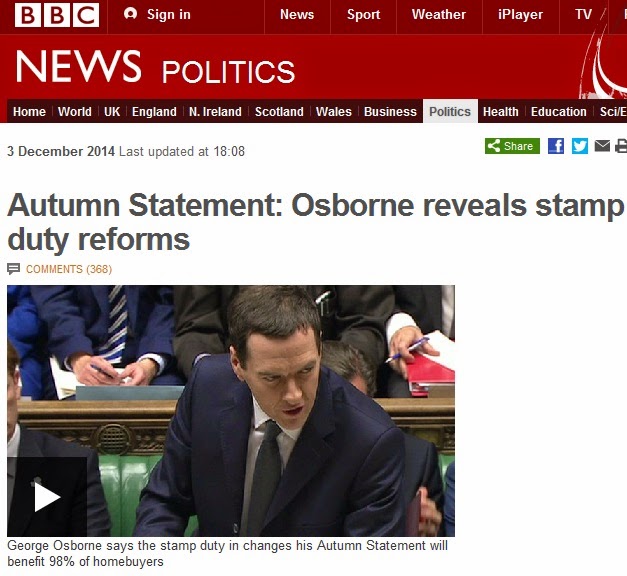
It is welcome therefore that in the Autumn statement that Osborne is attempting to iron out the stamp duty 'jumps'
The chancellor said that from midnight the current system, where the amount owed jumps at certain price levels, would be replaced by a graduated rate, working in a similar way to income tax.
Clearly with the 2015 election in mind Osbourne's headline plan has a multitude of benefits; mainly appealing to "middle England" who are attempting to successfully sell their house, the headline of a tax cut and an attempt to outflank Labour on proposals of the mansion tax:
BBC political editor Nick Robinson said the headline announcements were "real electioneering" by the Conservative chancellor, saying the stamp duty proposals were the Tories' "own version of the mansion tax" proposed by Labour and the Lib Dems.
Thus we can see, along with Article 48 on immigration, Conservative policy is beginning to take shape six months before an election. Policy not aspiration. Contrast this with Ukip whose 'non-existent' policies are in a mess, and unlike the Iron Lady whom Farage alleges he admires, he is for turning, often, and with embarrassing consequences.

Whatever we think of either party, what is clear is with the steady rolling out of policy Tory candidates and PPCs will be prepared well in advance, particularly in hustings. However UKIP PPCs will have a manifesto dumped on them just weeks before and any policies contained within liable to be changed on the whim of its leader. We are thus seeing a repeat of what's gone on many times before. Its grassroot support deserves much better.

That aside we also see the cynicism of the Tories. Osborne could not have been unaware that stamp duty was fundamentally broken, he's been informed before. Thus it is very interesting that he attempts to address the issue particularly just before an election. He's allowed a broken system, and all the difficulties it entails for the rest of us, to continue right until an impending election when he makes the necessary amendments purely for political purposes.

This is of course further evidence that the only mechanism which concentrates politicians' minds is the threat of being removed from office before an impending election. Thus the current representative system of being "lied to on Thursday and ignored on Friday for another five years" does not work. Above all else we need another way.

Saturday, 17 May 2014

"Be Thankful I Don't Take It All"

"Prime Minister, the Treasury does not work out what it needs and then think how to raise the money. It pitches for as much as it can get away with and then thinks how to spend it." 
Sir Humphrey, Yes Prime Minister.
That the government views the private purse as a magic money tree is an old age problem - one aptly illustrated by the rather bitter but not inaccurate Beatles' song, Taxman.

And it's a problem that becomes ever acute when under planned new measures in the latest budget. HMRC will have an automatic power to take money from a bank account when the holder has failed to act on four formal warnings requiring payment. Currently such actions can only be done with the permission of a magistrate or judge.

TBF senior still has an ongoing complaint with his local MP on this matter. With this in mind we note that the Telegraph today on its front page has another example of HMRC mistakes that expose deep flaws behind this proposal:
The number of people being investigated by the taxman has doubled in one year, raising concerns that people who have made innocent mistakes are being targeted by the Government.

HM Revenue & Customs made inquiries about the tax affairs of 237,215 people last year, compared with about 119,000 in 2011-12, figures obtained by The Daily Telegraph show.

The number of self-employed people investigated has quadrupled in that time while annual prosecutions have risen sevenfold in three years.
The figures are evidence of the attempts HMRC is taking to minimise the estimated £35 billion of tax lost every year.

Experts have warned that people who have made simple errors when filling out self-assessment tax returns are “an easy target” for HMRC.
Not unsurprisingly HMRC will go after the "low hanging fruit". They are more unlikely to resist and lack the means of fighting back successfully:
Mark Giddens, a partner at the accountancy firm UHY Hacker Young, said HMRC was focused on collecting tax from “soft targets” such as “teachers, doctors..." These taxpayers were more likely to settle without dispute, he said.
As Bill Cosby noted "the government comes for the regular people first".

Other mistakes are not uncommon and HMRC even loses our data. Naturally despite overwhelming objections, we still get the "reassuring" dulcet tones of the Treasury on transmit only:
"Although the vast majority do this, there is still a minority that chooses not to pay, despite being able. The proposed powers will give HMRC another tool to collect tax debt owed. The current consultation includes a range of safeguards to ensure the power is tightly targeted.”
"A range of safeguards". Not that would amount to a tin of beans of course. Who decides how to implement the safeguards? Well HMRC... However those in government tend to enthusiastically support such measures as they rarely experience the downsides of their actions because they have the money and the means to immune themselves from the consequences at the coalface that the rest of us have to endure.

And as the experiences of Complete Bastard fighting with South Gloucestershire Council over council tax very clearly shows not even the law is a defence - especially when it consists of willful corruption by the Police, Councils and Bailiffs in the cause of forcing people to hand over money which the state believes is theirs regardless. He quite rightly notes in conclusion:
Put simply, this is a government at war with its people.
Of course we as a people can rebel...and demand a better way of running our own country.

Wednesday, 23 October 2013

China In Your Hand?

As Richard North notes the forthcoming announcement of the construction of a giant new nuclear plant at Hinkley represents a staggering escalation in costs. However leaving aside the continuing folly of the UK’s energy policy it’s intriguing that much comment has been made about the fact that it is Chinese, not UK, investment that is involved, as indicated by this Telegraph piece (pictured above):
But others were less sanguine about China possibly coming to dominate Britain’s nuclear industry. “It’s troubling how far the Government is bending over backwards to allow this,” said Paul Dorfman, research associate at the energy institute of University College London.
Que much teeth-nashing - sorrowful that a country which was once at the forefront of nuclear power is now having to rely on Chinese investment to "kick start" our nuclear industry. But as is typical of our increasingly isolationist and "Little Englander" media, it ignores the wider picture. And it misses the insidious, and in this case the subtle, nature of our membership of the EU.

The UK and China have been forging a closer relationship for some time now; and crucially it has been doing so in the process of an increasingly close relationship between China and the UK government to support internationalization of the Chinese currency – Renminbi (RMB).

China is seeking to replace the US dollar, with the RMB, as the major world reserve currency. To help fulfil the criteria it is doing so with increasing co-operation of the Hong Kong and London financial markets, as noted by the South China Morning Post:
With Hong Kong’s support, London has become the leading offshore RMB centre in terms of payments with Hong Kong and China.  According to the Society for Worldwide Interbank Financial Telecommunications (SWIFT), London now accounts for 28 per cent of offshore RMB settled transactions.
Thus China has an enormous vested interest in the health of the UK financial sector. One can imagine therefore that it won't be best pleased to see the increasing efforts of the EU to impose ever draconian rules deliberately designed to damage one of the UK’s most important parts of its economy:
George Osborne has launched an unprecedented legal challenge against European plans for a financial transactions tax.

The move, which will be seen as a further sign of fraying relations between the UK and the rest of the continent, is designed to force the European Commission to reconsider the levy on Europe-related financial activity.
And:
Chancellor George Osborne stood isolated after European Union finance ministers vowed to press on with proposals to curb bankers' bonuses.

He told a meeting of EU finance ministers that he could not back the plans, which he fears could damage London's financial centre.
By cosying up to the Chinese - which is not to everyone's liking - Osborne has a big player on our side when defending the City from EU laws. A big player that is effectively helping to prop up the Euro. A bigger game is being played here.

If one is to be generous we could argue that George Osborne has played a bit of a blinder, however a more realistic criticism would question whether the heavy reliance on the Chinese been so necessary if we weren't members of the EU?

Monday, 18 March 2013

The Fatal Flaw

The theft of Cypriots' savings without so much as by your leave is quite jaw dropping in its brazenness. As Zerohedge notes, bank accounts are private property so what has happened is effectively the confiscation of private property - the equivalent of the government driving off with your car on a whim.

Of course the situation is being described as "exceptional and unique", as were the bailouts of Ireland, Portugal, and Greece. A precedent has been set and it's not difficult to envisage that this will happen again (it's a possible trial run) or that contagion, in the form of bank runs, will happen across Europe.

But it's seems to be forgotten among the outrage that our own Government is not adverse to similar actions themselves, only it's called something different.

If you want to raid savings accounts you can call it; quantitative easing, inflation or devaluation of the sterling. Different names but a similar effect. Or confiscate shares without compensation to shareholders that were still trading on the market at 90p at the time as per the nationalisation of Northern Rock. Or raiding dormant accounts. Or indeed bailing out a Eurozone country with taxpayer's money, despite promises to the contrary, but calling it "compensating British troops". When were we consented about this?

The EU's fatal flaw is its openness on the theft, an openness that is necessary because, unlike a successful currency union like the one that exists in the UK, it cannot disguise it via other methods due to the inherent shortcomings of the Euro. It is hamstrung by a flawed currency of its own making. It is being hoisted by its own petard.

However we should not be under any illusions that anything would be any different should we leave without a sea change in democracy at home...

Friday, 19 October 2012

Us And Them

The irrepressible Witterings from Witney has two cracking posts today: one that the Tory chief whip has resigned and has appeared to confirm in his letter that he swore at police despite previous denials that he didn't and that with "Expensegate II bubbling away nicely" our 'esteemed' chancellor was caught in first class with a standard class ticket.

One wonders how long this contempt for us can go on...?

Wednesday, 5 September 2012

Cheering The Enemy

I was intrigued by this article by Donata Huggins in the Telegraph, articulating her shock at Gordon Brown being cheered at the Paralympics while George Osbourne was booed:
Crowds at the Paralympics this week booed George Osborne and cheered Gordon Brown. Yes, you read that right
Huggins is clearly astonished and baffled by this behaviour and doesn't understand so can only put forward the argument that it must be due to the stupidity of the British public, ill-disguised as this comment:
I cannot believe how short the public's memory is.
There is of course another explanation. When people have limited power they express their disaffection in the only ways available that they can. For example, when football fans fundamentally don't agree with their manager or board and have fallen out, they begin to celebrate opposition goals during a thrashing - as a way of trying to humiliate their own club. It's an expression which confirms powerlessness against vested interests.

Jonathan Aitken makes a similar point in his book, Porridge and Passion documenting his time in prison for perverting the course of justice, particularly when Michael Howard former Home Secretary visited him, which resulted in immature behaviour from the Prison Officers' Association:
The row between the screws and the Special Branch Officers continued for most of the visit, thereby alerting everyone in the room to this public spat between two traditional enemies: the police and the Prison Service. As a consequence, several prisoners decided to demonstrate their support for [Michael Howard my visitor].

As the visiting session ended with each inmate being called out by name, a dozen or so prisoners put on little demonstrations of respect towards the former Home Secretary. 'Good afternoon, Mr Howard,' 'Nice to see you at Standford Hill, Mr Howard,' 'Good to 'ave you with us sir,' and 'Thanks for coming to show yer loyalty to yer old friend, Mr Howard', were some of the bouquets tossed in Michael's direction by inmates passing our table as they left the visiting hall.

The point they were making was if the screws were going to be rude then the cons were going to be polite. It was a rather better point than any made that afternoon by the Prison Officers' Association.
So what better way of expressing discontent against Osborne than cheer on Brown who left him such a toxic legacy? Osborne the same chancellor who...er...didn't have successful budget in March and whose budget we the people pay for have absolutely no control over.

The only option left is to cheer a massively failed man in order to piss Osborne off. Such nuances though are above Huggins' head

Tuesday, 26 June 2012

Amateurs


I can't remember the last time a budget was still being talked about, and still controversial, months after it was delivered. But as the BBC reports, George Osborne has engaged in yet another Tory U-turn - I've now lost count:
The government has announced it will postpone its 3p-a-litre rise in fuel duty in August until January next year.

The move follows a campaign by road users' groups, who argued the increase would damage the economy.

Fuel duty will be frozen for the rest of the year, Chancellor George Osborne told MPs, adding that this would benefit families and businesses.

Labour, the SNP, Plaid Cymru and MPs from other parties had threatened to force a Commons vote on the issue.

The Sun newspaper and several Conservative MPs have also been pushing for a change of heart, amid concerns that prices at the pumps are squeezing living standards.
What's abundantly clear is that Westminster is infested by a bunch of amateurs, which at a time of Eurozone meltdown and an attempted power grab by the EU bodes well....

Friday, 22 June 2012

3%

As regular readers know I'm in the process of trying to move house. Despite being in an area of the South East where house prices have generally held up, as demonstrated by the rapid increase of new builds in my area, the market in my case is somewhat slow - and for one good reason, according to my feedback from estate agents - fucking stamp duty.

Now, I'm not moving house because I want to nor necessarily for profit - I love my current house - it's a necessity. Sadly Mrs TBF is struggling, due to health reasons to make the stairs and very soon it will no longer be an option. A move to a single story property is therefore essential.

The difficulty is my house comes over the £250,000 (3%) threshold but not worth enough not to be a problem. Wonderful. That results in potential buyers being very reluctant to pay the significant duty increase in order to purchase my house - thus stalemate. This has ultimately distorted the market - making my house too cheap or too expensive. There are, of course, ways of navigating around this which unintentionally puts me into more murky territory than Jimmy Carr, through no fault of my own. Thus I couldn't agree with Martin Lewis more:
I hate stamp duty. It’s not that I object to a tax on purchasing property. It’s this distortive tax that has absurd cliff hangers meaning an extra penny on a house’s price can cost thousands.
So when Osborne talks about more aggressive measures on stamp duty avoidance in a populist attempt to clamp down on the rich using loopholes there seems to be silence when it comes to those who aren't so well off and are forced to 'avoid the tax' as a necessity. And at the same time he wants to try to promote a strategy for growth - not moving because of 3% surely equals 0%?

He hasn't a clue.

Thursday, 29 March 2012

Benefits Of The EU?

The saga of 'PastyGate' rumbles on. Despite the VAT's origins in Brussels, what's intriguing (and not entirely surprising) has been the Tory response or lack of to damaging headlines.

A tax on food obviously resonates deeply, particularly after a budget that reduced the top rate of tax from 50p to 45p (my emphasis):
"This is basically a tax on the working man of Britain," she says, "and on the many elderly and unemployed people who come by here for a pasty every lunchtime.
"My hot pasties would go up by 50p from £2.75: for some people, that will make a big difference. I'm planning to put a sign up in the window: 'Hot for the rich, and cold for the poor.'"
But only a couple of years ago Cameron was desperate, as opposition leader, to 'decontaminate' the Tory brand: no issue was too cuddly to avoid and, acutely aware of his Eton background, he was eager to play down any thoughts that the Tories are for the rich - as his awkward interview with Andrew Marr in 2009 demonstrated.

Yet here we are with a tax which will hit the working man the hardest, and from Cameron et al there's silence. Osborne could have tried covering it up by saying it was all Brussels' fault - "we'll fight them on the beaches etc" even though we all know in reality it would be empty rhetoric as it so often is.

But no, instead they're prepared to take the electoral polling hit, prepared to scupper their next electoral chances and prepared to recontaminate the 'brand' (and once that sticks it ain't going anywhere). In short preparing to destroy their own party just for the sake of appeasing our EU masters.

All of which demonstrates very clearly who the EU benefits, and it certainly ain't us.

Friday, 23 March 2012

How Convenient?

I predicted about 2 months, but the minimum alcohol price story has reared its head after only just a month. So why so soon?

On a separate note, George Osbourne and the coalition have taken quite a kicking over the budget, particularly the so-called granny-tax:
The full extent of George Osborne’s stealth tax raid on pensioners was laid bare yesterday.

Around 700,000 people turning 65 next year will be hit the hardest – losing £323 annually with the end of age-related income allowances.

In all, the ‘granny tax’ will take £3.5billion from the pockets of more than 4.4million pensioners. Senior Tories have denounced it privately as the Chancellor’s biggest blunder.
So how convenient then that a perpetually announced policy that never materialises makes the headlines this morning.

Tuesday, 29 November 2011

Irrelevant

Much fuss, sorry I mean analysis, I'm sure will be made of Osborne's pre-budget report today or the Autumn Statement as it's now known because the Tories promised to abolish the PBR. Promises, promises eh? Oh and the Tories also pledged to report to Parliament first not leak stuff beforehand, something they criticised Labour for. That'll be yet another promise broken then.

Anyway, some are referring to it as Brown's 13th budget, which indicates not only the lack of substance - tinkering about the edges - but deliberately making it more confusing: such as flipping between using Office for Budget Responsibility figures on growth and debt but using Treasury figures on the deficit. Witterings from Witney has also come to similar conclusions - labelling Osborne as an economic prat. I must say I can't disagree.

Yet it doesn't matter what the forecasts are - they've been wrong four times in the last 18 months already - the continuing eurozone crisis renders any such predictions as null and void.

Interestingly though Ed Balls, in response to the Chancellor's statement gave a great demonstration of a political dog whistle:
"If we are all in it together, why is it families, women and children always pay the most?"
See what he did there? The vast majority of men have families too, in some form or another, including the multi-millionaires: Osborne, Clegg and Cameron. So the statement is factually correct and logically he's referring to almost everyone in the country but the implication Balls' wants to give is entirely different.

Talking of agendas, out of all the 'announcements' made by Osborne see what the BBC has gone with just before tomorrow's strike:

Tuesday, 14 June 2011

More 'Red Lines'

According to the Telegraph:
The government is fighting off new powers for the EU to summon George Osborne, the Chancellor, in front of the European Parliament to justify and defend Britain's economic policy.
The Treasury Minster says:

"The government would not accept any proposal for the European Parliament to be able to summon ministers to appear before it," said a spokesman.

"We are clear that democratic accountability is very important, however this is why we have national parliamentary scrutiny procedures, which the European Parliament must not eclipse.

It might be a red line for Britain but it is also one for MEPs and a deal must be done quickly before a summit on 24 June. Something will have to give and negotiations are very delicate," said a Brussels diplomat.

Leaving aside that 'red lines' leak like a sieve, what's notable about this article is the 'pride' that we are all supposed to feel because Osborne is allegedly 'standing up' to Europe - apparently we are all supposed to be grateful.

How low we've fallen as a nation.

Monday, 18 April 2011

138.9

That's the price of the cheapest local garage (Tesco) for me for unleaded petrol. Just before Osborne lowered the duty by 1p on budget day, the price went up 1p then it went back down at 6pm to the same price it was before Osborne's announcement - 133.9p. Since then it's gone up 1p a week relentlessly. Apparently with his budget Osborne wanted to inject:
"fuel into the tank of the British economy"
Well, I'm still waiting.

Wednesday, 23 March 2011

Open Your Wallets (Again)

On budget day here when, laughably, we have had a so-called "budget for growth", the Portuguese Prime Minister Jose Socrates has resigned after the country's parliament rejected an austerity budget:
Britain is facing another multi-billion euro bail-out bill as Portugal followed Ireland into debt crisis when the country's government on Wednesday night lost a confidence vote on austerity measures.

The prospect of a new Portugal crisis and a potential bail-out worth up to £61 billion will overshadow Thursday's EU summit, a meeting aimed at repairing the damage done to the euro by Irish and Greek bailouts last year.
Portugal is about to be bailed out - with our money.

Wednesday, 16 February 2011

UK Refuses To Endorse EU Accounts

The Telegraph reports that:
The British Government has put the Commission "on notice" that the accounts, which have not been signed off by auditors for 16 years because of apparent inconsistencies, are unacceptable.
The UK Government follows where UKIP leads. However what's amusing is that the Telegraph accompany the story with the above picture, which rather mischievously shows anything but Mr Osborne standing up to the EU (it looks like he's being told off). The chap on the left is EU commissioner Ollie Rehn, who has form on expressing his views on democracy and adopting budgets.

Monday, 29 November 2010

UK Will Bail Out Portugal

Osborne confirms, what we already knew, in the Commons today (my emphasis in the text):
Mr Tobias Ellwood (Bournemouth East) (Con): What will happen if another eurozone country requires a bail-out? Will Britain’s involvement be kept to a minimum?

Mr Osborne: I say this about any future action that we may or may not have to take. On the bilateral loan, I said last week that there were some very specific—I stress the words “very specific”—circumstances that would lead us to support Ireland because of the interconnectedness of our economies. I also said that the European financial stability mechanism, the EU fund, was something that the previous Government had signed up to, and that the UK could not block its use because it operated under qualified majority voting.
...and Spain and Italy and Belgium.

Can we leave yet please?

Monday, 13 September 2010

6-0

The Wall Street Journal today carries an article by Irwin Stelzer, a director of economic-policy studies at the Hudson Institute, arguing that the EU has 'whipped' Britain 6-0 in the recent negotiations on financial regulation:
Four goals scored by setting up new regulatory agencies to supervise national regulators—one each for insurance, banking and securities markets, another to ensure financial stability...Two more points for pushing through an increase in the EU budget in the face of cuts in member state spending, and for granting Olli Rehn, EU commissioner for economic and monetary affairs, the power to review national budgets and to impose the eurocracy's notion of acceptable deficit limits.
Despite today's Telegraph reporting that the coalition is pressing ahead with a “referendum lock”, Stelzer is clear in his analysis:
Mr. Osborne roared loudly but carried a twig. His boss, the prime minister, promised to fight tooth and claw to prevent any further transfer of British sovereignty to the EU; he now stands toothless and declawed.
In other words, that sovereignty horse has already bolted thus rendering the 'lock' redundant. But it is this paragraph that really stands out:

What is a surprise is that [Lib Dem] coalition partners also aim to cut the City down to size. Leading Tories tell me that the financial sector bulks too large in the UK economy, creating excessive macroeconomic volatility. That view spawns a host of misbegotten policies, including the decisions to raise the effective marginal tax rate to 52%, and to subsidize economic development in low- or no-growth areas of the country. Why anyone would believe it good policy to attack an industry in which Britain has a clear competitive advantage remains a mystery.

At first I thought I had misread that paragraph. But no, leading Tories do actually want to reduce the size of the City which provides nearly 14% of total Government tax receipts, and are happy for a foreign Government to carry out the process for them.

There's only one conclusion left. The Tory party has passed on. This party is no more. It has ceased to be. It's expired and gone to meet its maker...It is an ex-party.

Monday, 23 August 2010

Cameron Sell Out

Ironies Too alerts me to this particular passage in this European Council report (page 6) from June:
16. The European Council agrees that Member States should introduce systems of levies and taxes on financial institutions to ensure fair burden-sharing and to set incentives to contain systemic risk.1

Such levies or taxes should be part of a credible resolution framework. Further work is urgently required on their main features and issues of level playing field and cumulative impacts of various regulatory measures should be carefully assessed. The European Council invites the Council and the Commission to take this work forward and report back in October 2010.
And the footnote at the bottom of the page?
1 The Czech Republic reserves its right not to introduce these measures.
Despite the desperate "thou doth protest too much" claims of Tories that this is all UKIP's fault, it's clear that Cameron can't sign up to EU measures fast enough, and he was voted in as leader by the...er...Tory Party.

They are not signing up to these measures under duress, but willingly and without a whimper. The Tory sceptics could say and do something but they choose not too. Not even a protest.

Power before principles. The perfect coalition then!

Tuesday, 22 June 2010

Budget On TV


Throughout the Budget, the above screen shot was typical of the television coverage. I thought where is Cameron? Osborne appears to be flanked by two Lib Dem MPs; Nick Clegg and Danny Alexander.

And then periodically the camera would show this, below:


Cameron is sat right behind Osborne's arse. Surely a coincidence on so many levels, (manipulation of the media is a Labour tactic, the Tories would never stoop so low?)