Showing posts with label Ireland. Show all posts

Monday, 23 July 2012

And So It Rumbles On...

I haven't done a Eurozone post for a while largely because it consists of soporific repetition, however rumble on it still does:

And:


And:
It all reminds me of this post by the FT in 2010 regarding the sterling devaluation crisis in the 1960's:
To some who went through the unsuccessful struggle from 1961 to 1967 to stave off sterling devaluation, the series of crises surrounding the euro will be drearily familiar. First there is a surprise loss of confidence. Then there is a series of rescue operations, usually taking the form of international guarantees of one kind or another. These are backed up by domestic restrictive measures leading to a domestic recession of sorts. In time the financial pressures ease and near-normality is seen to return. But then, when few are looking, there is another crisis, another set of international rescues and another set of domestic restrictions. And so on. Eventually the struggle is abandoned, and political and financial leaders work to pick up the pieces.

During the period when sterling devaluation was known as “the great unmentionable” a tiny band of Treasury officials kept “a war book” on how to deal with the unmentionable if it nevertheless happened. Harold Wilson, the prime minister, ordered that the “war book” be physically burned, which it was of course not. It is difficult to believe that such a manual does not exist in Athens, Frankfurt and perhaps other European centres.
Can we put it out of its misery yet...?

Saturday, 3 December 2011

I'm So Happy....

Sometimes, just sometimes I wonder if I live on a different planet to most other people... This from the Irish Times:
Psychiatrist calls for lithium to be added to water

A consultant psychiatrist last night called on Government to add lithium salts to the public water supply in a bid to lower the suicide rate and depression among the general population.

At a mental health forum on “Depression in Rural Ireland” in Ennistymon, Co Clare, Dr Moosajee Bhamjee said that “there is growing scientific evidence that adding trace amounts of the drug lithium to a water supply can lower rates of suicide and depression”.

Dr Bhamjee said that a community would not get “hooked” on lithium “because the doses would be so small”.

He said: “There are 200,000 people suffering from depression in Ireland and the Government must think of new ways of tackling the problem.”

Mr Neville said that with the well-publicised suicide of footballer Gary Speed, it raised contagion or copycat suicide concerns.
Do read the article in full, ironically it makes you laugh and depressed at the same time. Perhaps it's a clever ruse by Dr Bhamjee on behalf of the Irish Government to drug the Irish into pretending the Euro crisis is not much to worry about.

Anyway at least it gives me an excuse, on a Saturday evening, to plug a Nirvana classic:

Thursday, 21 July 2011

Euro Fudge

Zerohedge has a list of draft proposals for the Euro crisis - 'leaked to Reuters' - here, and the Telegraph have reported that it was deliberately leaked to support the Euro:
Speculation here in Brussels that draft eurozone proposals were deliberately leaked to Reuters to stop the euro plunging on the markets.
However (my emphasis):
The markets wanted to hear about measures such as using the eurozone's €440bn EFSF bailout to give loans to non-programme countries (Italy and Spain) for bank recapitalisation or allowing it to "intervene on a precautionary basis".

All well and good except that these proposals could well require a change to the EFSF rules, the fund is supposed to be last resort for example, and changes must be agreed in parliaments.

Germany does not want that battle as German voters revolt against even more of their money flowing south. The Finns and Dutch don't like it either.

Markets have now firmed up. Will that message be passed on to Chancellor Merkel in a bid to twist her arm?

Your voters might not like it but the markets need it.
Zerohedge has his doubts this can be achieved (i.e. it's EU fudge):
So far all the news out of Europe is based on changes to EFSF. Greece will be able to borrow for 15 years at 3.5%. French bonds with a 15 year maturity trade at 3.8%. So the EFSF will have to pay more on its debt than it receives? Interesting. Have the rating agencies signed up to rate the new EFSF as AAA? From deals I've worked on, things that always hurt ratings were:
  1. extending maturity,
  2. including banks in addition to sovereigns,
  3. allowing trading,
  4. vague rules as opposed to written rules.
The headlines all indicate the new EFSF has all of these components. I am sure the agencies have been involved in these discussions, but I remain dubious how happy the market will be to finance the EFSF at rates that are remotely in line with the rates the EFSF plans to provide financing at.
And even if the proposals are correct, then it's inevitable that Portugal and Ireland will use this Greek precedent to force better terms as well. The crisis is not over yet by a long way.

Wednesday, 6 July 2011

EU Criticises The Messenger

Apparently the Euro crisis is all the ratings agencies' fault:
European politicians accused credit rating agencies on Wednesday of anti-European bias after Moody's downgrade of Portugal's debt to "junk" cast new doubt on EU efforts to rescue distressed euro zone states without debt restructuring.

European Commission President Jose Manuel Barroso said the decision to cut Lisbon's rating by four notches so soon after it became the third country to receive an EU/IMF bailout was fuelling speculation in financial markets.
Greece is bust, Portugal will need a second bailout (it's only just received the first one) and Ireland is likely to need a second bailout also but no, apparently these ratings agencies are acting all a bit strange and with 'anti-European conspiracy' intentions:
"It seems strange that there is not a single rating agency coming from Europe. It shows there may be some bias in the markets when it comes to the evaluation of the specific issues of Europe," Barroso told reporters in the European Parliament.
Clearly the EU wants its own ratings agency so that it could try to circumnavigate the markets like it does with its own treaties - then everything in the EU garden would be rosy.

Wednesday, 22 June 2011

Allied Irish Bank Defaulted On Monday

While all eyes have been on Greece it appears that AIB has quietly defaulted this week:
A new ruling by the International Swaps and Derivatives Association, the trade body that oversees the credit default swaps market, ruled that a failure to pay credit event – a financial markets term for a default on a payment or breach of a bond covenant – had occurred at AIB.

The ruling means that bondholders will be able to recover some of their losses as a result of insuring against a default by the bank.
The Irish Independent reports that this was done with full knowledge of the European Central Bank who did nothing:

As a consequence yesterday, faced with a default by AIB, the ECB did nothing. Following Mr Noonan's threat to burn the senior bondholders, did the ECB cut off the Irish banks from the repo market? No it didn't. Did the market sell off Irish government bonds in the wake of Mr Noonan's musings? No it didn't. Why?

Because the market already knows that the Irish banks are bust. The market knows that they have become re-cycling vehicles for the Irish Government, which is simply upholding the ECB's will that an Irish bank doesn't declare itself bust, because that would look bad for the euro. So the ECB is now allowing the Irish banks to go bust by stealth rather than by diktat.

Which means there's more trouble ahead:
The Irish banks will now begin to default bit by bit and Irish depositors will wake up to this and react by doing what the ECB doesn't have the courage to do -- they might just continue to take their money out. Now that would be a real crisis.
hattip: Richard at EUReferendum

Monday, 18 April 2011

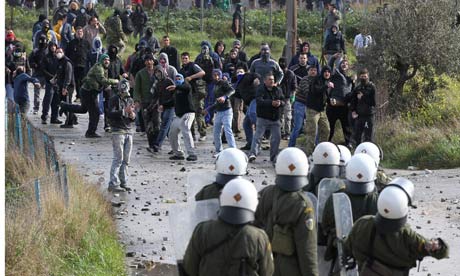
Anarchy In Greece


Following on the heels of Finland's vote last night, the Guardian is reporting that not only is a default in Greece ever more likely but that the country is becoming ungovernable:
Amid speculation over the country's ability to avoid default, a wave of civil disobedience is causing many to wonder if Greece is becoming ungovernable.

"There is clearly a breakdown of the rule of law, and without the rule of law there can be no economic development," said political analyst Takis Michas. "It is organised lawlessness spearheaded by the hard left."

"In any other country people would have been arrested but here the lack of arrests has contributed to the feeling that anything goes," said Michas.
And Moody's have now downgraded Ireland's banks to junk status:
This means all Government-backed banks are now classified as junk.
No wonder the Euro is falling this morning.

Friday, 15 April 2011

Move Along, Nothing To See Here

The Boiling Frog's favourite EU Commissioner has decided that everything in the Euro garden is rosy, here's a selection of his latest quotes:

"While I cannot yet say ‘Mission accomplished', I am increasingly confident that we are entering into the endgame of the crisis management phase."

And:

"Preventing a European Lehman has not been a simple task, with 27 fiscal authorities and 11 central banks - we never had the genius of Alexander Hamilton to draw on, like you did, unless you count Jacques Delors for this too - but the task has nevertheless been accomplished."
And:
"The euro's critics are wrong to claim that [the crisis] will lead to its failure or break-up. The euro will not only survive but is coming out of the crisis stronger than before."

With Greece about to default, and Ireland and Portugal in the same boat plus Spain not being out of the woods yet, not to mention significant worries about Italy and Belgium (who currently hold the world record for not having a government - with implications on its credit rating), one might be tempted to beg to differ.

Although in fairness Mr Rehn wasn't wrong when he said the following:

He concluded by repeating the mantra EU leaders have chanted from the very beginning of the area's crisis that the bloc will do "whatever it takes" to save the single currency.

"The euro is not just a technical monetary arrangement, but rather the core political project of the European Union."

I suspect EU Commissioner Olli Rehn will come to regret his words, and I look forward to that day very much.

Thursday, 14 April 2011

Greece Default?

With Portugal not having even completed their bailout terms yet, there's a growing, yet entirely inevitable, view that Greece is about to default.
The cost of insuring Greek debt has hit a record high on renewed fears the country will default on its borrowings. But support came from the head of the IMF, who insisted the embattled country would "make it".
And:
Investors' flight from Greek government debt left 10-year bond yields at a new euro lifetime high of over 13pc and yields on two-year bonds at over 18pc, after Wolfgang Schaeuble said "additional steps" could be necessary if the European Central Bank concludes that the country's burden is unsustainable. l
Ireland is also in this 'default' territory too - there's no way they can repay under the terms imposed on them either. The Euro crisis therefore appears to be gathering pace.

The EU taxpayer will be footing the bill for this as German government economic advisor Lars Feld has warned; the European Central Bank has abandoned all pretence at being the guardian of sound monetary policy, along the lines of the original Bundesbank, as per the Maastricht Treaty. Instead the ECB has been buying up Greek and other government debt even when it is rated as junk - breaking every EU law going. The ECB is becoming, if not already, a bad bank and a Greek default is inevitable.

The EU elite is clinging onto their precious currency for as long as it takes, regardless of the economic consequences but the end is coming - "He will knock four times".

Sunday, 27 March 2011

Dear Portugal

A wonderfully caustic editorial from the Irish Independent today, I reproduce here in full:

Dear Portugal, this is Ireland here. I know we don't know each other very well, though I hear some of our developers are down with you riding out the recession.

They could be there for a while. Anyway, I don't mean to intrude but I've been reading about you in the papers and it strikes me that I might be able to offer you a bit of advice on where you are at and what lies ahead. As the joke now goes, what's the difference between Portugal and Ireland? Five letters and six months.

Anyway, I notice now that you are under pressure to accept a bailout but your politicians are claiming to be determined not to take it. It will, they say, be over their dead bodies. In my experience that means you'll be getting a bailout soon, probably on a Sunday. First let me give you a tip on the nuances of the English language. Given that English is your second language, you may think that the words 'bailout' and 'aid' imply that you will be getting help from our European brethren to get you out of your current difficulties. English is our first language and that's what we thought bailout and aid meant. Allow me to warn you, not only will this bailout, when it is inevit-ably forced on you, not get you out of your current troubles, it will actually prolong your troubles for generations to come.

For this you will be expected to be grateful. If you want to look up the proper Portuguese for bailout, I would suggest you get your English-Portuguese dictionary and look up words like: moneylending, usury, subprime mortgage, rip-off. This will give you a more accurate translation of what will be happening you.

I see also that you are going to change your government in the next couple of months. You will forgive me that I allowed myself a little smile about that. By all means do put a fresh coat of paint over the subsidence cracks in your economy. And by all means enjoy the smell of fresh paint for a while.

We got ourselves a new Government too and it is a nice diversion for a few weeks. What you will find is that the new government will come in amidst a slight euphoria from the people. The new government will have made all kinds of promises during the election campaign about burning bondholders and whatnot and the EU will smile benignly on while all that loose talk goes on.

Then, when your government gets in, they will initially go out to Europe and throw some shapes. You might even win a few sports games against your old enemy, whoever that is, and you may attract visits from foreign dignitaries like the Pope and that. There will be a real feel-good vibe in the air as everyone takes refuge in a bit of delusion for a while.

And enjoy all that while you can, Portugal. Because reality will be waiting to intrude again when all the fun dies down. The upside of it all is that the price of a game of golf has become very competitive here. Hopefully the same happens down there and we look forward to seeing you then.

Love, Ireland.

Sunday Independent

Thursday, 17 March 2011

Quote Of The Day

Well, more accurately, a quote from last Sunday's Irish Independent, regarding Ireland's request for a change in the interest rate it pays on its bailout terms. Sarkozy had asked Kenny, Irish Taoiseach, for a "gesture" on Ireland's 12.5 per cent corporation tax rate. The Irish Independent's response?
"Well, he deserves a gesture -- but a gesture involving two digits and no other numbers"

Tuesday, 18 January 2011

Ireland Prints Its Own Euros

A great spot by the Talking Clock, the Irish Independent reports (my emphasis):

EMERGENCY lending from the ECB to banks in Ireland fell in December, the first decline since January 2010, but only because the Irish Central Bank stepped up its help to banks.

The Irish Independent learnt last night that the Central Bank of Ireland is financing €51bn of an emergency loan programme by printing its own money.

Wow! This is desperate stuff, the ramifications of which are potentially enormous. It surely defeats the object of a single currency having individual member states printing money on a whim. What is now obvious is that the issue of Ireland and its bailout is far from over:

In hindsight, the attention of the market moving to Portugal or Spain was a misdirection of where the real attention needed to be, and that is Ireland still.

The bail out of Ireland, funded currently from their own retirement savings, has not been ratified by their government. The ECB has not started to poured funds from the Stabilization fund into Ireland yet, as they await ratification of the bailout.

The bailout, like a ticking time bomb has not been ratified yet, and if Fianna Fail’s 1 vote coalition collapses before the vote, all bets are off as to it ever being passed.

And it's not even clear that Ireland have permission to do this:

Ireland Central Bank was allowed, with or with out permission, to print up up new Euros without new sovereign debt issued behind them.

As Ireland have now set a precedent will Greece, Portugal and Spain do the same? The inflationary pressures of doing so will greatly increase. So how will Germany react to this, given that they are obsessed with keeping inflation low at all costs for very obvious historical reasons.

The crisis affecting the Euro has just deepened.

Saturday, 18 December 2010

Thursday, 16 December 2010

Ireland (Sort Of) Loses Abortion Case

The European Court of Human Rights returned its verdict today on the Irish abortion case:

The European Court of Human Rights has ruled that Irish abortion laws violated the rights of one of three women who sought terminations in Britain.

The woman, who was in remission for a rare form of cancer, feared it might return as a result of her pregnancy.

Despite the press speculation, the judgment isn't a significant departure from current Irish law. It has ruled that abortion access must be made easier in life-threatening situations, an extension to existing law in Ireland - which was the result of the 'X' case, however the ECHR has not ruled that abortion must be widely available in other circumstances. So technically Ireland is not required to legalise abortion but will probably be under pressure to adopt a more flexible position in subsequent attitudes.

This still leaves a couple of issues. Can Ireland implement the ECHR's judgment without breaching the anti abortion condition of the constitution; the eighth amendment? If it does breach this, it would trigger a referendum. Even the Court acknowledges the implementation will be difficult to implement:
As to the burden which implementation of Article 40.3.3 would impose on the State, the Court accepts that this would be a sensitive and complex task. However, while it is not for this Court to indicate the most appropriate means for the State to comply with its positive obligations (Marckx v. Belgium judgment, § 58; Airey v. Ireland judgment, § 26; and B. v. France, § 63, all cited above), the Court notes that legislation in many Contracting States has specified the conditions governing access to a lawful abortion and put in place various implementing procedural and institutional procedures (Tysiąc v. Poland judgment, § 123). Equally, implementation could not be considered to involve significant detriment to the Irish public since it would amount to rendering effective a right already accorded, after referendum, by Article 40.3.3 of the Constitution.
Given the current circumstances, should a referendum be triggered it's hard to imagine that the Irish will do anything other than reject further perceived erosion of their sovereignty, thus putting the nation on a collision course with the ECHR. Certainly at the very least Brian Cowen's 'clarification' on abortion, in order to secure a 'yes' in the second vote on Lisbon, looks a very empty one indeed. Can his already record low support in the polls get any lower?

But there was a more potential and fundamental far-reaching outcome of this judgment. Has the ECHR just effectively by-passed the domestic courts, thus breaching its mandate? Article 35/1 of the Convention of the Protection of Human Rights and Fundamental Freedoms requires that all possible domestic remedies be exhausted before the ECHR has jurisdiction:

Article 35 – Admissibility criteria

  1. The Court may only deal with the matter after all domestic remedies have been exhausted, according to the generally recognised rules of international law, and within a period of six months from the date on which the final decision was taken.
The women in question; A,B & C, did not exhaust 'domestic remedies' and this formed part of the Irish Government's defence.

In the Court's response to this defence, it's important to note that there is a difference between C’s claim and that made by A&B. C’s complaint was that her situation was allowed under the Irish constitution but no suitable domestic remedy was available to her - there was a lack of legislation that allowed her to have her abortion case to be assessed properly despite being entitled to. Her ability to exhaust domestic remedies was limited, therefore the court ruled accordingly:

154. The third applicant feared her pregnancy constituted a risk to her life and complained under Article 8 about the lack of legislation implementing the constitutional right to an abortion in the case of such a risk. She argued that she therefore had no effective procedure by which to establish her qualification for a lawful abortion in Ireland and that she should not be required to litigate to do so.

155. In those circumstances, the Court considers that the question of the need for the third applicant to exhaust judicial remedies is inextricably linked, and therefore should be joined, to the merits of her complaint under Article 8 of the Convention (Tysiąc v. Poland, no. 5410/03 (dec.) 7 February 2006).

4. The Court’s conclusion

156. Accordingly, the Court dismisses the Government’s objection on grounds of a failure to exhaust domestic remedies as regards the first and second applicants and joins this objection to the merits of the third applicant’s complaint under Article 8 of the Convention.

Conversely A&B were bringing a case that was not permitted under the Irish constitution. And it's clear from the judgment that the ECHR considered that any domestic remedies would have been next to pointless which is why they also considered their cases - again the ability to exhaust 'domestic remedies' was very limited:
147. However, the Court does not consider that it has been demonstrated that such an action would have had any prospect of success, going against, as it would, the history, text and judicial interpretation of Article 40.3.3 of the Constitution.
Thus the view that domestic remedies were virtually non-existent permitted the ECHR to rule on these cases, allowing them to bypass domestic courts.

The Court's rulings though have essentially upheld the Irish constitution. It did not condemn abortion and in the case of A&B it appears to have tried to strike a balance between women's rights and the wishes of the Irish people:
The Court considers it reasonable to find that each applicant felt the weight of a considerable stigma prior to, during and after their abortions: they travelled abroad to do something which, on the Government’s own submissions, went against the profound moral values of the majority of the Irish people.
However the Court ruled that C's case was a failure of the state to legislate properly under her right of the constitution:*
‘The Court considers that the uncertainty generated by the lack of legislative implementation of Article 40.3.3, and more particularly by the lack of effective and accessible procedures to establish a right to an abortion under that provision, has resulted in a striking discordance between the theoretical right to a lawful abortion in Ireland on grounds of a relevant risk to a woman’s life and the reality of its practical implementation‘
In my view the ECHR has pulled off quite a deft trick here (if cynically you think courts judge in political terms not legal ones); subtlety changing Ireland's abortion laws without breaching legally its mandate.

Though I doubt any appreciation of the slight trick of the hand will be enough to pacify Ireland, as anti-Europe emotions are still running high; the reaction is likely to be altogether different.

*It's worth noting here, that I think a conflict arises here between the ECHR's (and EU state's) 'positive obligations' and Ireland's common law based 'classical obligations'.

Ireland's Abortion Ruling Due Today

You'd think that Ireland has suffered enough already however at just over a year since the hearing, the European Court of Human Rights will today give its judgment on Ireland's abortion laws:
The European Court of Human Rights is due to rule on whether the Irish Republic's anti-abortion laws violate women's human rights.

The case was brought to the Strasbourg-based court by three Irish women who say their health was put at risk by having to travel abroad for abortions.

The ruling could have all sorts of significant implications and the gravity of the decision is reflected by the decision of the court to issue its ruling at a public sitting rather than by a written statement.

We will know shorty whether Ireland will face another attack on its sovereignty.

Monday, 29 November 2010

The New Dictator Of Ireland

Barely has the signature ink dried on Ireland's bailout agreement and this unelected tosser aka the EU Commissioner for Economic Affairs, Olli Rehn has waded in with his orders:
"The EU Commissioner for Economic Affairs, Olli Rehn, has said that it would not be advisable for any new government in Ireland to attempt to renegotiate either the interest rate on the EU/IMF loan or the use of the National Pension Reserve Fund in repairing the banking sector."
It won't be advisable to any new Government which has an elected mandate? So if the majority of the Irish vote to default, then tough? Why not do away with elections altogether then Mr Rehn?
In an interview with RTÉ News, Commissioner Rehn said it did not want to involve himself in democratic politics in Ireland.
Of course not, democratic politics is an alien concept to you, much better to remain above it all, directing operations but out of the grasp of accountability.
He said he 'fully understood' the frustration and anger of the Irish people about the banking sector, which he said had made big mistakes in the past.
Ahhh 'fully understood'? How sympathetic, however...
'...we have to move on and the essential thing is to complete the repair, implying both the restructuring and downsizing of the banking system,' he said.
In other words, the people, their jobs, their lives, their concerns are irrelevant.

Mr Rehn said he did not see any tensions or reservations in other member states approving the loan. 'I trust there is the same sense of responsibility and solidarity both for Ireland and Europe as a whole,' he stated.
Not from where I'm standing there isn't. If Mr Rehn comes anywhere near this country with such statements then he's going to promptly receive an oversized, ticking, Jiffy bag with the letters ACME stamped on it.

UK Will Bail Out Portugal

Osborne confirms, what we already knew, in the Commons today (my emphasis in the text):
Mr Tobias Ellwood (Bournemouth East) (Con): What will happen if another eurozone country requires a bail-out? Will Britain’s involvement be kept to a minimum?

Mr Osborne: I say this about any future action that we may or may not have to take. On the bilateral loan, I said last week that there were some very specific—I stress the words “very specific”—circumstances that would lead us to support Ireland because of the interconnectedness of our economies. I also said that the European financial stability mechanism, the EU fund, was something that the previous Government had signed up to, and that the UK could not block its use because it operated under qualified majority voting.
...and Spain and Italy and Belgium.

Can we leave yet please?

The Longest Ransom Note In History

The Irish bailout unsurprisingly isn't working to calm Euro fears, and the details are making the Irish distinctly unhappy:

This is not a rescue plan. It is the longest ransom note in history: do what we tell you and you may, in time, get your country back.

The extent of the abandonment of Irish national interests is clear from three aspects of the deal.

The interest rate, at almost 6 per cent, is viciously extortionate.

The National Pension Reserve Fund, which is all we’ve got left for strategic investment to rebuild our economy, is to handed over – in a brazen example of “demanding money with menaces” – to failed banks.

The disastrous banking strategy is to be continued: “an intensification of the measures already adopted by the Government” is the Government’s own phrase. And a savage attack on low-paid workers, in the form of a huge reduction in the minimum wage, is to be written into a binding agreement.

Would the Irish people, if asked, vote for any of these measures as decent solutions to our very real dilemmas? That the answer is so obviously “no” tells us the brutal truth: Irish democracy has been abandoned by a zombie government.

No, Irish democracy was abandoned by its very own people who agreed to further EU integration.

Friday, 26 November 2010

Yes You Do, No We Don't,

Portugal is now entering the first step of being bailed-out by denying that it needs one:

Portugal insisted this morning that it was under no pressure from its European Union partners to accept a multimillion euro bailout that could prevent the crisis in the eurozone spreading to its neighbour Spain.

After Financial Times Deutschland reported eurozone nations and the European Central Bank were urging Portugal to follow Ireland and capitulate to financial aid, the office of the Portuguese prime minister José Sócrates said it was "totally false" that the country was under such pressure.

Which has done nothing to lessen the markets fears:

LONDON (Dow Jones)--Denials by the Portuguese and Spanish governments that Portugal is under pressure to seek financial aid failed to prevent another sell-off in both countries' sovereign bonds Friday.

The yield premium that investors demand to hold 10-year Portuguese sovereign bonds rather than German bunds rose 12 basis points to 444 basis points, according to Tradeweb.

Spain's 10-year bund spread rose 15 basis points to a fresh euro-era record high of 267 basis points.

The contagion is gathering momentum and spreading:
"[Talk of Portugal being forced to accept aid] all looks like papering over the cracks and will not lead to any confidence in the single currency," Citigroup said in a note. "It seems that factors are lining up now to conspire against the euro. No amount of jawboning from various officials will lessen the chance of contagion spreading."
One wonders how long the EU can keep putting off the inevitable.

Update: Spain are doing the denying bit now:

MADRID (Reuters) - Spain flatly ruled out needing a bailout and said results of extra health checks on its ailing savings banks would be published next spring, as its government and central bank stepped up efforts to calm uneasy investors.

Prime Minister Jose Luis Rodriguez Zapatero said there was "absolutely" no chance Spain would need to seek outside help to manage its finances..

That's "flatly ruled out"...and..."absolutely no chance".