Showing posts with label Nigel Lawson. Show all posts

Wednesday, 9 April 2014

Brexit: The Winning Entry?


Iain Mansfield will be a happy man this morning having won the Brexit prize and walked away with a sizable cheque. His winning submission can be found here.

We invite readers, before they continue to read the rest of this post, to first study both the winning entry and compare it with the one submitted by Richard North, with help from his blog readers, which didn’t even make the final six shortlist, and come to their own conclusions.

We do so to negate the charge of “sour grapes” which of course is an easy accusation to make. We also like to make it clear that there's no particular personal ill will towards Mr Mansfield – that he’s entered a competition and won is hardly his fault.

That said as the winning contestant of what should be considered an academic paper with “prestige” he should put himself in position to defend the arguments he makes. By deleting his blog this morning and also being hamstrung by being a member of the Civil Service he is compromised by failing to be able do so. As a consequence the paper cannot further the cause of UK exit.

Largely though our deep concerns are directed at the IEA and the potential severe damage this competition will do to the eurosceptic movement.

It’s worth noting that the competition wasn’t the idea of the IEA, it was instead the brain child of Lord Pearson, ex UKIP leader of course, and he raised the necessary funds. Pearson took the view that the IEA was a suitable organisation to run the competition.

What’s becoming apparent though is the competition wasn’t run with entirely honest intentions by the IEA, they have used the opportunity of Pearson’s 'naivety' - of not seeking a remit - to hijack it to impose their own free market ideology. That the IEA have attempted to hijack the prize is not just the opinion of Richard North but also some of the other contestants as well, who are equally unhappy.

It's also interesting to note that Mr Mansfield not only walks away with the main prize but also wins the prize for being "the best entry from an individual aged 30 or under”. How convenient.

Such concerns are reinforced by the continuing changes in the rules during the competition. Not only did the IEA arbitrarily impose upon contestants a further shortlist of six – which immediately announced that any submission failures were at least 7th best not 4th best - a decision which wasn’t stated from the start, but they then made public their clear expectations as demonstrated by the video above, contrary to the original competition requirements.

After the competition had closed the judges revealed that they wanted a "free trade" solution, something that was never specified throughout the competition. As an example below is the full guidance sent via email sent on 25th November 2013 where a free trade only solution was not specifically required:
Dear all,
The Brexit judges met again last week and discussed the development of the short-listed papers into full submissions. They asked me to send entrants on the short list some further guidance, which has been integrated into the original further guidance, in order to help you meet the objectives of the competition.
1.      The full paper should not concern itself with reasons as to why the UK might exit the EU or the advantages or disadvantages of such a step, nor should it spend time looking at how such a situation might arise. The starting point is that the decision to leave has already been taken and the paper should explore and set out a programme of policy steps to be followed by a UK government in that event.

2.      While, obviously, you need to consider the precise mechanism and procedure for exit, this should not be the main or primary focus of the final submission. Rather the full submission should look at the areas of government policy and overall political economy that would be affected by a UK exit and suggest a coherent and structured set of policy responses. The most obvious one is trade policy but there are many others, notably regulation in general (including financial regulation, environmental regulation, labour market regulation, immigration, and so on), foreign and fiscal policies and wider questions of economic policy.

3.     Wherever possible you should seek to provide costed and quantitative estimates and arguments. For example (and this only as an example, not a suggestion) there could be an analysis of trade flows over the last thirty years with estimates of where the greatest potential advantages from bilateral trade deals might lie; what trade policy options would confront the UK - from unilateral free trade through to joining particular free trade areas or remaining in the EEA; where the fastest benefits of lower trade barriers might be achieved and what impediments might stand in the way.
4.    However, when it comes to some of the more difficult issues, there will not be a hard and fast answer. Nevertheless, entrants should try to provide estimates and make judgments and these must be backed up with argument and evidence.
5.    Though the exit process should not be the primary focus of the papers, the successful entrant should include a clear sense of the practical steps that would need to be taken and the likely timetable in relation to them.
6.    As the context for point 2, above, there should be a clear picture of the various choices and options facing the UK upon exit with a discussion of the pros and cons and there should be a discussion of the pros and cons of various special arrangements which the UK might make with the EU after BREXIT.
7.    The entry should outline what the worst case for the UK might be after BREXIT and discuss ways of avoiding this and/or mitigating it if it transpires (for example, would the worst case be the EU refusing to negotiate any trade arrangements and refusing to make any agreements relating to the operation of UK companies throughout the EU and then imposing trade barriers and how might the UK respond?).
8.    Use of several tables and charts should be expected.
The fact that none of the EEA solutions - or variations of - did not make the unexpected announced six adds weight to our suspicions. If contestants had been informed from the start of the "free-trade" desires of the IEA, then EEA solutions would not have been put forward by entrants on the basis that they had no chance.

Those who have now read both papers linked above may feel a sense of being completely underwhelmed by the winning entry. The winning paper contains wishful thinking, superficiality, and is completely lightweight. It simply does not address the complexities of leaving. It also contains basic errors such as this on page 12:
The Single Market is far more than a customs union or a comprehensive free trade agreement. The treaty that instigated the Single Market was not the Treaty of Rome, but the Single European Act of 1987 [sic], which concerned much more in depth matters of economic integration.
I have to remind my readers that paragraph was part of a winning entry. Unbelievable. One wonders whether Dr David Starkey is keen, as a constitutional historian of note, to be associated with a paper that quite clearly falls below the accepted standard of an academic paper.

Another example is point 8 in the email above; “Use of several tables and charts should be expected."

Point 8 caused no end of consternation for us. Richard’s submission put forward the case rightly - a point acknowledged by more than one judge on the panel - that exit from the EU was a political argument not an economic one. Given that the IEA is obviously an economic think-tank we concluded that they were looking for a paper festooned with economic graphs.

Typical examples are this paper from Ruth Lea and this from Nexit. With this in mind and after long hours of cogitation and discussion we managed to include in Flexcit many original tables and charts that were relevant to our submission which also tried to confirm with possible expectations of an economic argument. Even so we still had concerns that the lack of economic graphs was a potentially obvious weakness, in the sense of Richard’s submission being looked upon kindly by economically biased judges.

But as it turns out we needn’t have bothered or been worried. Clearly by the winning submission this was never an issue. By way of example this is an original graph from the Flexcit submission (click to enlarge throughout):
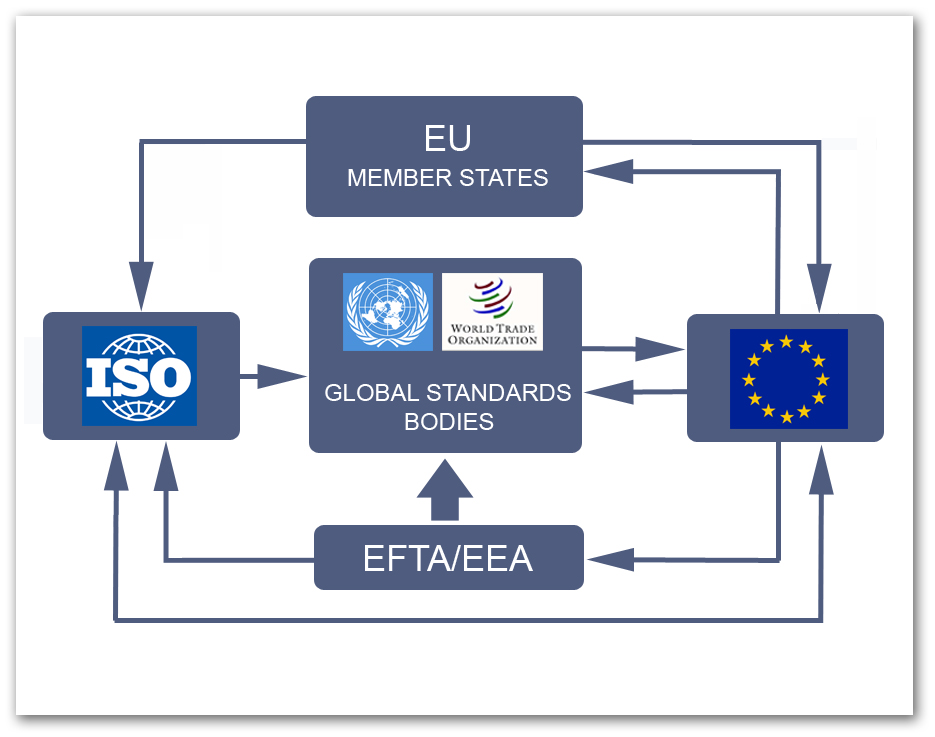
And another regarding the Article 50 process:

In contrast this is one from the winning submission, picked at random on page 57:
or this on page 56:

The graphs used in the winning submission have obviously been copied and pasted; they are unoriginal and they are blurred - in the paper - to the exent they are unreadable. And this submission won? Even by comparision with the papers (linked to above) from Ruth Lea, Roger Bootle and again this from Ruth Lea all associated with the IEA this is a very poorly drafted paper.

And that is without noting it came up short in the word count - 10,000 to 20,000 words was the requirement - the winner came in at fewer than 9,500 words. As Richard notes, Mansfield's arguments are also incoherent:
Mansfield, however, rejects the idea of joining the EEA, although he does suggest we join EFTA. As an aside, does he explore the views of EFTA members, as to whether they would accept the UK? He doesn't, but we did.

I actually went to Norway, and to Iceland. The Norwegians and Icelanders both, wanted us in EFTA and the EEA, because we could help them renegotiate the deal. Would they want us in EFTA without the EEA? I very much doubt it – but this is something Mansfield doesn't even explore. And the judges let him get away with it.

Howsoever, what Mansfield advocates is a pick'n mix bilateral agreement, adopting a position "somewhere between that of Turkey's and Switzerland's membership of EFTA". This is not only politically unattainable in the timescale, it is incoherent.

Turkey's relationship with the EU is of membership of a Customs Union. Switzerland has bilateral free trade deals with the EU. The relationship with the Swiss deals and EFTA is complex. Some are via EFTA, some are outside. But the one thing absolutely certain is that there is no position at all between Turkey and Switzerland. Mansfield is comparing chalk and cheese.

And, having talked so some of the other competitors last night, I know that we were not the only entrants to point out the impossibility of attaining an ab initio bilateral deal within the two years.
The big danger now is that the eurosceptic movement will be hampered by this paper which now has "prestige" and is seen as best way forward. Europhiles will take great delight in taking it apart - it will be seen as the best eurosceptics can offer. It’s going to be akin to shooting fish in a barrel. Huge damage has been done.

I'll end this post with the now ironic words of one of the judges:
“In the past most politicians have focused on the economic rather than the political implications of the European Union. The debate about Europe‘s future is a battle of ideas and ideologies. The European Union has always been a deeply political project."
The IEA is simply another London based institution that will not understand how or why the EU exists. It's lost any credibility it had left whatsoever.

Wednesday, 26 March 2014

Brexit: Not Shortlisted

"The European Union is, and always has been, a political project, even though this has not been something that has been as openly acknowledged as it should have been in Britain" Labour MP and IEA judge Gisela Stuart

Today we learnt the names of the final six to go forward to the IEA Brexit prize. Unfortunately the entry by Richard North was not selected; it can be read or downloaded from here.

In many ways it was not a surprise. We had doubts from the start that a submission which aims to negate the economic arguments in order to win a referendum against FUD would be in direct contrast to the economic bias of the IEA.

Despite that a number of the judges acknowledged publically that the EU is a political project not an economic one, a feeling persists the IEA in general and indeed this country still cannot get to grips with the true nature of what the European Union is. This is reflected in the obvious concentration of economic interests in the final six.

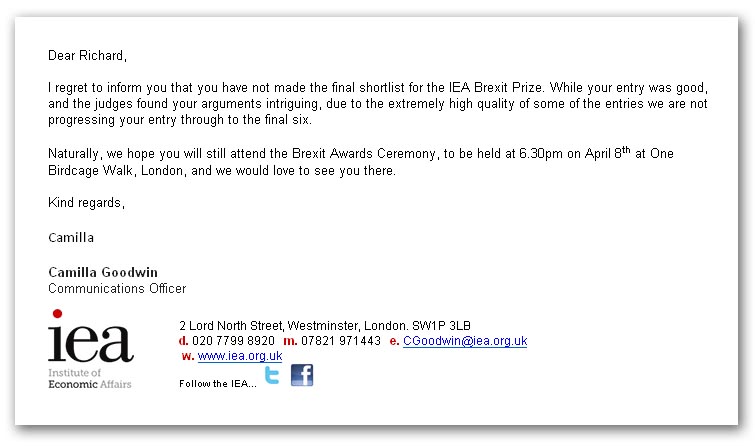
What compounds the disappointment though is that after many months of hard work the news was received by a rather terse email from a press person:

The words "good and intriguing" are rather patronising to say the least. "Intriguing" is clearly a euphemism for not what we were looking for. After months of hard work by Richard researching a very complex and important subject and producing an original thesis of "Flexcit" contestants deserve much better than a patronising, bland and standard email.

Despite that it's encouraging that we now have a very detailed, layered and practical document on how the UK can exit the EU, that in itself is progress.

Finally I would like to thank Richard for his enormously hard efforts since October, much of it unseen, in producing a very valuable and useful piece of work. One that needs to be re-read a few times to fully appreciate its scope.

Wednesday, 12 February 2014

Brexit: And In It Goes

Nearly four months after being shortlisted for the Brexit prize by the IEA - covering the actual process of withdrawing from the EU and the post-exit position of the UK globally - Richard North's submission has now gone in today in anticipation of tonight's midnight deadline.

With 17 papers shortlisted in the prize they will hopefully provide a quality and genuine debate on the best way to exit the anti-democratic monstrosity that we are members of - a debate that has been severely lacking in other, sometimes surprising, quarters.

With the submissions still anonymous and now under judges' consideration I'm reluctant to give away too many details publically (having read it) which may give an indication who wrote it and thus maybe affect the outcome.

Just to be shortlisted was an achievement in itself but given the massive prodigious, mostly unseen, efforts by Richard over the last months the submission should walk away with the prize on merit alone. It could have very easily been over 100,000 words - given the complexity of EU exit - way above the 20,000 word limit.

Despite the merits of Richard’s paper, the outcome of the prize is too difficult to call. Especially given that exit from the EU is primarily a political problem, and process, not an economic one – a point that encouragingly some of the judges appreciate. Yet to produce a paper that argues that the economic consequences must be neutral potentially goes against the economic bias of IEA as a whole, especially given the economic arguments of NExit endorsed by judge Roger Bootle.

The paradox is the IEA remit was on the basis that the referendum had already been won, but the “Norway option” is there largely to help win the referendum in the first place by negating the fear of exit on economic grounds.

Yet the Norway (EEA) and the Swiss current arrangements are essentially a fudge. The EEA has among other problems a veto - a 'temporary' solution that tried to reassure the Norwegians on the merits of entering the Single Market while really trying to "bounce" them into full membership of the EU.

The Swiss agreements have similar intent but with the recent referendum on immigration, the Swiss model of bilateral agreements is set to unravel - especially given the guillotine clause which exists between the EU and Switzerland. Both Switzerland and the EU consider the arrangement very unsatisfactory.

What then is clear is if the UK exit and adopt the Norway model, it can be only temporary. Yet the UK's exit will be of such magnitude, with the addition of regaining our position at the "top table" of international organisations (without the EU to represent us), the UK can as a result play an important role in re-ordering the European post-war settlement. Britain would have the ability to take an active role in shaping the European landscape. We need not resort ourselves to a passive role.

Thus the submission offers a very positive outlook for the UK's role in the world. One hopes it wins.

Wednesday, 30 October 2013

Shortlisted In The Brexit Competition


As described in the above video showing a BBC Daily Politics interview with Lord Lawson back in July this year, the Institute for Economic Affairs launched a competition for submissions on the best way to exit the EU. As an encouragement the competition came with a cash prize of 100,000 euros (rather ironically) for the best submission:
Against [the background of an 'out' vote] competitors are invited to compose a Blueprint for Britain outside the EU, covering the process of withdrawal from the EU and the post-exit repositioning of the UK in the global trading and governance systems,
Naturally, when looking at the list of judges where the concentration of their expertise was largely economically based, there was some reluctance to submit a paper when in reality the primary reason for EU exit is political. The founding father Jean Monnet always made it clear the EU was a political project. Ted Heath described it as a "common market" knowing full well it was a Trojan horse to facilitate political union. The Euro for example is a political project disguised as an economic one - with disastrous consequences.

In this context the primary objective of any withdrawal by the UK is to stop and then reverse the progress of political integration between the UK and the rest of the EU member states. This means that a successful "out" vote will be more a political event rather than an economic one, albeit one with considerable economic consequences.

Thus a twin-track approach has to be adopted. Not only to win a referendum, to negate the fear, lies and "cling onto nurse" tactics which have been used so effectively by, for example, the dishonest Europhile Nick Clegg - but it's also an acknowledgment that political withdrawal will be much quicker than an economic one. Should the UK public vote for a withdrawal from the EU they will be understandably impatient for a relatively rapid exit.

In this spirit as not to delay attainment of political objectives the economic question should be "parked". The primary aim is to deal with political issues while clearing the way for a favourable economic settlement in the future, which given the enormous and fiendish complexities of international economic treaties will take time.

The best way of achieving a reasonably quick political exit while acknowledging the economic difficulties is the Norway option - a ready made solution that allows the UK to leave the EU while remaining within the Single Market. It means no immediate disruption to trade but allows us to exit politically.

This was the fundamental premise of Richard North's submission, written with some help from fellow readers and bloggers. The publication of the shortlist of the 20 best initial submissions to the IEA are made today and Richard North's "Norway option" has been shortlisted. To be shortlisted to just 20 out of 149 entries is an achievement indeed, and an endorsment that the "Norway option" arguments is seen to have merit. Particularly important given our Prime Minister argues against it using a lie.

As I understand it UKIP did not submit an official paper (though some members may have done so independently). It's not unreasonable to assume that this would be their meat and drink; leaving the EU is their raison d'etre. But apparently not. The lack of a credible exit plan from UKIP is a frustration I’ve echoed before.

Revealingly it takes a few unpaid bloggers to be on the shortlist, while UKIP doesn't bother. Being on the shortlist now means writing a full submission of between 10,000 and 20,000 words by 10th February 2014 in order to win the IEA prize. More than anything winning means having the possibility of a document - an EU exit paper - that has "prestige", a document that would be taken seriously by virture of its IEA status.

Any contributions by readers to the final full submission are very welcome here and/or on the Eureferendum forum.

Wednesday, 23 November 2011

Who Will Blink First

As Eurozone contagion swirls around Germany, Merkel has apparently made her position clear with what appears to be a Shermanesque statement:
"I am firmly convinced that the mandate of the European Central Bank cannot, absolutely cannot, be changed."
So now what? There are two stark options for Merkel; integration or break-up. Instead what we have here is a game of brinkmanship being taken right to the wire where all of our lives are being messed about on a whim. We've been here before, but it won't affect them it will instead affect us.

We should not be accepting this.

Monday, 5 September 2011

The Former Mr Large...

...as Angus Deayton once called Nigel Lawson on Have I Got News For You, has apparently called for a tear up of the Lisbon Treaty in today's Times. As the Guardian points out this is the same man who semi officially shadowed the Deutsche Mark because he supported membership of the ERM and whose eventual membership led directly to the recession in the early '90s:
In his assault on the euro, Lawson failed to mention his support for the warm up for the single currency – the European exchange rate mechanism. The former chancellor resigned from the cabinet in 1989 after Margaret Thatcher refused to distance herself from her late economic adviser, Sir Alan Walters, after he described the ERM as "half baked". As I blogged last month, Lawson explained to William Keegan in 2007 why he supported the ERM but not the single currency.
I've only ever (so far) seen my Mum cry twice; once when her mum (my Gran) died and once in 1992 when my Dad was telephoning her constantly to give updates on the interest rates during black / white Wednesday which ultimately led to the UK's exit from the ERM. At those levels of interest rates in the afternoon we were certain to be homeless. I have never forgotten it and will never forgive.

In light of Lawson's comments today Nigel Farage has invited him to join UKIP:

UKIP Leader Nigel Farage is writing to Lord Lawson, Baroness Thatcher's former Chancellor, with an invite to join UKIP after Lawson has called for a fundamental change in the European Treaties and the UK's relationship with the European Union.

So I want to be clear, I don't want the wanker Lawson anywhere near UKIP; if he does join (probably unlikely) then I'm off, membership lapsing - the lot.